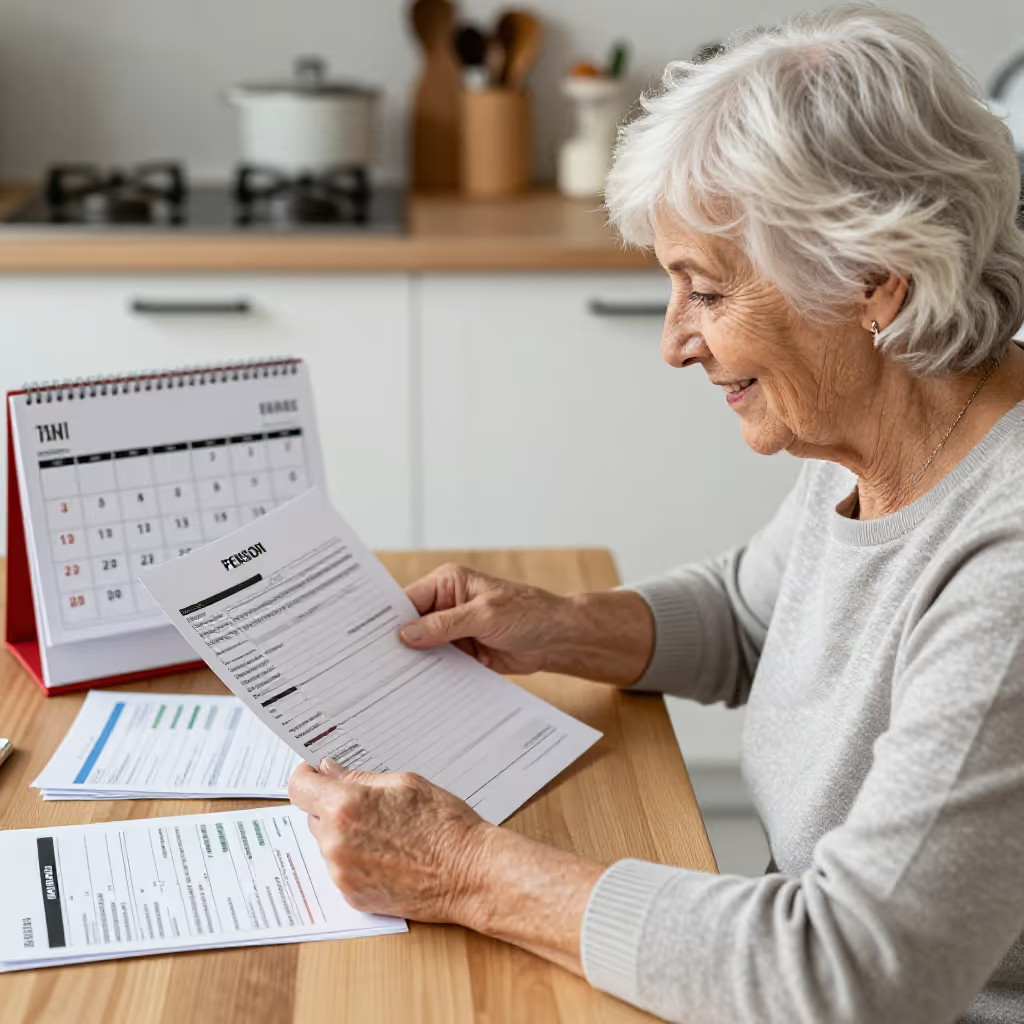
The regular payment that a person receives after the end of their working life from the statutory pension insurance system or from private retirement provision.
example
Nach 45 Arbeitsjahren freut er sich auf seine wohlverdiente Rente.
After 45 years of work, he is looking forward to his well-earned pension.

Usage tips
Word family
The terms for people 'der Rentner' (male retiree/pensioner) and 'die Rentnerin' (female retiree/pensioner) are derived from 'die Rente' (pension). These are the usual terms for people in retirement.
EXAMPLE
Als Rentner hat man endlich mehr Zeit für seine Hobbys.
As a retiree, you finally have more time for your hobbies.
Transition vs. state
The phrase 'in Rente gehen' (to retire) describes the transition into retirement and uses the accusative. The state of being retired is expressed with 'in Rente sein' (to be retired) and the dative.
EXAMPLE
Mein Kollege geht nächstes Jahr in Rente.
My colleague is retiring next year.
Typical collocations
Common verbs in connection with the statutory pension are 'Rente beantragen' (to apply for a pension), 'Rente bekommen' (to receive a pension), or 'Rente beziehen' (to draw a pension). People also speak of 'von der Rente leben' (to live on one's pension).
EXAMPLE
Viele Menschen müssen ihre Rente mit einem kleinen Job aufbessern.
Many people have to supplement their pension with a small job.
Context clue
When 'Rente' (income) means income from assets, the source is often specified. Look for additions such as 'aus Immobilien' (from real estate), 'aus Kapitalvermögen' (from capital assets), or 'private Rente' (private pension/income).
EXAMPLE
Er finanziert sein Leben durch eine Rente aus seinen Immobilien.
He finances his life through income from his real estate.
Compare with
near_synonym · confusable
Rente vs Ruhestand
retirement
'Rente' and 'Ruhestand' both belong to the end of working life. 'Rente' usually means the money you receive regularly then, or the fixed expression 'in Rente gehen' (to retire). 'Ruhestand' means the stage of life in which you no longer work. Learners can easily confuse the words because both often occur in the same situation. Remember: you receive a 'Rente'; you live in 'Ruhestand'. For the step out of working life, people very often say 'in Rente gehen' or 'in den Ruhestand gehen' (to retire).
Rente
Mein Vater geht nächstes Jahr in Rente und freut sich auf mehr Zeit im Garten.
My father is retiring next year and is looking forward to having more time in the garden.
Ruhestand
Im Ruhestand möchte Frau Becker viel reisen und einen Sprachkurs machen.
In retirement, Ms. Becker would like to travel a lot and take a language course.