


retten
to rescue
To free someone or something from immediate danger or an emergency situation.
EXAMPLE
Die Feuerwehr konnte die Familie aus dem brennenden Haus retten.
The fire department was able to rescue the family from the burning house.
to save / rescue
Loading your saved state.
to rescue
To free someone or something from immediate danger or an emergency situation.
Die Feuerwehr konnte die Familie aus dem brennenden Haus retten.
The fire department was able to rescue the family from the burning house.

to save
To preserve something, often something abstract like a situation, a project, or honor, from failure or a negative outcome.
Mit seinem Tor in der letzten Minute hat er das Spiel für seine Mannschaft gerettet.
With his goal in the last minute, he saved the game for his team.

to save oneself
To bring oneself to safety from a dangerous situation.
Die Schwimmerin konnte sich mit letzter Kraft ans Ufer retten.
With the last of her strength, the swimmer was able to save herself by reaching the shore.

to recover
To restore or save data from a damaged storage medium.
Ich hoffe, der Techniker kann die Fotos von der kaputten Festplatte retten.
I hope the technician can recover the photos from the broken hard drive.
Important nouns are derived from the verb 'retten' (to save/rescue): 'die Rettung' (the act of saving or rescuing) and 'der Retter' or 'die Retterin' (the person who saves or rescues).
Die Rettung kam in letzter Sekunde.
Rescue came at the last second.
When using 'retten' (to save/rescue), the prepositions are important. You rescue someone 'aus' (from/out of) a danger, e.g., a house, or save someone 'vor' (from) a danger, e.g., death. The danger is always in the dative.
Der Hund wurde aus dem eiskalten Wasser gerettet.
The dog was rescued from the ice-cold water.
'Retten' (to save) is also used for abstract things that are preserved from a negative ending. Typical expressions are 'den Tag retten' (to save the day), 'die Situation retten' (to save the situation), or 'die Ehre retten' (to save one's honor).
Als das Mikrofon ausfiel, hat der Techniker mit einer schnellen Reparatur den Tag gerettet.
When the microphone stopped working, the technician saved the day with a quick repair.
The reflexive form 'sich retten' means that a person brings themselves to safety. A destination or place is often mentioned with a preposition like 'an' (to), 'auf' (onto), or 'in' (into).
Als das Schiff sank, konnten sich viele Passagiere auf die Rettungsboote retten.
When the ship sank, many passengers were able to save themselves by getting onto the lifeboats.
In the digital age, 'retten' (to recover/save) has an important meaning in connection with computers. You can 'recover' or 'save' 'Daten' (data), 'Dateien' (files), or 'Fotos' (photos) from a damaged device.
Nach dem Systemabsturz war ich froh, dass ich meine Dokumente retten konnte.
After the system crash, I was glad that I was able to recover my documents.
to receive / preserve / support
Both words can express protecting a building from destruction. „Erhalten“ emphasizes securing its condition and continued existence over the long term. „Retten“ is especially suitable when a specific, immediate danger, such as a planned demolition, is prevented.
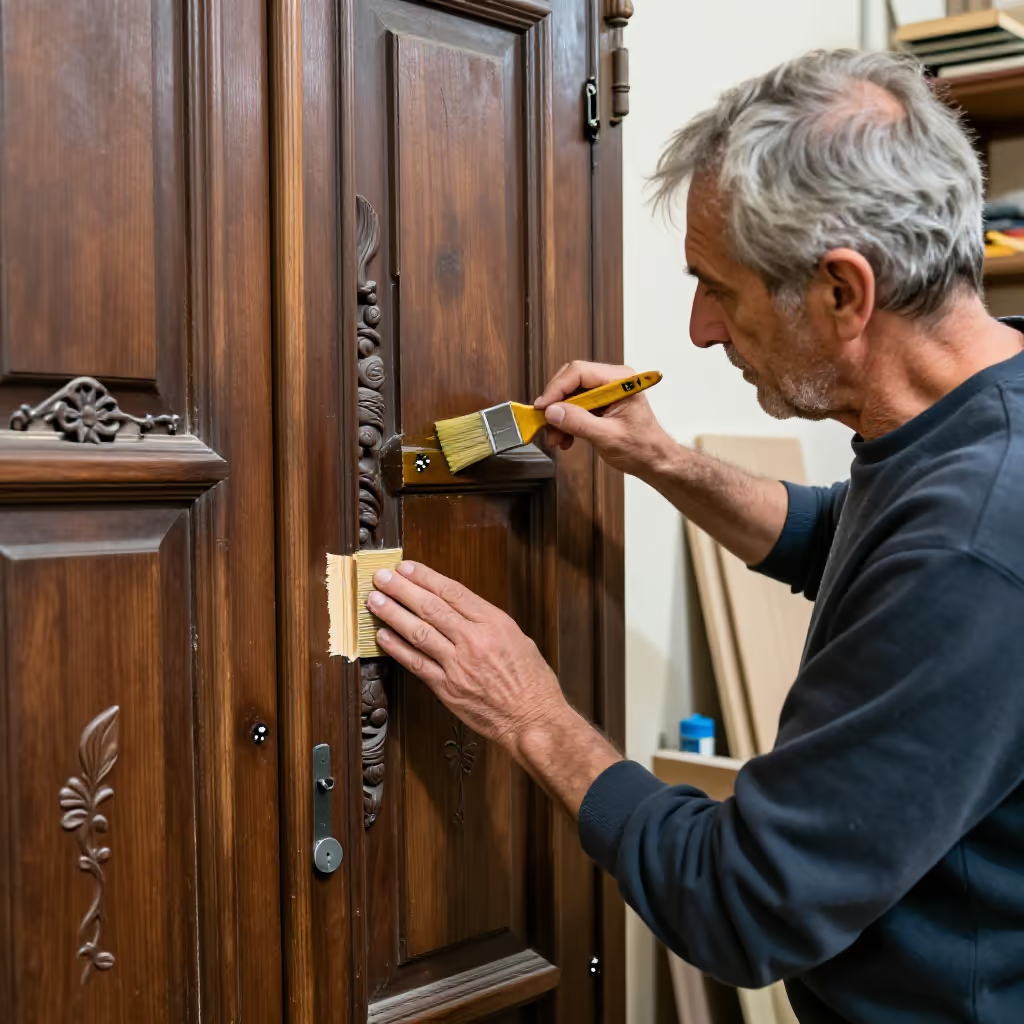
Die Bürger retten das historische Gebäude in letzter Minute vor dem Abriss.
The citizens save the historic building from demolition at the last minute.
Die Stadt erhält das historische Gebäude durch regelmäßige Reparaturen.
The city preserves the historic building through regular repairs.