


der Satz
sentence
A grammatically complete unit made up of words that expresses a thought or statement and usually contains a subject and a predicate.
EXAMPLE
Bitte formulieren Sie einen vollständigen Satz.
Please formulate a complete sentence.
sentence / set
Loading your saved state.
sentence
A grammatically complete unit made up of words that expresses a thought or statement and usually contains a subject and a predicate.
Bitte formulieren Sie einen vollständigen Satz.
Please formulate a complete sentence.

set
A group of things that belong together and are considered as a unit; a set.
Für den Winter brauchen wir einen neuen Satz Reifen.
For the winter, we need a new set of tires.

set
A section of play in certain sports such as tennis, table tennis, or volleyball, whose win gives you a point toward winning the match.
Sie hat den ersten Satz im Tennis-Finale mit 6:2 gewonnen.
She won the first set in the tennis final 6–2.

leap / bound
A jump or a quick, long movement performed with a single impulse.
Mit einem Satz sprang die Katze auf das Fensterbrett.
With one bound, the cat jumped onto the windowsill.

rate
A fixed tariff, fee, or percentage, for example in finance or taxation.
Der ermäßigte Mehrwertsteuersatz liegt bei sieben Prozent.
The reduced VAT rate is seven percent.
movement
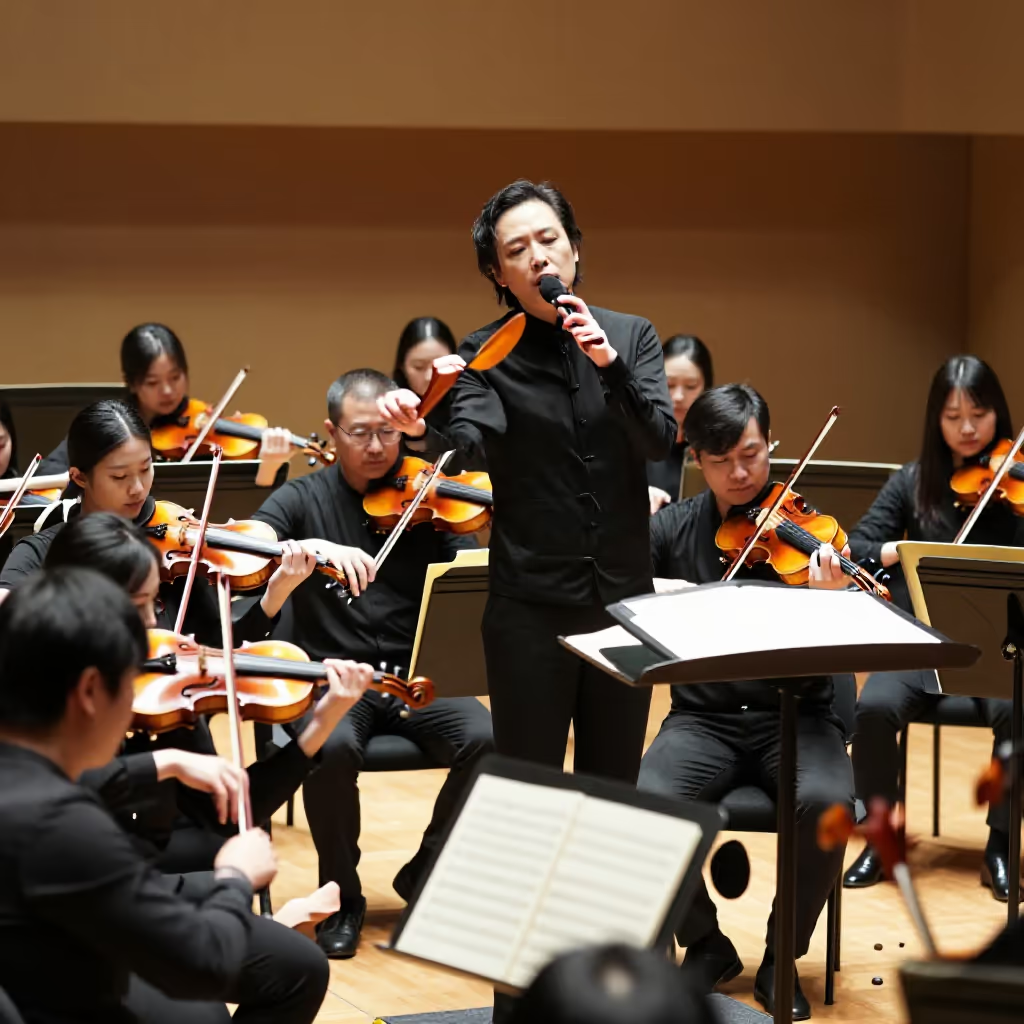
A self-contained, independent part of a larger musical work, such as a symphony or sonata.
Der zweite Satz der Mondscheinsonate ist weltberühmt.
The second movement of the Moonlight Sonata is world-famous.

sediment / grounds
The solid particles that settle at the bottom of a liquid; sediment.
Nach dem Ausschenken des Weins blieb der Satz in der Flasche zurück.
After the wine was poured, the sediment remained in the bottle.
'Der Satz' is closely related to the verb 'setzen' (to set/place). Many meanings can be derived from the idea that something is 'gesetzt' (set/fixed): a group of words (sentence), a group of objects (set), or particles that settle at the bottom (sediment).
Der Autor setzt die Wörter sorgfältig, um einen schönen Satz zu bilden.
The author places the words carefully to form a beautiful sentence.
Since 'Satz' has many meanings, context is crucial. Pay attention to the accompanying words: Is it about language (grammar), sports (tennis), economics (interest), music (symphony), or a jump?
Der Lehrer erklärte den Satz an der Tafel.
The teacher explained the sentence on the board.
In a grammatical context, 'Satz' is often combined with verbs such as 'bilden' (to form), 'formulieren' (to formulate), or 'verstehen' (to understand). Typical adjectives are 'einfach' (simple), 'kompliziert' (complicated), 'kurz' (short), or 'lang' (long).
Können Sie bitte einen einfachen Satz mit diesem Wort bilden?
Could you please form a simple sentence with this word?
When 'Satz' means a group of things that belong together, it is often followed by a plural noun that describes what the set consists of. The structure is typically 'ein Satz + noun (plural)' (a set of + plural noun).
Ich habe mir einen neuen Satz Handtücher gekauft.
I bought myself a new set of towels.
In the meaning 'Sprung' (jump/leap), 'Satz' is almost always used in the fixed expression 'mit einem Satz' (with one bound/leap). It describes a quick, sudden movement.
Mit einem Satz war der Hund über den Zaun.
With one bound, the dog was over the fence.
In financial or legal contexts, 'Satz' is often the second part of a compound noun. Examples are 'der Zinssatz' (interest rate), 'der Steuersatz' (tax rate), or 'der Regelsatz' (standard rate).
Die Bank hat den Zinssatz für Kredite erhöht.
The bank has raised the interest rate for loans.
The meaning 'Bodensatz' (sediment) can be recognized from the context of liquids in which something can settle. Common combinations are 'der Kaffeesatz' (coffee grounds) or 'der Bodensatz' (sediment) in a wine bottle.
Trink den Kaffee nicht ganz aus, da ist viel Satz am Boden der Tasse.
Don't drink all of the coffee; there are a lot of grounds at the bottom of the cup.
movement
„Der Satz“ and „die Bewegung“ can both refer to a self-contained part of a symphony or sonata. „Satz“ is the usual German term for this, while „Bewegung“ sounds more like a direct translation and is also used. „Satz“ is therefore usually the better choice in ordinary writing about music.
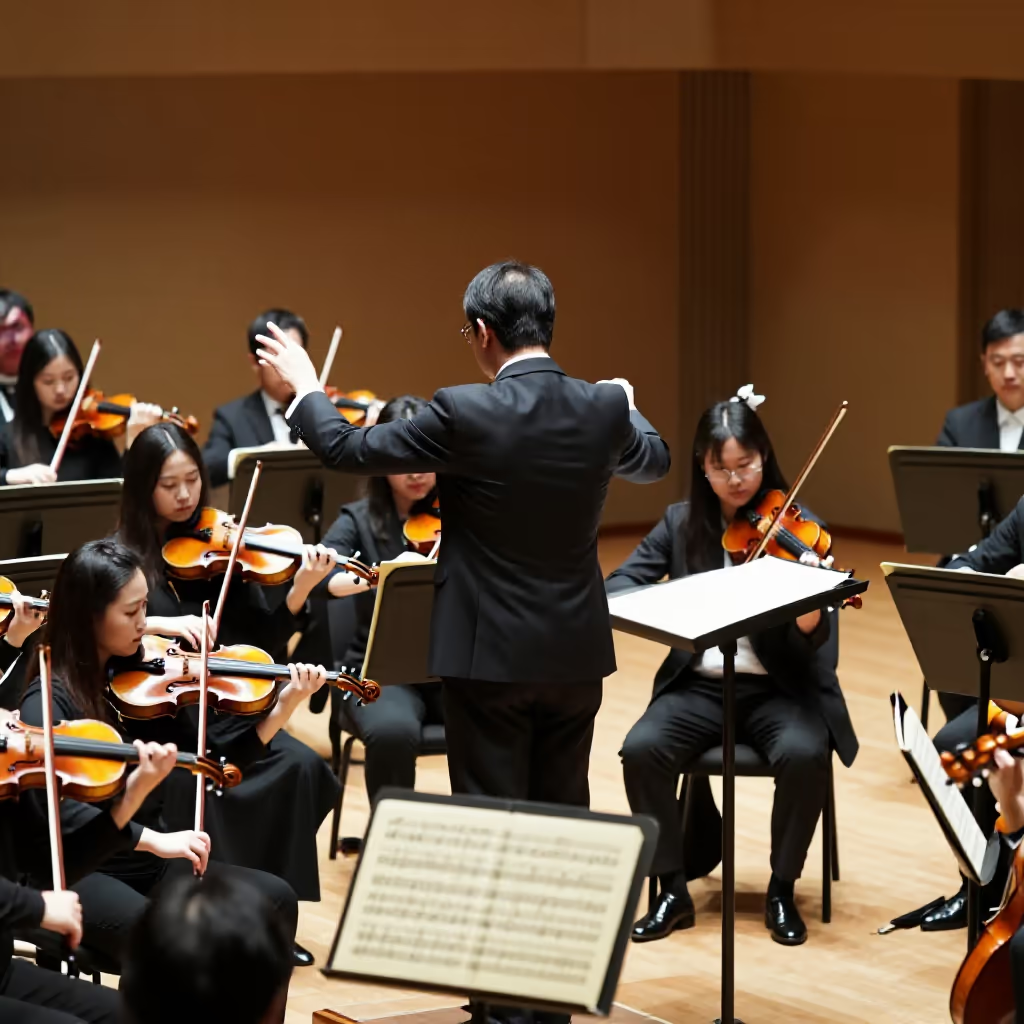
Der dritte Satz der Symphonie beginnt ruhig und endet sehr lebhaft.
The symphony's third movement begins calmly and ends very energetically.
Die dritte Bewegung der Symphonie beginnt ruhig und endet sehr lebhaft.
The symphony's third movement begins calmly and ends very energetically.