


die Spur
track / trace
An imprint or mark left behind by someone or something, for example footprints in the sand.
EXAMPLE
Im Schnee waren deutlich die Spuren eines Rehs zu erkennen.
The tracks of a deer could be clearly seen in the snow.
track / trace
Loading your saved state.
track / trace
An imprint or mark left behind by someone or something, for example footprints in the sand.
Im Schnee waren deutlich die Spuren eines Rehs zu erkennen.
The tracks of a deer could be clearly seen in the snow.
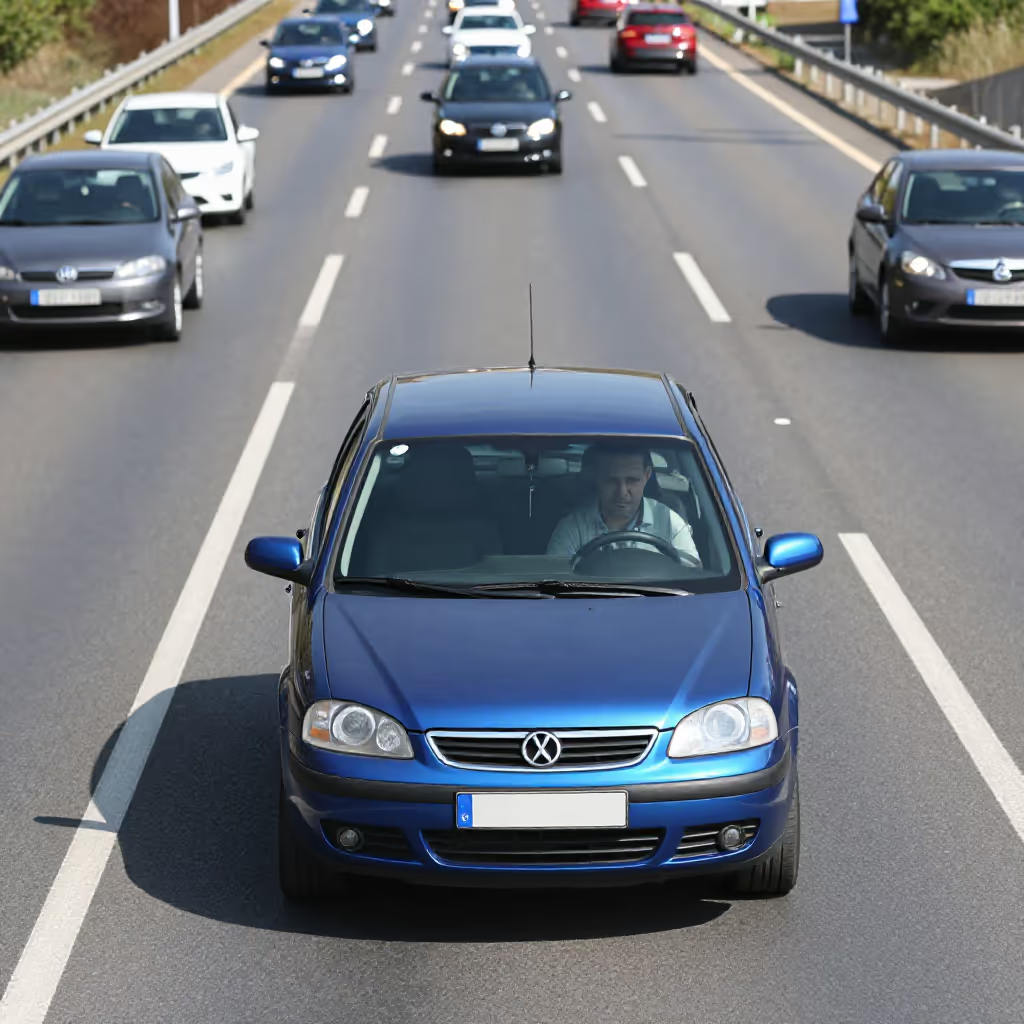
lane / track
A lane on a road or a track on a railway.
Wegen eines Unfalls ist die rechte Spur der Autobahn gesperrt.
Because of an accident, the right lane of the highway is closed.

lead / clue
A clue or piece of evidence that helps solve a crime or mystery.
Die Polizei hat eine neue Spur, die zum Täter führen könnte.
The police have a new lead that could point to the perpetrator.

trace
A very small amount or a barely perceptible hint of something.
Dieses Lebensmittel kann Spuren von Nüssen enthalten.
This food may contain traces of nuts.

track
A single channel of an audio or video recording that can be edited separately.
Der Gitarrist nahm seine Spur getrennt von der Rhythmusgruppe auf.
The guitarist recorded his track separately from the rhythm section.

no trace of
Expresses that something or someone is completely absent or does not show a particular feeling.
Von dem vermissten Bergsteiger fehlte auch nach Tagen noch jede Spur.
Even after days, there was still no trace of the missing mountain climber.
When 'Spur' (track/trace) means an imprint, it is often combined with verbs such as 'hinterlassen' (to leave behind), 'folgen' (to follow), or 'finden' (to find). The context is often nature, e.g. tracks in the sand, snow, or mud.
Das Tier hat deutliche Spuren im weichen Boden hinterlassen.
The animal left clear tracks in the soft ground.
In the context of traffic and driving, 'Spur' (lane) always means a traffic lane. Typical verbs here are 'die Spur wechseln' (to change lanes) or 'die Spur halten' (to stay in one's lane).
Auf der Autobahn muss man zum Überholen die Spur wechseln.
On the highway, you have to change lanes to overtake.
When it comes to crimes or mysteries, 'Spur' (lead/clue) means a clue or lead. A common expression is 'eine heiße Spur' (a hot lead), which means a very promising clue.
Die Polizei verfolgt eine neue Spur im Fall des gestohlenen Gemäldes.
The police are following a new lead in the case of the stolen painting.
In the meaning 'very small amount,' the expression 'Spuren von ...' (traces of ...) is very often found on food packaging as a warning for people with allergies.
Das Produkt kann Spuren von Erdnüssen enthalten.
The product may contain traces of peanuts.
In the field of audio and video production, 'Spur' (track) refers to a single channel of a recording. Typical verbs are 'eine Spur aufnehmen' (to record a track) or 'Spuren mischen' (to mix tracks).
Wir müssen die Gesangsspur noch einmal neu aufnehmen.
We need to record the vocal track again.
The expression 'keine Spur von' (no trace of) is a fixed expression meaning that something is completely missing. The noun that is missing usually follows in the dative.
Am nächsten Morgen war keine Spur mehr von dem Schnee.
The next morning, there was no trace of the snow left.
train / track
Bahn and Spur can both refer to a clearly defined path. In sports, a designated running or swimming lane is usually called a Bahn, whereas Spur primarily refers to a lane on a road or a railway track. The type of movement therefore determines which word is appropriate.

Die Fahrerin bleibt während der Baustelle auf ihrer Spur.
The driver stays in her lane during the roadworks.
Die Läuferin bleibt während des Rennens auf ihrer Bahn.
The runner stays in her lane throughout the race.