

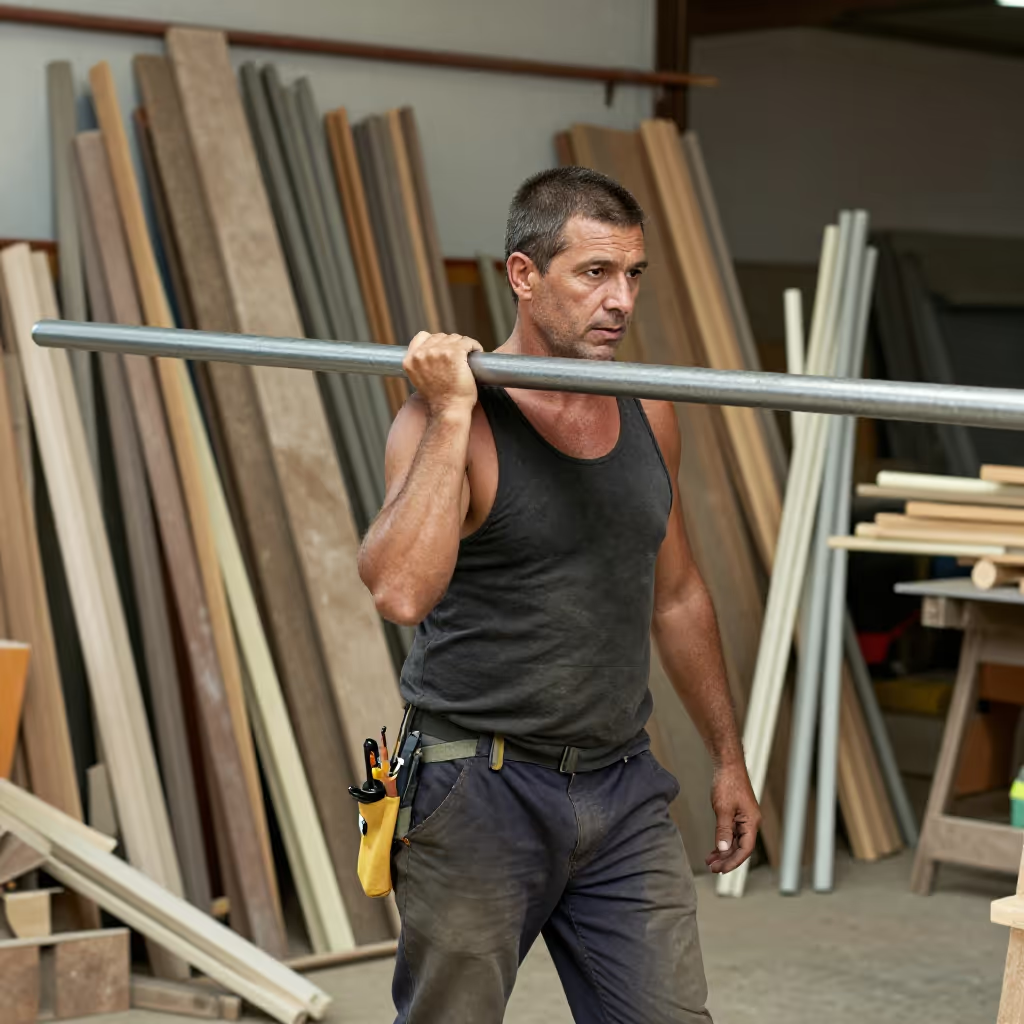
die Stange
pole / rod
A long, thin, and usually round object made of a solid material such as metal, wood, or plastic.
EXAMPLE
Er befestigte die Fahne an einer langen Metallstange.
He attached the flag to a long metal pole.
pole / rod
Loading your saved state.
pole / rod
A long, thin, and usually round object made of a solid material such as metal, wood, or plastic.
Er befestigte die Fahne an einer langen Metallstange.
He attached the flag to a long metal pole.

a lot of money
A colloquial expression for a very large sum of money.
So ein Haus kostet natürlich eine Stange Geld.
A house like that costs a lot of money, of course.

to stand by someone
A fixed expression meaning to support someone and be loyal to them, especially when that person is being criticized or is in trouble.
Obwohl alle gegen ihn waren, hat seine beste Freundin ihm die Stange gehalten.
Although everyone was against him, his best friend stood by him.

to stick with it
A fixed expression meaning to keep doing something, not give up, and continue.
Das Training ist anstrengend, aber wenn du bei der Stange bleibst, wirst du bald Erfolge sehen.
The training is exhausting, but if you stick with it, you'll soon see results.

carton
A specific packaging unit, especially for cigarettes, that contains several packs.
Im Duty-Free-Shop kaufte er eine Stange Zigaretten.
In the duty-free shop, he bought a carton of cigarettes.

Stange glass
A tall, narrow glass typically used for serving Kölsch beer.
In Köln bestellt man beim Köbes ein Kölsch in einer Stange.
In Cologne, you order a Kölsch in a Stange glass from the Köbes.
The base word 'Stange' (pole/rod) is part of many compound nouns that describe a long, thin object. Examples are 'Gardinenstange' (curtain rod), 'Fahnenstange' (flagpole), or 'Kleiderstange' (clothes rail).
Wir müssen noch eine neue Gardinenstange für das Wohnzimmer kaufen.
We still need to buy a new curtain rod for the living room.
The idiom 'jemandem die Stange halten' (to stand by someone) requires the dative. The person who is being supported is in the dative.
Seine Freunde haben ihm auch in schwierigen Zeiten die Stange gehalten.
His friends stood by him even in difficult times.
The expression 'bei der Stange bleiben' (to stick with it) is always used with the preposition 'bei'. It means that you do not give up an activity or plan.
Deutsch zu lernen ist schwer, aber ich versuche, bei der Stange zu bleiben.
Learning German is hard, but I'm trying to stick with it.
The expression 'eine Stange Geld' (a lot of money) is a fixed, colloquial expression for a large sum of money. The word 'Stange' cannot be replaced by another word here.
Die Reparatur des Autos hat eine Stange Geld gekostet.
Repairing the car cost a lot of money.
In the context of tobacco products, 'eine Stange' (a carton) is a fixed unit of quantity. A 'Stange Zigaretten' (carton of cigarettes) refers to packaging that typically contains 8 to 10 packs.
Am Flughafen kann man Zigaretten oft günstiger pro Stange kaufen.
At the airport, you can often buy cigarettes more cheaply by the carton.
In Cologne and the surrounding area, 'die Stange' refers to a special tall, narrow 0.2-liter glass from which the beer 'Kölsch' is traditionally drunk.
Der Kellner brachte uns zwei frische Stangen Kölsch.
The waiter brought us two fresh Stange glasses of Kölsch.
stick / floor
Stock and Stange both refer to long, thin objects. Stock generally means a handheld or branch-like piece, while Stange usually refers to a longer, straight structural part. Use Stock, for example, as a walking aid, and Stange for a straight structure made of wood or metal.

Im Flur befestigte der Mann eine lange gerade Stange für den Vorhang.
In the hallway, the man attached a long, straight rod for the curtain.
Beim Wandern stützte sich der Mann auf einen stabilen Stock.
While hiking, the man supported himself with a sturdy walking stick.