

der Ton
tone
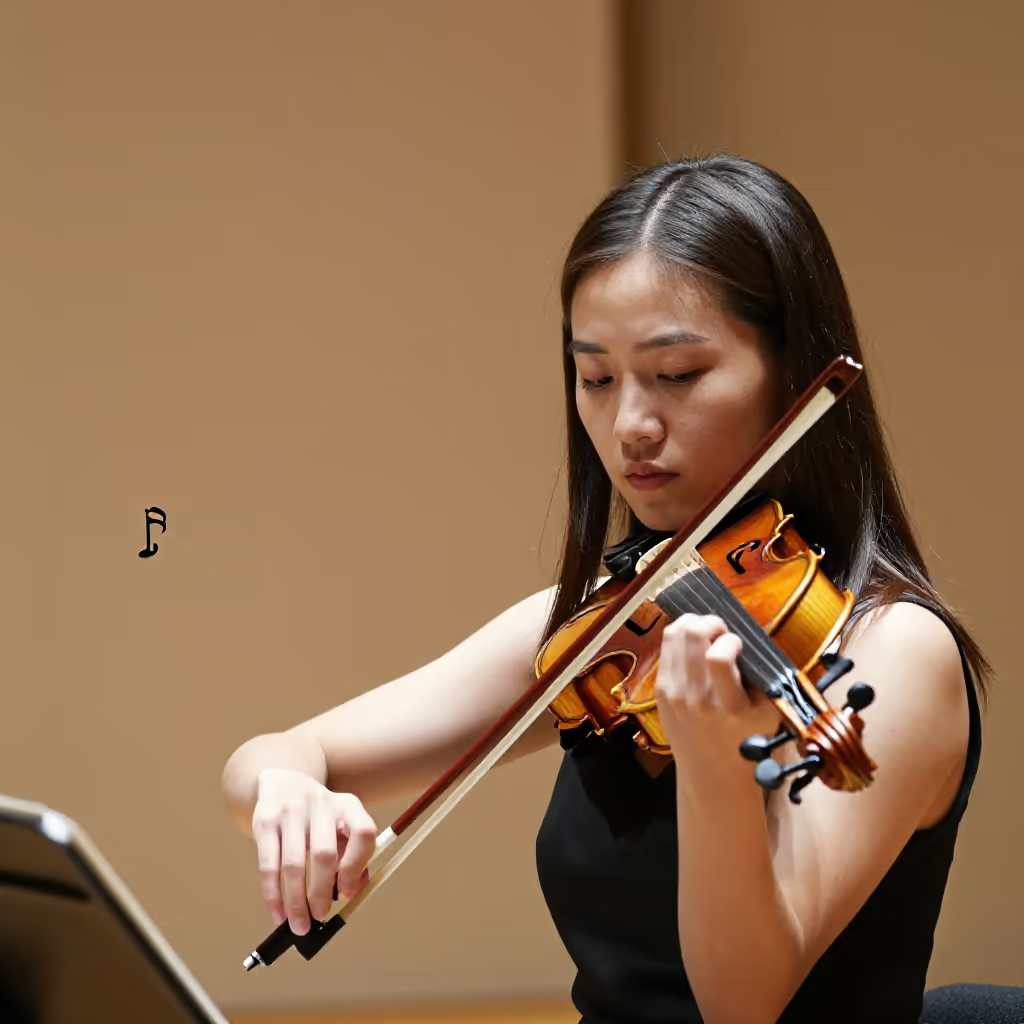
A noise or sound with a particular pitch and quality.
EXAMPLE
Ich höre einen hohen Ton, der sehr störend ist.
I hear a high tone that is very annoying.
tone / clay
Loading your saved state.
tone
A noise or sound with a particular pitch and quality.
Ich höre einen hohen Ton, der sehr störend ist.
I hear a high tone that is very annoying.

tone
The way someone speaks or writes, thereby expressing a particular mood or attitude.
Sein scharfer Ton zeigte, dass er verärgert war.
His sharp tone showed that he was upset.

shade
A particular nuance or shade of a color.
Das Zimmer ist in einem warmen Gelbton gestrichen.
The room is painted in a warm shade of yellow.

clay
A type of earth that is moist and moldable and is used for pottery or bricks.
Die Kinder formten kleine Figuren aus Ton.
The children shaped small figures out of clay.

to call the shots
To have the leading or determining role in a group; to decide what is done.
In dieser Abteilung gibt der neue Projektleiter den Ton an.
In this department, the new project manager calls the shots.
The word 'Ton' (tone/clay) has two completely different origins and meanings. One group concerns sounds and styles (music, voice, color), while the other refers to the material 'Ton' (clay, earth for pottery). The context always makes it clear what is meant.
Der Musiker traf jeden Ton perfekt.
The musician hit every note perfectly.
To describe the way someone speaks, the structure 'in einem [Adjektiv] Ton' (in a [adjective] tone) is often used. The adjective describes the emotion or attitude.
Bitte sprich in einem ruhigeren Ton mit mir.
Please speak to me in a calmer tone.
The saying 'Der Ton macht die Musik' means that the way you say something is just as important as the content.
Du hast zwar Recht, aber der Ton macht die Musik.
You may be right, but it's not what you say, it's how you say it.
In the meaning 'Farbnuance' (color nuance/shade), 'Ton' is often the second part of a compound word, for example 'Farbton' (shade/hue), 'Blauton' (shade of blue), or 'Erdton' (earth tone).
Die Wände sind in einem warmen Orangeton gestrichen.
The walls are painted in a warm shade of orange.
When 'Ton' means the material clay, it is often combined with verbs such as 'formen' (to shape), 'brennen' (to fire), 'kneten' (to knead), or with the preposition 'aus' (out of/made of).
Im Kunstunterricht haben wir Schalen aus Ton geformt.
In art class, we shaped bowls out of clay.
The idiom 'den Ton angeben' means to lead a group or determine what happens. The person who leads is the subject of the sentence.
In der Besprechung hat von Anfang an die Chefin den Ton angegeben.
In the meeting, the boss called the shots from the very beginning.
loud / according to
Laut and der Ton both relate to something that can be heard, but they focus on different aspects. Laut describes high volume, whereas der Ton refers to a sound with a particular pitch and quality. Use laut when talking about how strongly something can be heard, and Ton when describing its audible qualities.

Der Sänger trifft bei dieser Stelle einen klaren und hohen Ton.
The singer hits a clear, high note at this point.
Der Sänger singt laut, damit ihn auch die Menschen hinten im Saal hören.
The singer sings loudly so that even the people at the back of the hall can hear him.