


die Stimme
voice
The sound that a person produces with their larynx when speaking or singing.
EXAMPLE
Er hat eine sehr tiefe und angenehme Stimme.
He has a very deep and pleasant voice.
voice / vote
Loading your saved state.
voice
The sound that a person produces with their larynx when speaking or singing.
Er hat eine sehr tiefe und angenehme Stimme.
He has a very deep and pleasant voice.

vote
The casting of a vote in an election or ballot.
Bei der Wahl hat jeder Bürger genau eine Stimme.
In the election, every citizen has exactly one vote.

voice / opinion
An expressed opinion or point of view on a particular topic.
Nach der Entscheidung wurden viele kritische Stimmen laut.
After the decision, many critical voices were raised.
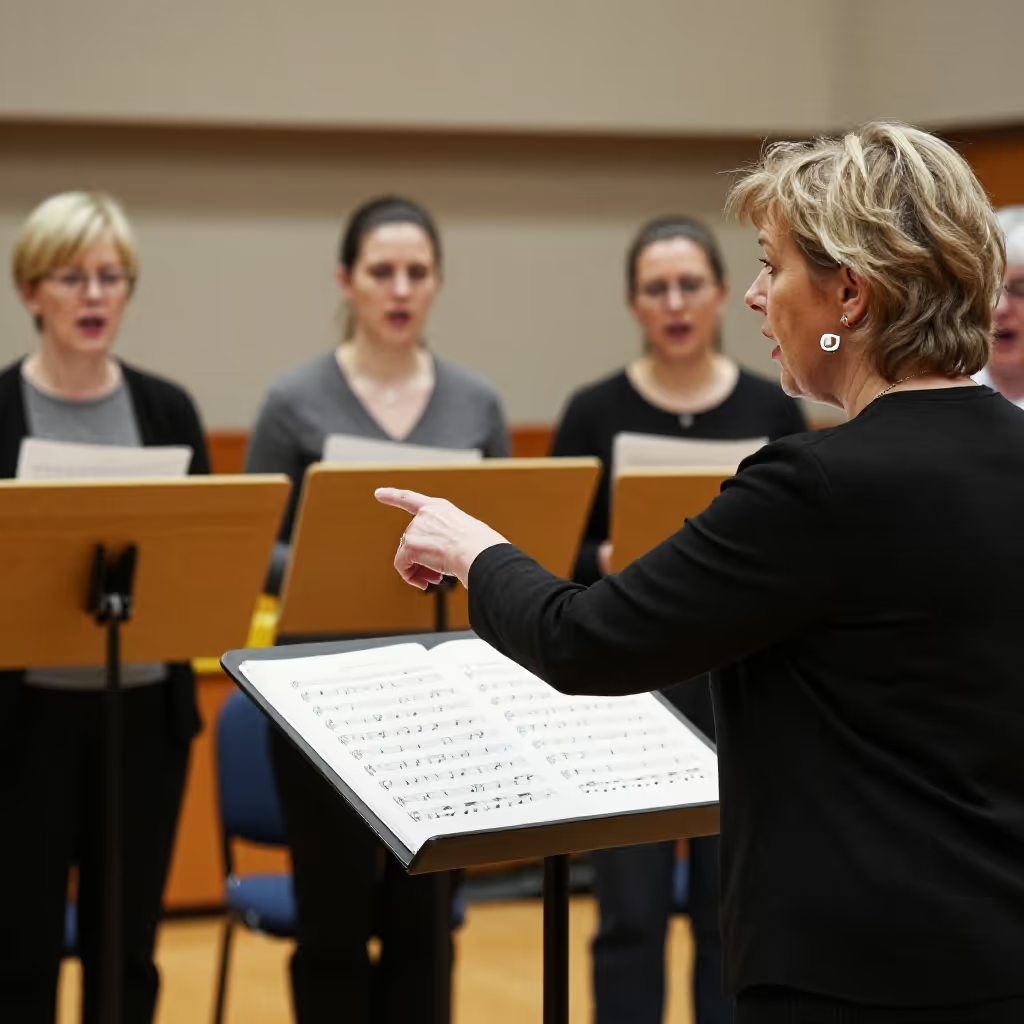
part / voice
A single melodic line or part in a piece of music with several voices.
Im Chor singt sie die zweite Stimme.
In the choir, she sings the second part.

inner voice
A feeling, intuition, or conscience that tells you what is right or wrong.
Meine innere Stimme riet mir davon ab, das Angebot anzunehmen.
My inner voice advised me not to accept the offer.
The noun 'die Stimme' (voice/vote) is closely related to the verb 'stimmen' (to be correct/to agree). When something 'stimmt' (is correct), it is right or fitting. So a voice is originally the sound that 'fits' a person or with which they make themselves understood.
Ihre Stimme passt perfekt zu diesem Lied.
Her voice fits this song perfectly.
You can recognize the meaning of 'Stimme' (voice/vote) from the context. If it is about elections or politics, it means a vote (m02). In the context of music, it refers to a melodic line (m04). In debates, it often means opinions (m03), usually in the plural 'Stimmen' (voices/opinions).
Die Partei erhielt bei der letzten Wahl viele Stimmen.
The party received many votes in the last election.
To describe the sound of a voice, adjectives such as 'hoch' (high) or 'tief' (deep), 'laut' (loud) or 'leise' (quiet), and 'angenehm' (pleasant) or 'zitternd' (trembling) are often used.
Er sprach mit leiser Stimme, damit niemand ihn hörte.
He spoke in a quiet voice so that no one would hear him.
In a political context, a vote is typically 'abgegeben' (cast). After an election, the votes are 'gezählt' (counted).
Jeder wahlberechtigte Bürger darf seine Stimme abgeben.
Every eligible voter is allowed to cast their vote.
'Die innere Stimme' (the inner voice) is a fixed expression for intuition or conscience. You can 'auf seine innere Stimme hören' (listen to your inner voice) or 'ihr folgen' (follow it).
Ich hätte auf meine innere Stimme hören sollen.
I should have listened to my inner voice.
opinion
Die Meinung is the mental content of a personal standpoint. In a public debate, die Stimme usually refers more to a person or to their perceptible contribution expressing that standpoint. If you are asking about the view itself, use Meinung; if you are highlighting participation in the discourse, use Stimme.

Sie ist eine wichtige Stimme in der Debatte über die neue Verkehrspolitik.
She is an important voice in the debate about the new transportation policy.
Ihre Meinung zur neuen Verkehrspolitik ist klar.
Her opinion on the new transportation policy is clear.