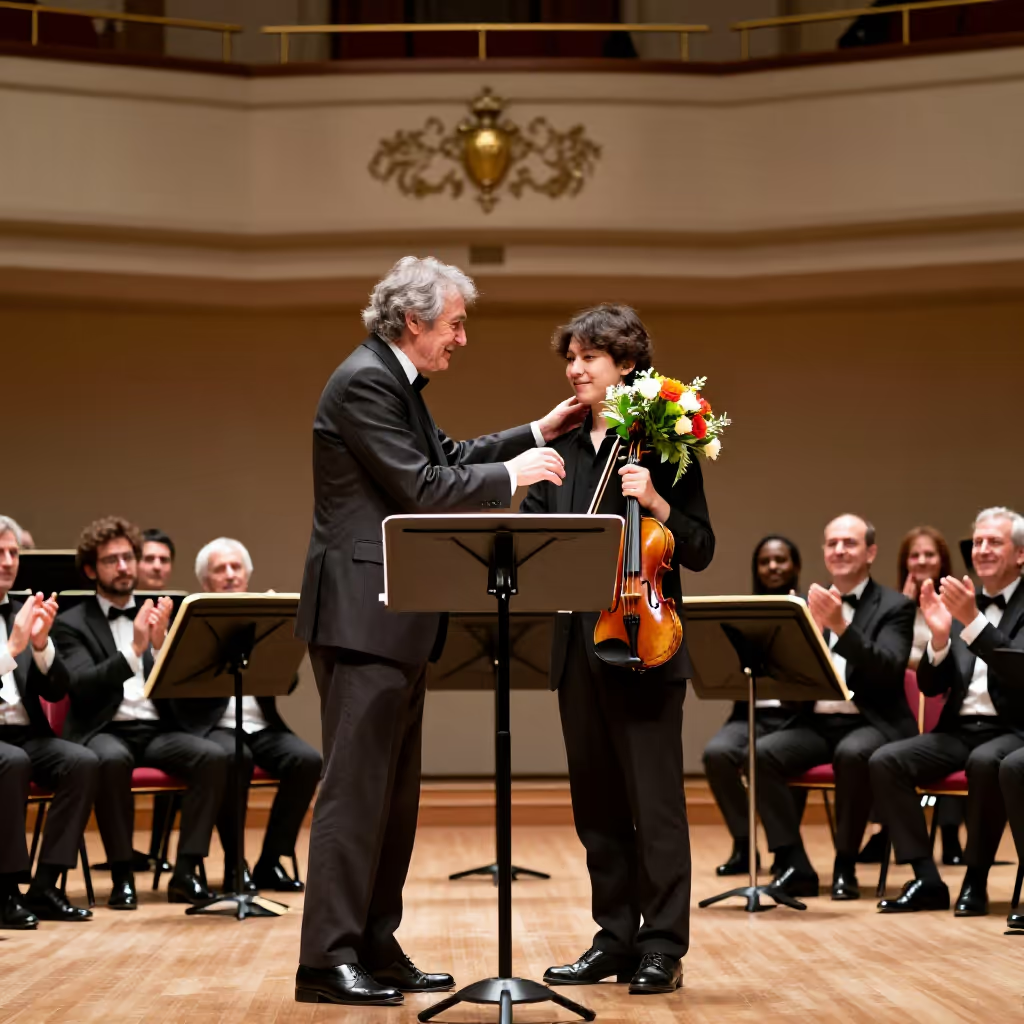
To present someone or something in an exaggeratedly positive way in terms of their significance, value, or importance; to idealize or glorify something.
example
In seiner Biografie neigt er dazu, seine eigene Rolle bei den historischen Ereignissen zu überhöhen.
In his biography, he tends to idealize his own role in the historical events.

Usage tips
Inseparable verb
'Überhöhen' (to idealize / bank) is an inseparable verb. The prefix 'über-' remains firmly attached to the verb in all sentence forms and is not placed at the end of the sentence.
EXAMPLE
Er hat seine eigenen Verdienste in der Rede stark überhöht.
He strongly idealized his own achievements in the speech.
Context clue
The meaning can be recognized from the object. If 'überhöhen' (to idealize) refers to abstract things like a role, a person, or an achievement, it means 'to idealize'. If it refers to a curve or a track, the technical meaning from construction is meant.
EXAMPLE
Man sollte die Leistungen der Vergangenheit nicht künstlich überhöhen.
One should not artificially idealize the achievements of the past.
Typical objects
In the meaning 'idealisieren' (to idealize), the verb is often used with abstract nouns such as 'die Rolle' (the role), 'die Bedeutung' (the significance), 'die Leistung' (the achievement), or 'eine Person' (a person).
EXAMPLE
Der Film überhöht die Hauptfigur zu einem makellosen Helden.
The film idealizes the main character into a flawless hero.
Technical language
The meaning in road and railway construction is technical language. You find it in texts about engineering, traffic engineering, or architecture.
EXAMPLE
Der Ingenieur berechnete, wie stark die Kurve überhöht werden muss.
The engineer calculated how strongly the curve has to be banked.
Compare with
confusable
überhöhen vs erhöhen
to increase
'erhöhen' and 'überhöhen' look similar, but they do not mean the same thing. 'erhöhen' is neutral and means that a value, amount, or degree is made larger. 'überhöhen' usually means presenting someone or something as too positive, too important, or too ideal. The risk of confusion comes from the similar form and the part 'höhen'. In normal situations with prices, temperatures, or quantities, you say 'erhöhen'. When it is about an exaggerated presentation or evaluation, you say 'überhöhen'.
überhöhen
Der Film überhöht den Politiker und zeigt kaum seine Fehler.
The film idealizes the politician and hardly shows his flaws.
erhöhen
Wegen der hohen Kosten hat der Laden die Preise erhöht.
Because of the high costs, the store raised its prices.