


überziehen
to put on
To put on a piece of clothing, usually over something else that you are already wearing.
EXAMPLE
Zieh dir bitte eine Jacke über, es wird kühl.
Please put on a jacket; it's getting chilly.
to put on / overdraw / coat
Loading your saved state.
to put on
To put on a piece of clothing, usually over something else that you are already wearing.
Zieh dir bitte eine Jacke über, es wird kühl.
Please put on a jacket; it's getting chilly.

to overdraw / exceed
To exceed an account balance or a time limit; to spend more money than is available or need more time than is allowed.
Ich habe mein Konto diesen Monat schon wieder überzogen.
I've overdrawn my account again this month.

to coat
To cover something with a layer or coating.
Der Konditor überzieht den Kuchen mit einer Schokoladenglasur.
The pastry chef coats the cake with a chocolate glaze.

to overrun
To make a speech, lecture, or event last longer than planned.
Der Professor hat die Vorlesung heute um 15 Minuten überzogen.
The professor overran the lecture by 15 minutes today.
The separability of 'überziehen' depends on the meaning. When it means 'ein Kleidungsstück anziehen' (to put on a piece of clothing), it is separable. In the other meanings (account, time, covering something), it is inseparable.
Zieh dir einen Pullover über, es ist kalt!
Put on a sweater; it's cold!
In the meaning 'Kleidung anziehen' (to put on clothes), the verb is often used reflexively with a dative pronoun. The structure is: sich (dative) etwas (accusative) überziehen.
Ich ziehe mir nur schnell eine andere Hose über.
I'm just quickly putting on a different pair of pants.
In this meaning, 'überziehen' is almost always used with financial or time limits. Typical objects are 'das Konto' (the account), 'das Budget' (the budget), or 'das Zeitlimit' (the time limit).
Studenten dürfen ihr Konto oft bis zu einem bestimmten Betrag überziehen.
Students are often allowed to overdraw their account up to a certain amount.
When something is covered with a layer, the structure 'etwas mit etwas überziehen' (to coat something with something) is used. The layer is introduced with the preposition 'mit' and the dative.
Die Plätzchen werden mit flüssiger Schokolade überzogen.
The cookies are coated with melted chocolate.
When it is about time, 'überziehen' can be used with or without an object. Without an object, it means that a person speaks longer or an event lasts longer than planned.
Bitte versuchen Sie, bei Ihrem Vortrag nicht zu überziehen.
Please try not to overrun during your presentation.
to refer / move into / receive
With an armchair, beziehen means putting on a new fabric or leather covering. Überziehen is more general and describes applying an outer layer or coating. beziehen fits a new furniture covering; when covering something with a layer is the focus, überziehen fits.
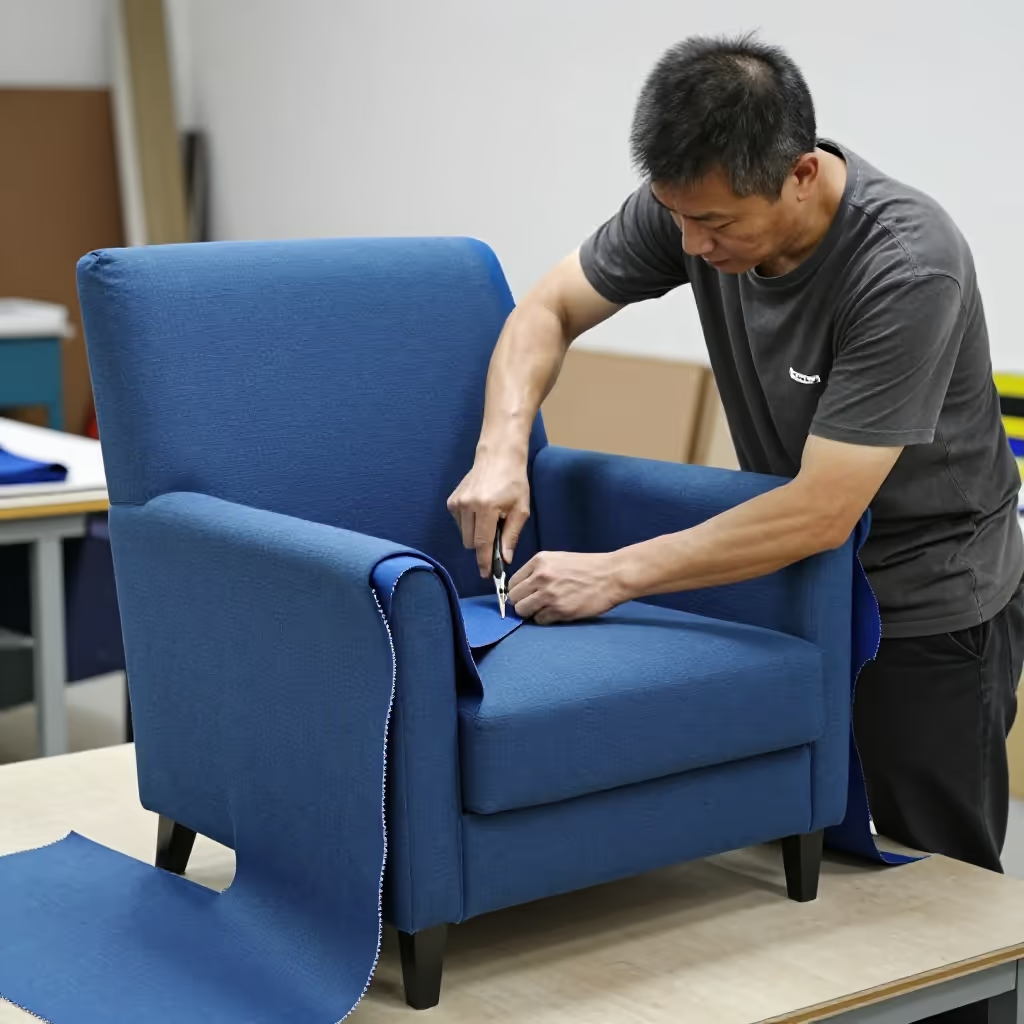
Die Restauratorin überzieht das Holz des alten Sessels mit einer dünnen Lackschicht.
The restorer is coating the wood of the old armchair with a thin layer of varnish.
Der Polsterer bezieht den alten Sessel mit rotem Stoff.
The upholsterer is covering the old armchair with red fabric.