

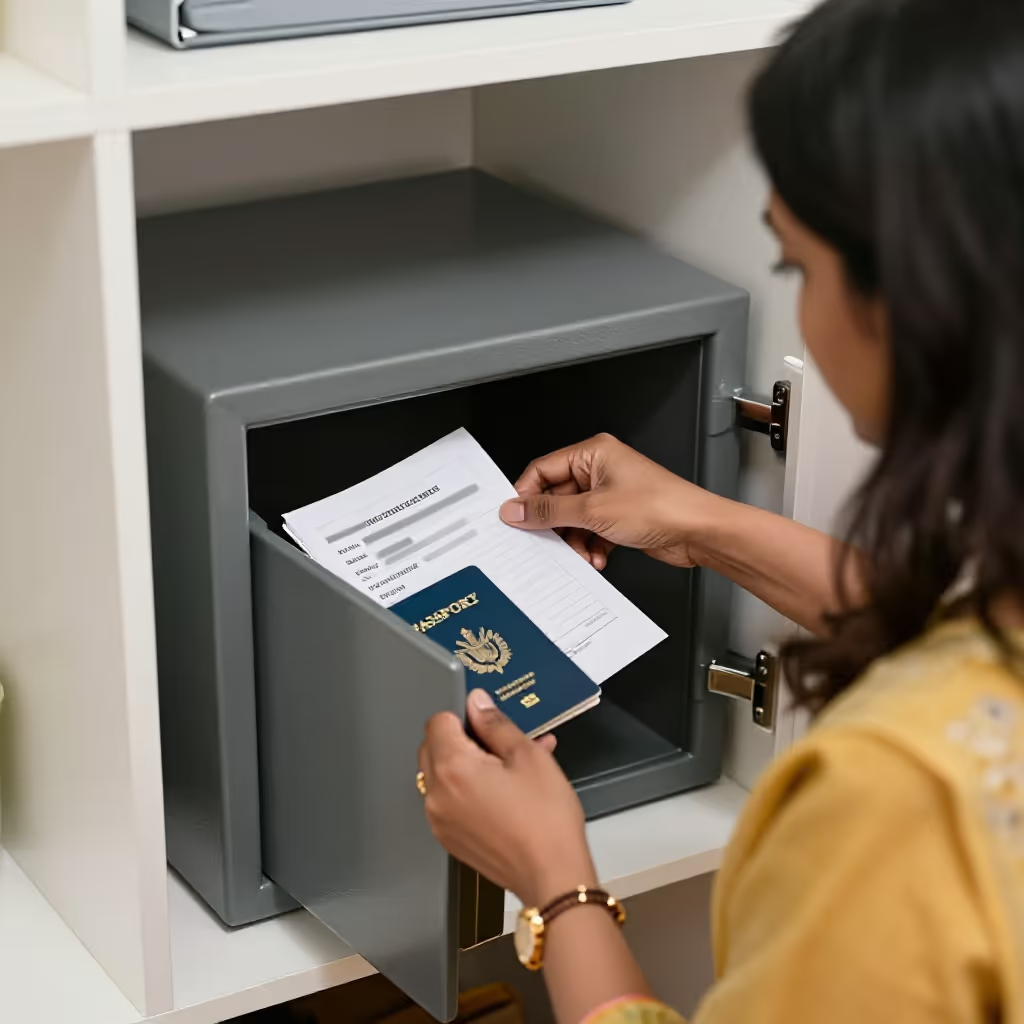
verwahren
to store
To keep something in a safe place in order to protect it from loss, theft, or damage.
EXAMPLE
Sie verwahrt ihre wichtigen Dokumente in einem feuerfesten Tresor.
She stores her important documents in a fireproof safe.
to store / to object
Loading your saved state.
to store
To keep something in a safe place in order to protect it from loss, theft, or damage.
Sie verwahrt ihre wichtigen Dokumente in einem feuerfesten Tresor.
She stores her important documents in a fireproof safe.

to object to
To defend oneself firmly and formally against an accusation, insinuation, or action and reject it decisively.
Die Ministerin verwahrte sich gegen die Anschuldigung, sie habe die Öffentlichkeit getäuscht.
The minister objected to the accusation that she had deceived the public.
'Verwahren' (to store / to object) is an inseparable verb. The prefix 'ver-' always remains attached to the stem 'wahren' and is not separated.
Er verwahrt sein Geld nicht zu Hause, sondern auf der Bank.
He doesn't store his money at home, but at the bank.
In the meaning 'sicher aufbewahren' (to keep safe), 'verwahren' (to store) is often combined with valuable or important things. Typical phrases are: 'Schmuck verwahren' (to store jewelry), 'Dokumente verwahren' (to store documents), or 'etwas an einem sicheren Ort verwahren' (to store something in a safe place).
Bitte verwahren Sie Ihr Gepäck während der Veranstaltung in den Schließfächern.
Please store your luggage in the lockers during the event.
The two meanings can be clearly distinguished grammatically. The meaning 'protestieren' (to protest) is always reflexive and appears with the preposition 'gegen' (against). If you see 'sich verwahren gegen' (to object to), this meaning is always intended.
Der Angeklagte verwahrte sich gegen den Vorwurf des Betrugs.
The defendant objected to the accusation of fraud.
The construction for 'protestieren' (to protest) has a fixed structure: the person is the subject, followed by the reflexive verb and the preposition 'gegen' with an accusative object. So the pattern is: 'jemand verwahrt sich gegen etwas (Akk)' (someone objects to something).
Wir verwahren uns gegen diese unfairen Unterstellungen.
We object to these unfair insinuations.
The expression 'sich gegen etwas verwahren' (to object to something) belongs to formal language. You often find it in official statements, in politics, or in legal contexts.
In einer Pressemitteilung verwahrte sich das Unternehmen gegen die Kritik.
In a press release, the company objected to the criticism.
to preserve / protect
Bewahren and verwahren can both mean keeping an important object in a safe place. Bewahren also fits ordinary personal situations. Verwahren sounds more formal and is used especially for official, custodial, or explicitly secure storage.

Bei der Bank wurde der wertvolle Schmuck in einem Schließfach verwahrt.
The valuable jewelry was stored in a safe-deposit box at the bank.
Zu Hause bewahrte sie den wertvollen Schmuck in einem verschlossenen Schrank.
At home, she kept the valuable jewelry in a locked cabinet.