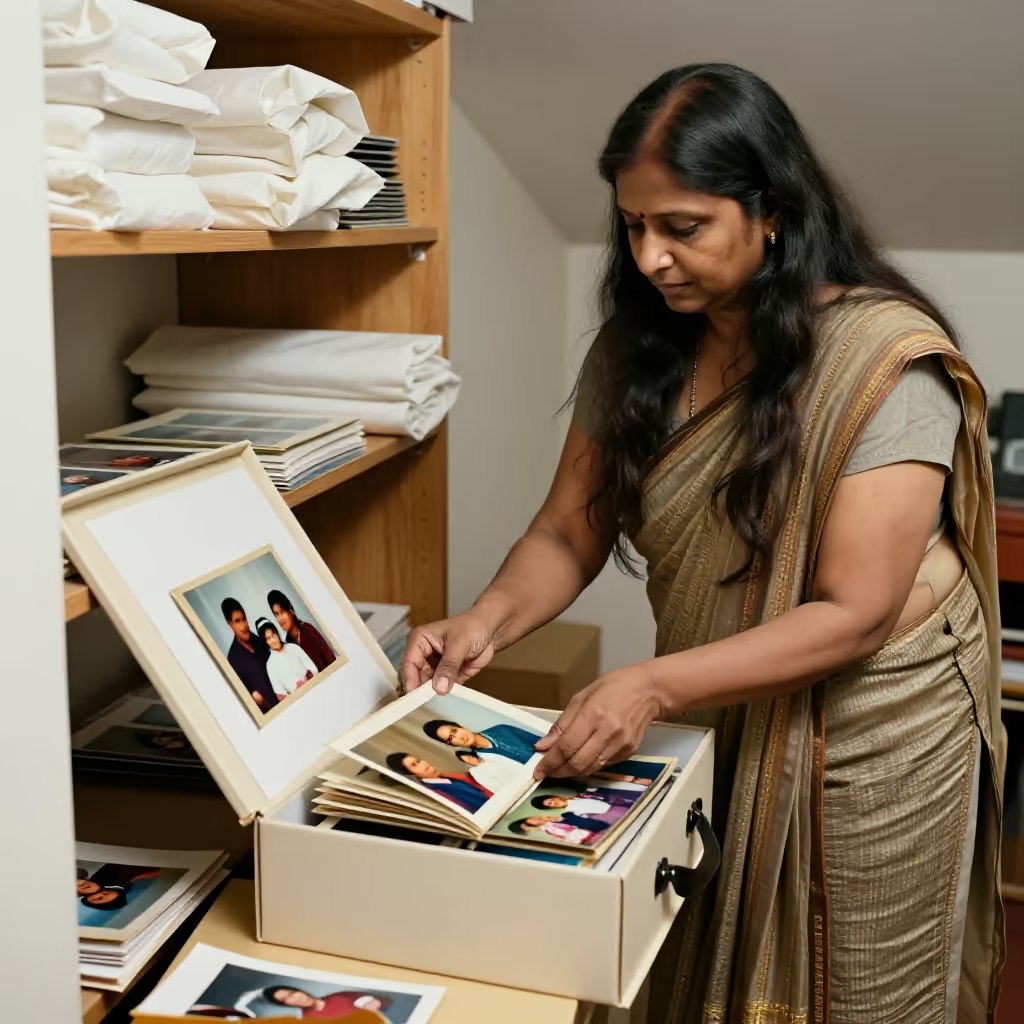
To maintain a certain state, quality, or feeling and not lose it.
example
Trotz der Hektik bewahrte sie die Ruhe und arbeitete konzentriert weiter.
Despite the hectic pace, she preserved her calm and continued working with concentration.

Usage tips
Inseparable verb
'Bewahren' (to preserve/protect) is an inseparable verb. The prefix 'be-' remains firmly attached to the verb stem 'wahren' in all tenses and sentence positions.
EXAMPLE
Er hat auch in schwierigen Zeiten seinen Optimismus bewahrt.
He preserved his optimism even in difficult times.
Register
The verb 'bewahren' (to preserve/protect) belongs more to written language or an elevated style. It often sounds more formal and deliberate.
EXAMPLE
Wir müssen dieses historische Gebäude für die Nachwelt bewahren.
We must preserve this historic building for future generations.
Typical collocations
In the meaning 'aufrechterhalten' (to maintain), 'bewahren' (to preserve) is often combined with abstract nouns that describe a positive or neutral state. Typical examples are: 'die Ruhe bewahren' (to keep calm), 'Haltung bewahren' (to maintain one's composure), 'einen kühlen Kopf bewahren' (to keep a cool head), or 'Stillschweigen bewahren' (to remain silent).
EXAMPLE
Versuchen Sie, in dieser stressigen Situation einen kühlen Kopf zu bewahren.
Try to keep a cool head in this stressful situation.
Sentence structure with 'vor'
When 'bewahren' means 'schützen' (to protect), it is always followed by the preposition 'vor' with the dative. The structure is: 'jemanden/etwas' (accusative) + 'vor etwas' (dative) + 'bewahren'.
EXAMPLE
Eine gute Versicherung kann Sie vor finanziellem Ruin bewahren.
Good insurance can protect you from financial ruin.
Reflexive dative structure
The reflexive form has a fixed structure with the dative: the person is the subject, followed by 'sich' in the dative and what is being preserved in the accusative. The structure is: subject + 'hat' + 'sich' (dative) + object (accusative) + 'bewahrt'.
EXAMPLE
Sie hat sich ihre offene und neugierige Art bewahrt.
She has retained her open and curious nature.
Compare with
near_synonym
bewahren vs halten
to hold
'halten' and 'bewahren' can both mean that a state is not lost. 'halten' is often simpler and more everyday, for example with calm, order, or a certain level. 'bewahren' sounds a bit more deliberate: you want not to lose something valuable, for example calm, hope, or a positive quality. When talking about feelings or personal qualities, 'bewahren' is often more precise. When you simply want to say that a state continues, 'halten' is usually more natural.
bewahren
Die Familie bewahrt auch in schwierigen Gesprächen ihre Ruhe.
The family preserves its calm even during difficult conversations.
halten
Bitte haltet die Küche heute sauber, weil morgen Besuch kommt.
Please keep the kitchen clean today, because we have visitors coming tomorrow.