
To bring a piece of work, a creation, or a task to a conclusion, often with a sense of perfection or completeness.
example
Der Komponist hat seine letzte Sinfonie kurz vor seinem Tod vollendet.
The composer completed his last symphony shortly before his death.
Usage tips
Word structure
The verb 'vollenden' (to complete) is made up of 'voll' (full) and 'enden' (to end). Literally, it means to bring something to a 'full end.' It is an inseparable verb, so the prefix always stays attached to the stem.
EXAMPLE
Sie hofft, dass sie ihr Kunstwerk bald vollendet.
She hopes that she will complete her artwork soon.
Register and style
'Vollenden' (to complete) is an elevated and formal word. In normal usage, you would often use simpler verbs like 'fertig machen' (to finish) or 'beenden' (to end/finish).
EXAMPLE
Der Künstler brauchte Jahre, um das Gemälde zu vollenden.
The artist needed years to complete the painting.
Typical collocations
This meaning is often used for large, important, or creative tasks. Typical objects are 'ein Werk' (a work), 'ein Projekt' (a project), 'ein Bauwerk' (a structure), or 'eine Mission' (a mission).
EXAMPLE
Die Architekten haben den Plan für das neue Museum vollendet.
The architects completed the plan for the new museum.
Fixed construction
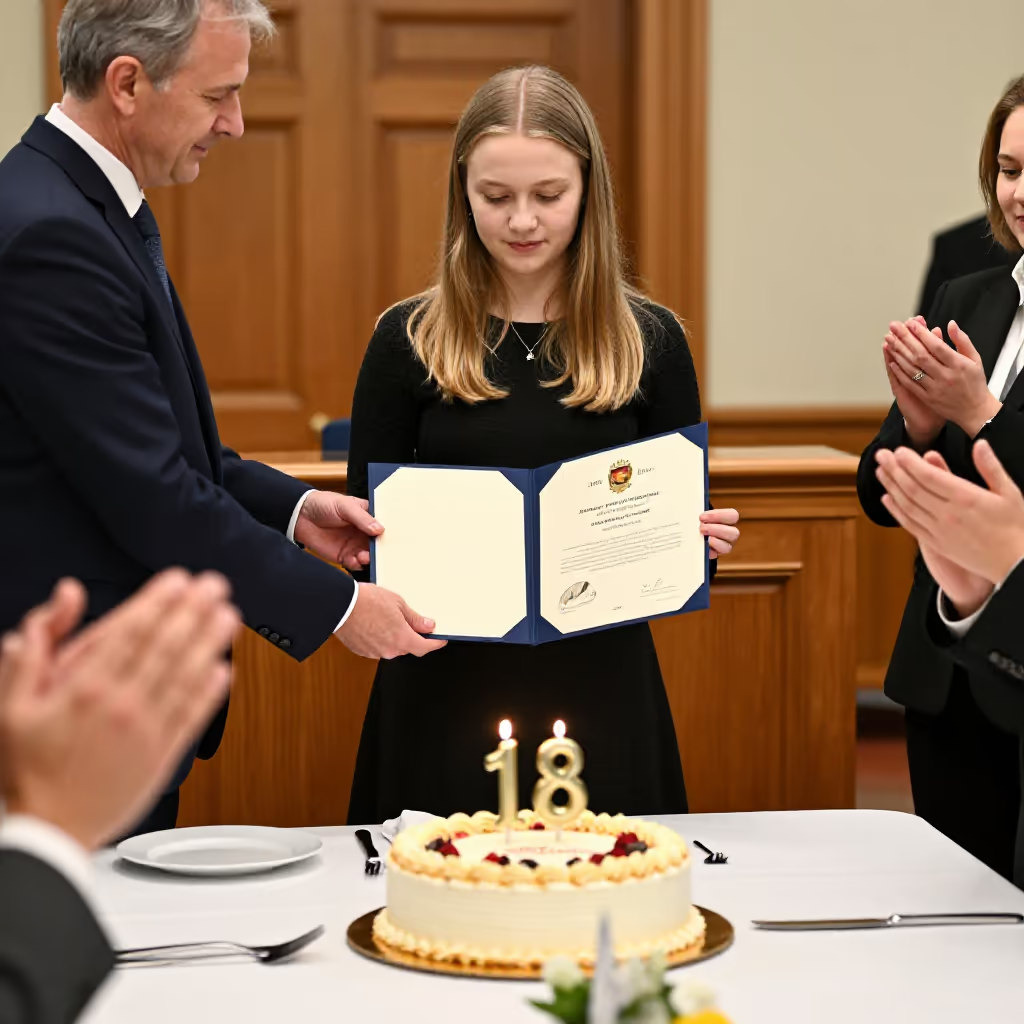
When talking about age, a fixed structure is used: 'das [Zahl]. Lebensjahr vollenden' (to reach one's [number]th year of life). The object is always 'das Lebensjahr' with an ordinal number.
EXAMPLE
Nächste Woche vollendet mein Großvater sein 80. Lebensjahr.
Next week my grandfather reaches his 80th year of life.
Compare with
near_synonym · confusable
vollenden vs erreichen
to reach
'erreichen' and 'vollenden' can both have to do with reaching an endpoint. 'erreichen' is used when you achieve a goal, a state, or a certain level. 'vollenden' means that you bring a piece of work, a creation, or a task fully to an end. It often sounds a bit more formal or solemn than 'fertig machen' (to finish). With age, there is a special expression: 'das 18. Lebensjahr vollenden' means to reach that age, but it is more formal. Learners may confuse the words because both refer to an endpoint. Put simply: you achieve a goal; you complete a task or a year of life.
vollenden
Meine Großmutter hat in diesem Jahr ihr achtzigstes Lebensjahr vollendet.
My grandmother reached her eightieth year of life this year.
erreichen
Yusuf erreicht heute ein wichtiges Ziel in seiner Ausbildung.
Yusuf is achieving an important goal in his training today.