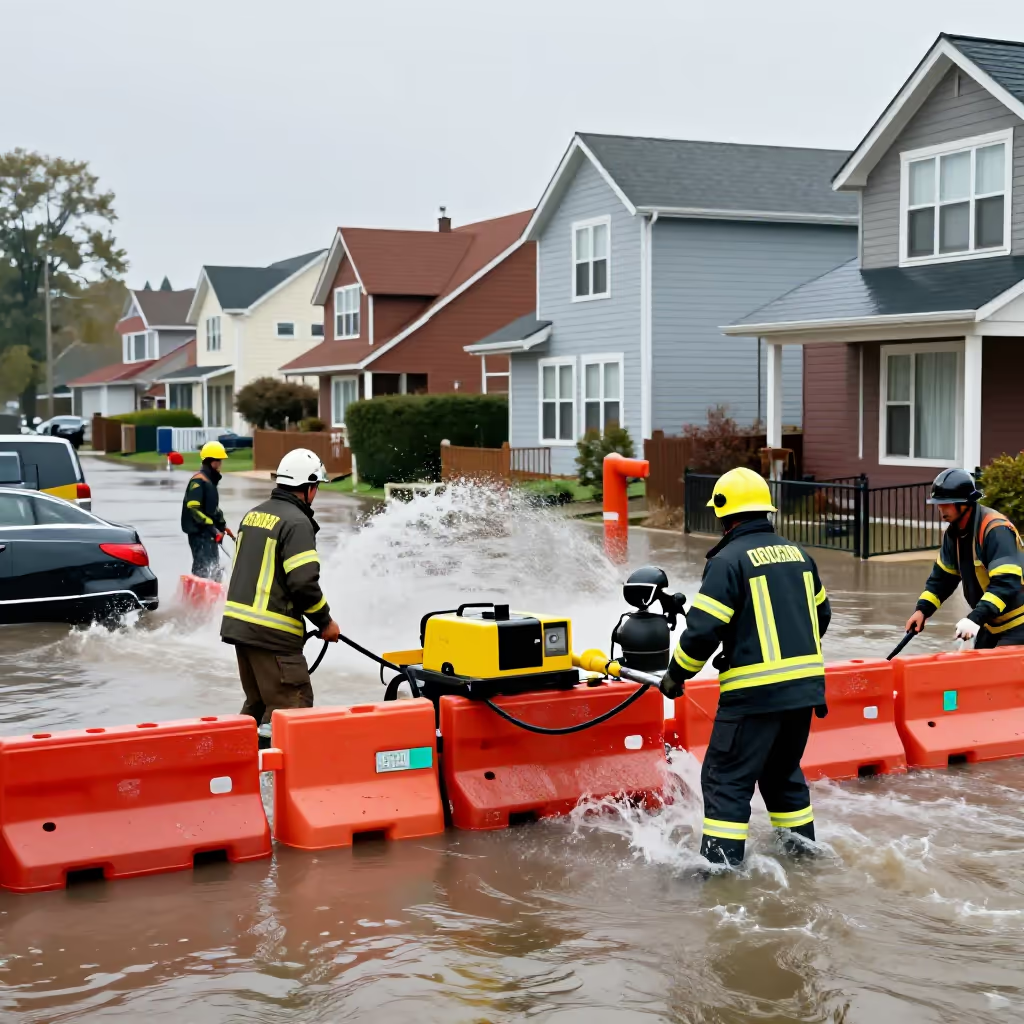
To take measures to prevent something undesirable (such as an illness or a problem) from happening. It is used with a dative object.
example
Um Missverständnissen vorzubeugen, sollten wir alles genau besprechen.
To prevent misunderstandings, we should discuss everything in detail.

Usage tips
Separable verb
'Vorbeugen' is a separable verb. In a main clause, the prefix 'vor' comes at the end, but in a subordinate clause it remains attached to the verb.
EXAMPLE
Ein gesunder Lebensstil beugt vielen Krankheiten vor.
A healthy lifestyle prevents many illnesses.
Dative construction
When you prevent something undesirable, that thing is in the dative. You say you prevent 'einer Sache' (a thing, dative), not 'eine Sache' (a thing, accusative).
EXAMPLE
Durch regelmäßiges Lüften beugen wir Schimmelbildung vor.
By airing regularly, we prevent mold formation.
Reflexive use
The meaning 'den Oberkörper nach vorne neigen' (to lean the upper body forward) is always used reflexively. The reflexive pronoun (sich, mich, dich, etc.) makes it clear that a physical movement is meant.
EXAMPLE
Ich musste mich vorbeugen, um die Münze vom Boden aufzuheben.
I had to lean forward to pick up the coin from the floor.
Typical collocations
Common things that one prevents are illnesses, problems, misunderstandings, or dangers.
EXAMPLE
Die Polizei ergriff Maßnahmen, um Verbrechen in der Gegend vorzubeugen.
The police took measures to prevent crime in the area.
Compare with
near_synonym · confusable
vorbeugen vs verhindern
to prevent
'verhindern' and 'vorbeugen' both have to do with the goal of making sure that something unwanted does not happen. 'verhindern' says generally that something does not happen, often also in a specific situation. 'vorbeugen' is used when you take measures in advance so that a problem does not arise in the first place. It is often used with illnesses, accidents, or other risks and takes the dative: 'einem Problem vorbeugen' (to prevent a problem). The words can be confused because the result is similar. The difference is: 'vorbeugen' happens beforehand and in a planned way, while 'verhindern' more generally describes stopping something or something not occurring.
vorbeugen
Regelmäßige Pausen beugen Kopfschmerzen am Bildschirm vor.
Regular breaks prevent headaches when working at a screen.
verhindern
Ein Helm kann bei einem Unfall schwere Verletzungen verhindern.
A helmet can prevent serious injuries in an accident.