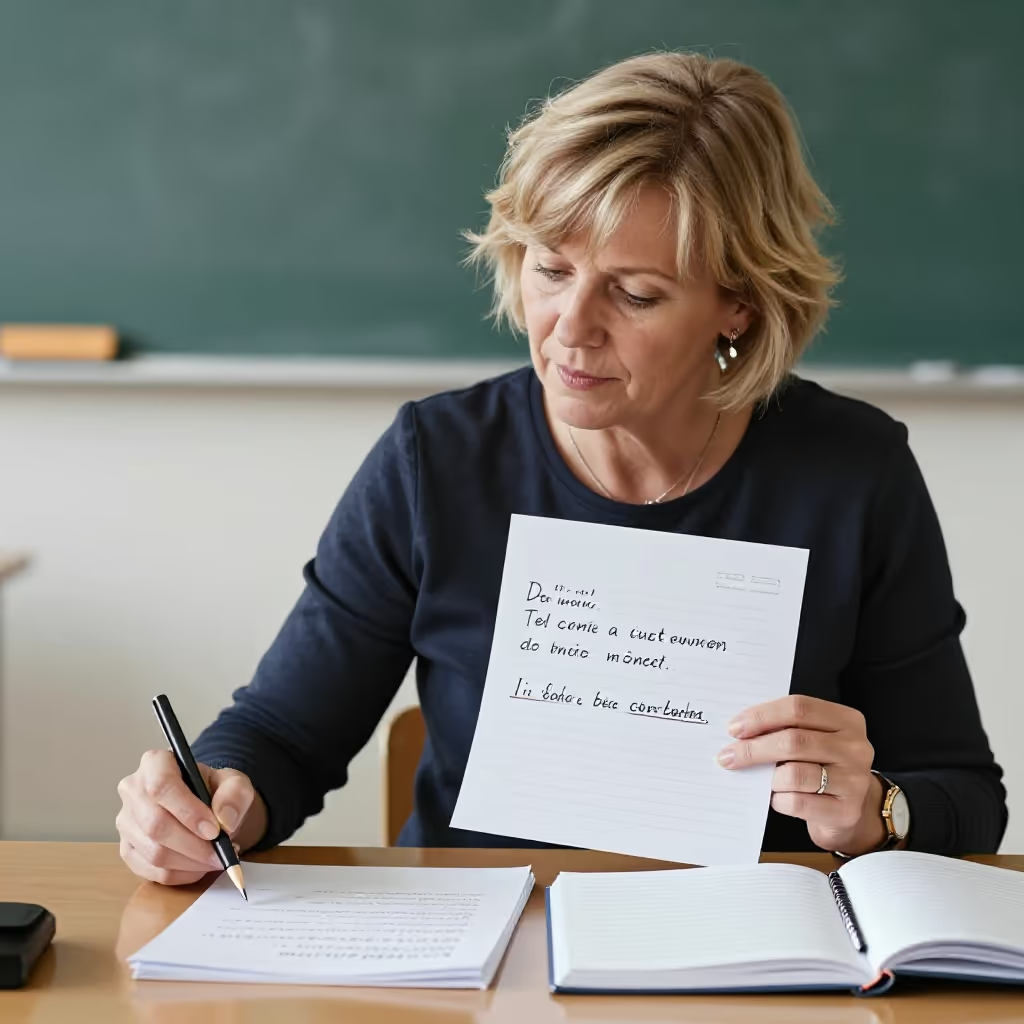
die Wendung
turn
A sudden and often unexpected change in a situation, story, or development.
Die Ermittlungen nahmen eine überraschende Wendung, als ein neuer Zeuge auftauchte.
The investigation took a surprising turn when a new witness appeared.

turn / expression
Loading your saved state.

turn
A sudden and often unexpected change in a situation, story, or development.
Die Ermittlungen nahmen eine überraschende Wendung, als ein neuer Zeuge auftauchte.
The investigation took a surprising turn when a new witness appeared.


expression
A fixed combination of words with an often figurative meaning; an idiom or expression.
Er benutzt oft die Wendung „im Großen und Ganzen“.
He often uses the expression 'by and large.'

turn
A physical rotation or a change of direction during movement.
Mit einer schnellen Wendung wich der Tänzer seiner Partnerin aus.
With a quick turn, the dancer dodged his partner.
'Die Wendung' (turn/expression) is derived from the verb 'wenden' (to turn). The basic idea of a turn or change appears in all meanings: a turn of events, a linguistic 'turn,' or a physical turn.
Er musste das Auto in der engen Straße wenden.
He had to turn the car around in the narrow street.
The context makes the meaning clear: if it is about a story or development, it means a change. If it is about language, it means an idiom or expression. If it is about sports or movement, it means a physical turn.
Die Geschichte nahm eine unerwartete Wendung.
The story took an unexpected turn.
In the meaning of 'Veränderung' (change), the fixed combination 'eine Wendung nehmen' (to take a turn) is almost always used. It is often expanded with adjectives like 'überraschend' (surprising), 'dramatisch' (dramatic), or 'positiv' (positive).
Durch die neue Information nahm der Fall eine entscheidende Wendung.
Because of the new information, the case took a decisive turn.
When 'Wendung' (expression) means an idiom, it is often combined with adjectives like 'fest' (fixed), 'bildlich' (figurative), or 'gebräuchlich' (common). You 'benutzt' (use) or 'verwendet' (use) an expression.
In seiner Rede benutzte der Politiker viele bildliche Wendungen.
In his speech, the politician used many figurative expressions.
expression / printout
The expression and the term can both refer to a linguistic unit. Ausdruck is the more general term and can also refer to a single word, while Wendung typically means a fixed combination of several words. For a single word, Ausdruck is more appropriate; for a fixed combination, Wendung is more appropriate.

Die Wendung „ins Gras beißen“ hat eine bildliche Bedeutung.
The expression „ins Gras beißen“ has a figurative meaning.
Der Ausdruck „danke“ ist in vielen Situationen passend.
The expression „danke“ is appropriate in many situations.