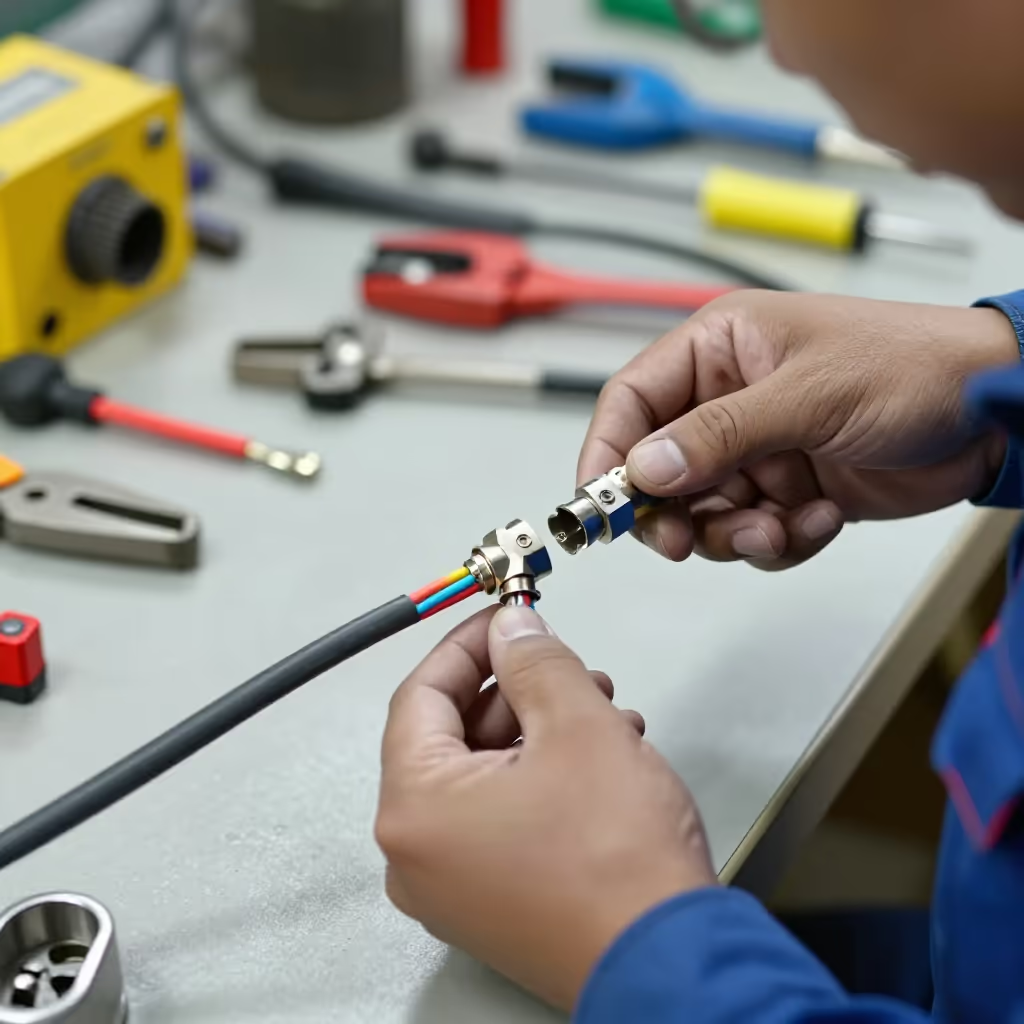
To connect different physical parts or elements in order to form a whole. This can be done by inserting, screwing, gluing, or other methods.
example
Er musste die Einzelteile des Schranks selbst zusammenfügen.
He had to assemble the individual parts of the cabinet himself.

Usage tips
Separable verb
'Zusammenfügen' (to assemble/combine) is a separable verb. In a main clause, the prefix 'zusammen' goes at the end. In subordinate clauses and in the infinitive with 'zu', the verb stays together.
EXAMPLE
Ich füge die beiden Teile vorsichtig zusammen.
I carefully put the two parts together.
Word structure
The verb is made up of the adverb 'zusammen' (together) and the verb 'fügen' (to fit/join). Its meaning is therefore very literal: to arrange things so that they fit together and form a unit.
EXAMPLE
Der Tischler fügt die Holzteile passgenau zusammen.
The carpenter joins the wooden parts together with a precise fit.
Sentence structure with 'zu'
To express what the result of the assembling or combining is, the preposition 'zu' with the dative is often used. The pattern is: 'Teile zu einem Ganzen zusammenfügen' (to assemble parts into a whole).
EXAMPLE
Die einzelnen Kapitel wurden zu einem spannenden Roman zusammengefügt.
The individual chapters were combined into an exciting novel.
Context clue
You can tell whether the physical or abstract meaning is intended from the object. With objects like 'Teile' (parts), 'Möbel' (furniture), or 'Puzzlestücke' (puzzle pieces), it is about concrete things. With 'Daten' (data), 'Informationen' (information), or 'Ideen' (ideas), the abstract meaning is intended.
EXAMPLE
Kannst du mir helfen, diese Bretter zusammenzufügen?
Can you help me join these boards together?
Compare with
near_synonym
zusammenfügen vs verbinden
to connect / to bandage
'verbinden' and 'zusammenfügen' can both mean that several parts form a connection or a whole. 'zusammenfügen' puts more emphasis on the process: individual parts are made into a unit piece by piece, for example in crafts, building, or with parts of a text. 'verbinden' is more general and also fits when two things are simply given a connection, but do not necessarily become a new whole. With cables, paths, or ideas, 'verbinden' often sounds more natural. With puzzle pieces, components, or sections of a text, 'zusammenfügen' fits especially well.
zusammenfügen
Lisa fügt die einzelnen Teile des Regals vorsichtig zusammen.
Lisa carefully assembles the individual parts of the shelf.
verbinden
Der Techniker verbindet den Drucker mit dem neuen WLAN.
The technician connects the printer to the new Wi-Fi.