

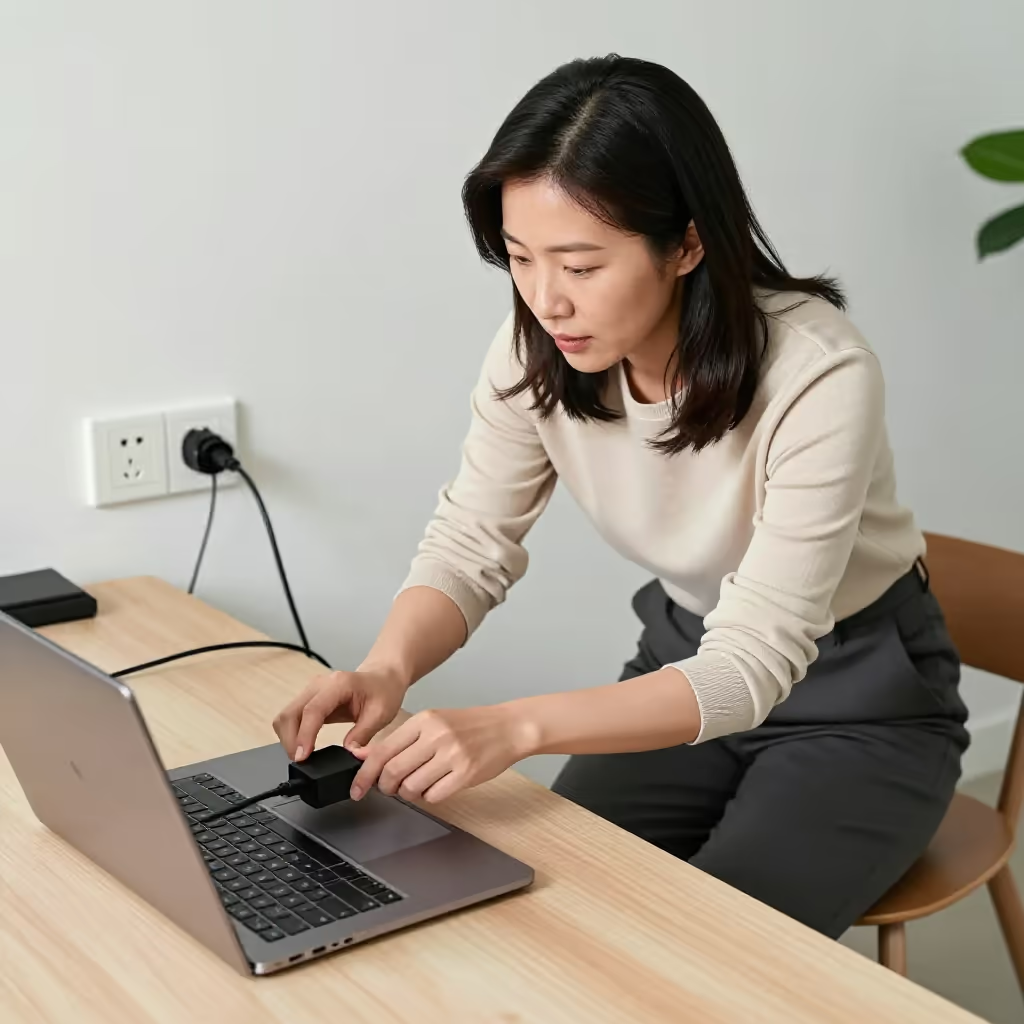
anschließen
to connect
To technically connect a device to a power source or another device.
EXAMPLE
Kannst du bitte den Drucker an den Computer anschließen?
Can you please connect the printer to the computer?
to connect / to join
Loading your saved state.
to connect
To technically connect a device to a power source or another device.
Kannst du bitte den Drucker an den Computer anschließen?
Can you please connect the printer to the computer?

to agree / join
Sich einer Meinung anschließen means to agree with an opinion. Sich einer Gruppe anschließen means to join a group.
Ich möchte mich deiner Meinung voll und ganz anschließen.
I would like to fully agree with your opinion.

to lock up
To fasten an object to something else with a lock in order to protect it from theft.
Vergiss nicht, dein Fahrrad anzuschließen!
Don't forget to lock up your bike!

to follow
To follow something in time or space.
An die Podiumsdiskussion schließt sich ein kleiner Empfang an.
A small reception follows the panel discussion.
'Anschließen' (to connect / to join) is a separable verb with the prefix 'an-'. In a main clause, 'an' comes at the end. In subordinate clauses and in the infinitive with 'zu', the verb stays together.
Ich schließe den Laptop an den Strom an.
I connect the laptop to the power supply.
The prefix 'an-' expresses a form of connection or addition in all meanings: a technical connection, chaining or locking something up, agreeing with an opinion, or linking up in time.
Schließen Sie sich unserer Gruppe an und entdecken Sie die Stadt.
Join our group and discover the city.
When connecting a device, you use the structure 'etwas (Akkusativ) an etwas (Akkusativ) anschließen' (to connect something to something). Here, the preposition 'an' takes the accusative because a direction or goal of the action is being described.
Schließ bitte die Lampe an die Steckdose an.
Please connect the lamp to the outlet.
When you agree with an opinion or join a group, the verb is reflexive ('sich anschließen'). The opinion or group that you join or agree with is in the dative.
Dieser Argumentation kann ich mich nicht anschließen.
I cannot agree with this line of argument.
To describe a temporal or spatial sequence, the sentence often begins with 'An...'. The verb then moves to position 2, and the separable prefix comes at the end.
An den Vortrag schließt sich eine Fragerunde an.
A Q&A session follows the lecture.
to follow
Folgen generally means that something comes after something else in time or space. Sich anschließen emphasizes more strongly that it begins directly afterward or is immediately attached to what came before. Folgen is appropriate for a simple sequence; sich anschließen is used for a close transition.

An den Vortrag schließt sich unmittelbar eine Fragerunde an.
A question-and-answer session immediately follows the lecture.
Auf den Vortrag folgt später eine Fragerunde.
A question-and-answer session follows the lecture later.