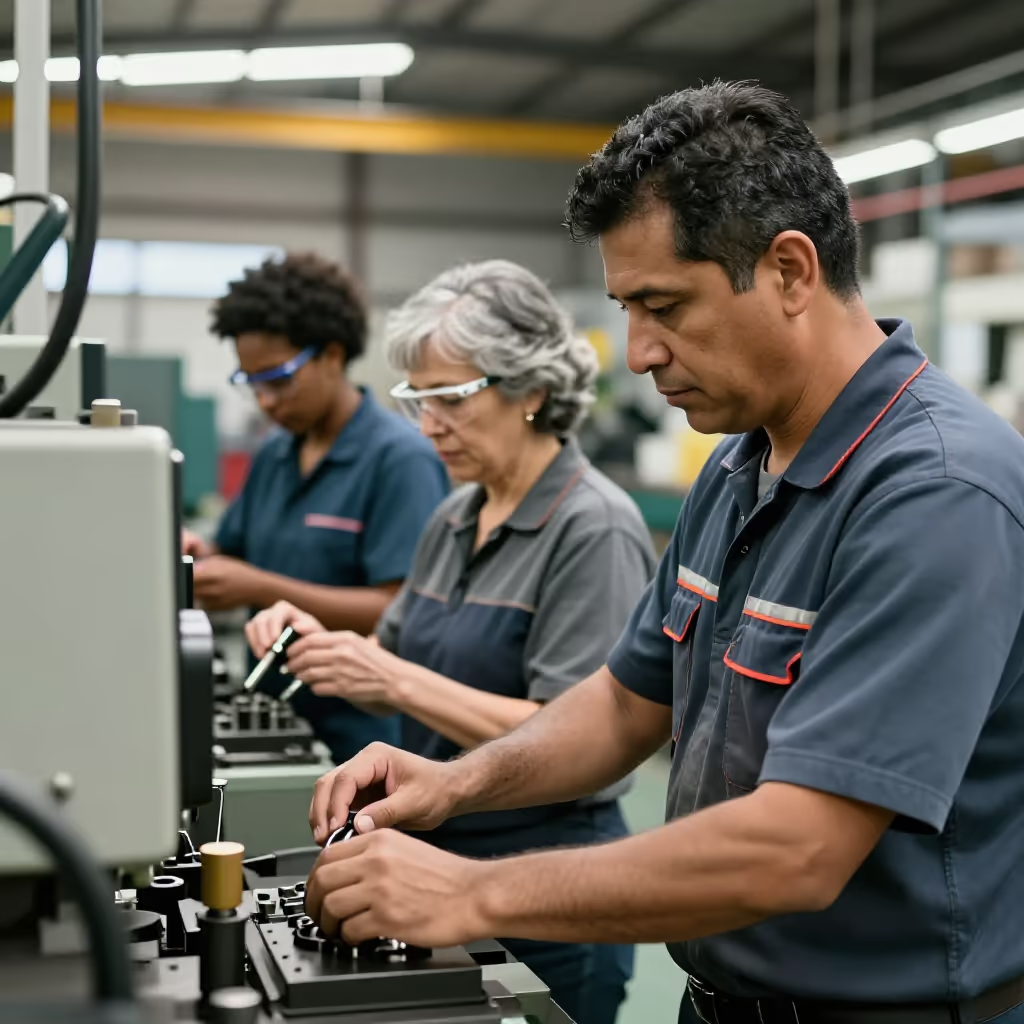
A person who works; a worker or employee. Often used in the plural to refer to the workforce of a company or industry.
example
Die Firma sucht dringend neue Arbeitskräfte für die Produktion.
The company urgently needs new workers for production.

Usage tips
Word composition
The word is made up of 'Arbeit' (work) and 'Kraft' (strength/force). So it literally means 'work-force'. This composition helps explain both meanings: the person who uses their strength for work, and the ability to work itself.
EXAMPLE
Ohne genügend Arbeitskräfte kann die Fabrik nicht produzieren.
Without enough workers, the factory cannot produce anything.
Context clue
In the plural ('Arbeitskräfte'), the meaning is almost always 'people/workers'. In the singular, either meaning is possible; the context makes it clear: if it is about personal energy, it means the ability to work; if it is about an individual person, it means the worker.
EXAMPLE
Dem Land fehlen Fachkräfte in vielen Branchen.
The country lacks skilled workers in many industries.
Typical collocations
When 'Arbeitskraft' (worker) refers to a person, it is often used with verbs such as 'suchen' (to look for), 'einstellen' (to hire), 'brauchen' (to need), or 'fehlen' (to be lacking). It is often described more precisely by adjectives such as 'qualifiziert' (qualified), 'billig' (cheap), or 'zusätzlich' (additional).
EXAMPLE
Wir suchen für unser Team dringend eine neue Arbeitskraft.
We are urgently looking for a new worker for our team.
Typical collocations
When 'Arbeitskraft' (working capacity) refers to the ability to work, it is often used with a possessive pronoun (meine, deine, seine Arbeitskraft — my, your, his working capacity). Typical verbs are 'investieren' (to invest), 'einsetzen' (to use/apply), 'widmen' (to devote), or 'schonen' (to conserve/spare).
EXAMPLE
Er investierte seine ganze Arbeitskraft in den Aufbau der Firma.
He invested all his working capacity in building the company.
Compare with
near_synonym · confusable
Arbeitskraft vs Mitarbeiter
employee
'der Mitarbeiter' and 'die Arbeitskraft' can both refer to a working person. 'Mitarbeiter' sees the person more as part of a company, a team, or a project. 'Arbeitskraft' sounds more general and often more impersonal. It is often used in the plural when talking about staffing needs, for example in an industry or company. In addition, 'Arbeitskraft' can also mean the ability or energy to work. Learners may therefore confuse the words, but the tone is different: 'Mitarbeiter' is more personal, while 'Arbeitskraft' sounds more like a resource or like staff in general.
Arbeitskraft
In der Erntezeit fehlen vielen Bauernhöfen zusätzliche Arbeitskräfte.
During harvest season, many farms are short of additional workers.
Mitarbeiter
Für das neue Projekt hat die Firma drei erfahrene Mitarbeiter eingestellt.
The company hired three experienced employees for the new project.