


aufnehmen
to record
To record sounds or images with a technical device so they can be played back later.
EXAMPLE
Ich möchte das Interview mit meinem Handy aufnehmen.
I want to record the interview with my phone.
to record / take in
Loading your saved state.
to record
To record sounds or images with a technical device so they can be played back later.
Ich möchte das Interview mit meinem Handy aufnehmen.
I want to record the interview with my phone.

to admit / take in
To integrate or accommodate someone or something in a group, house, or institution.
Der Verein hat letzten Monat zwanzig neue Mitglieder aufgenommen.
The club admitted twenty new members last month.

to make contact
To begin a connection or communication with someone.
Bitte nehmen Sie bei Problemen Kontakt mit dem Kundenservice auf.
Please contact customer service if you have any problems.

to absorb
To absorb or assimilate something (e.g. information, nutrients, liquid).
Pflanzen nehmen Kohlendioxid aus der Luft auf.
Plants absorb carbon dioxide from the air.
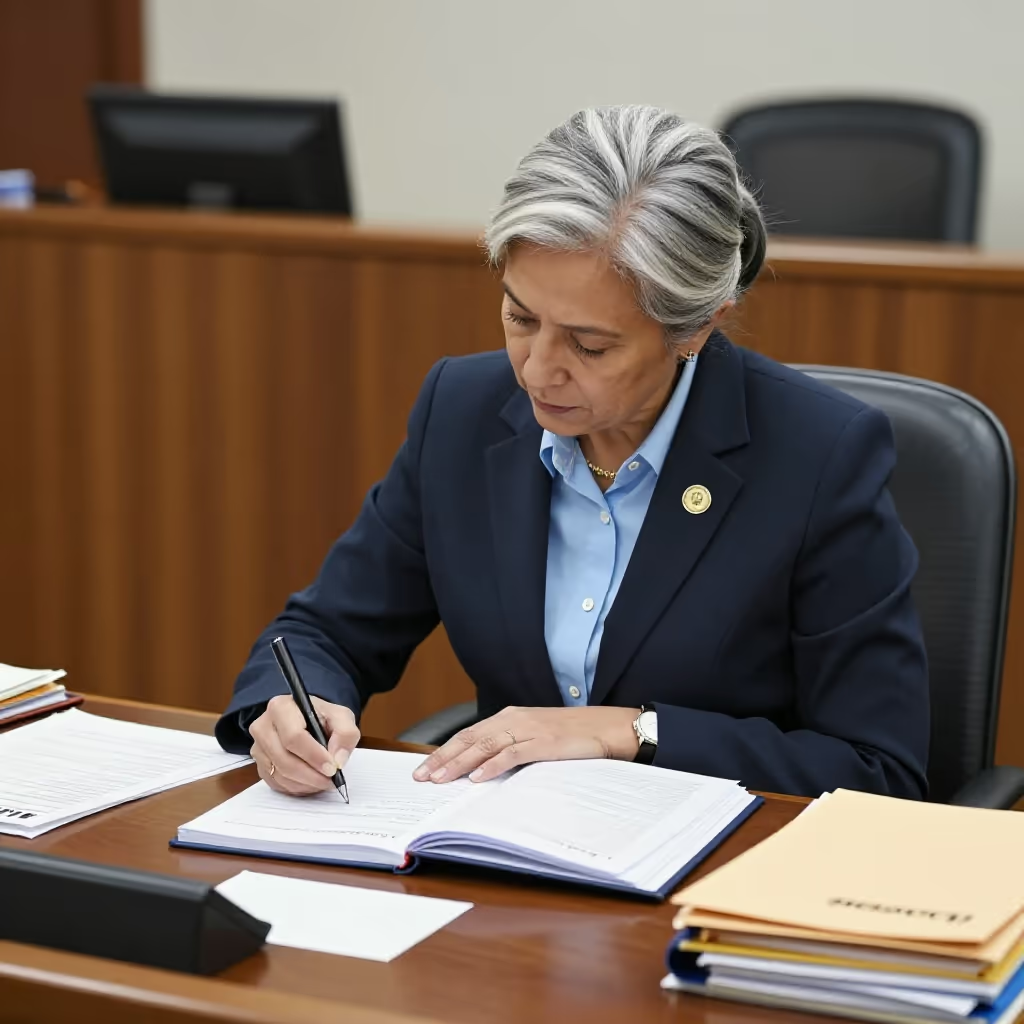
to record
To put something on record or write it down, often in an official context.
Die Polizei kam, um den Unfallhergang aufzunehmen.
The police came to record the course of events of the accident.

to resume / take up
To begin an activity or work, or continue it again after an interruption.
Nach der Kaffeepause nahmen wir die Diskussion wieder auf.
After the coffee break, we resumed the discussion.

to take out a loan
To borrow money from a bank or another institution.
Für den Hausbau mussten sie einen hohen Kredit aufnehmen.
They had to take out a large loan to build the house.

to take on
To measure oneself against someone or something; to dare to compete or confront an often stronger opponent.
Die kleine Mannschaft konnte es problemlos mit dem Tabellenführer aufnehmen.
The small team was easily able to take on the league leader.
'Aufnehmen' is a separable verb. The prefix 'auf-' goes at the end in a main clause. In subordinate clauses and in the infinitive with 'zu', the verb stays together.
Die Kamera nimmt alles auf.
The camera records everything.
The verb consists of 'auf' and 'nehmen' (to take). The basic idea is often to 'take something to oneself' or 'take something in', whether it is a sound, a person, information, or a task.
Die Familie hat einen Flüchtling bei sich aufgenommen.
The family took in a refugee.
In the meaning of 'aufzeichnen' (to record), the objects are typically media content. For example, you can record a song, a video, a podcast, a photo, or a conversation.
Die Band nimmt gerade ihr neues Album im Studio auf.
The band is currently recording their new album in the studio.
When someone is admitted into a group or institution, German uses the preposition 'in' with the accusative.
Die Universität hat dieses Jahr viele neue Studenten aufgenommen.
The university admitted many new students this year.
The expression 'Kontakt aufnehmen' (to make contact) is always used with the preposition 'mit' and the dative to name the person or office being contacted.
Ich muss dringend Kontakt mit meinem Anwalt aufnehmen.
I urgently need to make contact with my lawyer.
In the sense of 'protokollieren' (to record officially), 'aufnehmen' is often used by official people such as the police. Typical objects are 'einen Unfall' (an accident), 'eine Anzeige' (a report/complaint), 'die Personalien' (personal details), or 'eine Aussage' (a statement).
Die Polizistin nahm die Aussage des Zeugen auf.
The policewoman recorded the witness's statement.
In this meaning, 'aufnehmen' is often used for starting or resuming a formal activity. Typical objects are 'die Arbeit' (work), 'den Betrieb' (operations), 'das Studium' (studies), or 'die Verhandlungen' (negotiations).
Die Fabrik hat nach der Sommerpause die Produktion wieder aufgenommen.
The factory resumed production after the summer break.
The idiom 'es mit jemandem/etwas aufnehmen' (to take someone/something on) is fixed. The pronoun 'es' must always be included. It means to face an opponent or a challenge.
Der junge Boxer will es mit dem Weltmeister aufnehmen.
The young boxer wants to take on the world champion.
to accept / assume
For a new member, annehmen refers to approving the application. Aufnehmen refers to the person subsequently joining the group. A club can therefore first accept the application and then admit the person as a member.

Der Verein nimmt Lea als neues Mitglied auf.
The club admits Lea as a new member.
Der Vorstand nimmt Leas Antrag auf Mitgliedschaft an.
The board accepts Lea's application for membership.