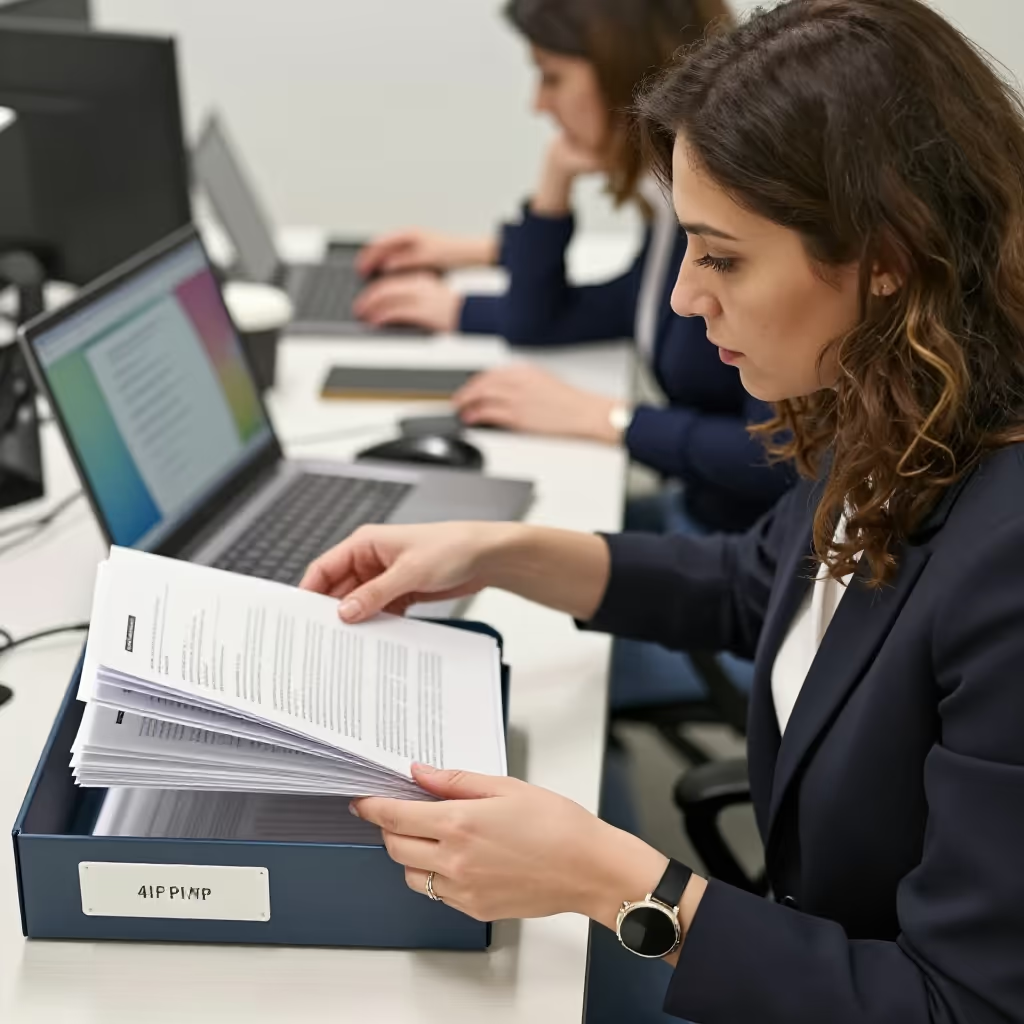
To work on a task, application, or topic in order to complete it or bring it to a result.
example
Die Sachbearbeiterin wird Ihren Antrag so schnell wie möglich bearbeiten.
The case worker will process your application as quickly as possible.

Usage tips
Inseparable verb
The verb 'bearbeiten' (to process/edit) has the prefix 'be-' and is inseparable. This means the prefix remains firmly attached to the verb in all sentence forms and tenses and is never placed at the end of the sentence.
EXAMPLE
Er bearbeitet gerade eine wichtige E-Mail.
He is currently editing an important email.
Always with accusative
The prefix 'be-' makes the verb transitive. This means that 'bearbeiten' (to process/edit) always needs a direct object in the accusative. You always process or edit 'etwas' (something).
EXAMPLE
Können Sie bitte diesen Antrag bearbeiten?
Could you please process this application?
Typical collocations
In administrative or professional contexts, 'bearbeiten' (to process) is often combined with tasks or documents. Typical examples are: 'einen Antrag bearbeiten' (to process an application), 'eine Anfrage bearbeiten' (to process a request), 'einen Fall bearbeiten' (to handle/process a case), or 'ein Thema bearbeiten' (to work on a topic).
EXAMPLE
Die Abteilung bearbeitet alle eingehenden Beschwerden.
The department processes all incoming complaints.
In creative contexts
When it is about media, 'bearbeiten' (to edit) is used for changes and improvements. Common combinations are: 'Fotos bearbeiten' (to edit photos), 'ein Video bearbeiten' (to edit a video), 'eine Audiodatei bearbeiten' (to edit an audio file), or 'einen Text bearbeiten' (to edit a text).
EXAMPLE
Sie hat das Video geschnitten und mit Musik bearbeitet.
She cut the video and edited it with music.
Figurative meaning
In this colloquial meaning, the object is always a person. It describes intensive talking in order to convince someone. The goal is often expressed with a 'bis' clause (until-clause).
EXAMPLE
Sie hat ihn so lange bearbeitet, bis er zugestimmt hat, mitzukommen.
She worked on him until he agreed to come along.
Compare with
near_synonym · confusable
bearbeiten vs arbeiten
to work
'arbeiten an' and 'bearbeiten' are close in meaning because both can involve a task or a material. 'arbeiten an' describes the process more: you are working on a project, a problem, or a task. 'bearbeiten' normally needs a direct object and means that you change something, deal with it, or bring it into a certain form. You can say 'einen Antrag bearbeiten' (to process an application), 'ein Foto bearbeiten' (to edit a photo), or 'Holz bearbeiten' (to work wood). They can be confused because both can express 'dealing with something'. In practical terms: you 'arbeitet an einem Text' when you are spending time on it; you 'bearbeitet den Text' when you make concrete changes to it.
bearbeiten
Mein Kollege bearbeitet die Kundenanfrage noch heute.
My colleague will deal with the customer inquiry today.
arbeiten
Wir arbeiten gerade an einer Lösung für das Problem.
We are currently working on a solution to the problem.