


bestellen
to order
To request goods or a service with the intention of buying or receiving them. This often happens in a restaurant, store, or online.
EXAMPLE
Wir haben zwei Pizzen und eine Cola bestellt.
We ordered two pizzas and a Coke.
to order
Loading your saved state.
to order
To request goods or a service with the intention of buying or receiving them. This often happens in a restaurant, store, or online.
Wir haben zwei Pizzen und eine Cola bestellt.
We ordered two pizzas and a Coke.

to send greetings
To ask someone to pass on greetings to another person.
Bestell deiner Mutter bitte schöne Grüße von mir.
Please send my warm regards to your mother.

to summon someone
To ask or instruct someone to come to a specific place.
Der Chef hat mich für 10 Uhr in sein Büro bestellt.
The boss summoned me to his office for 10 o'clock.
to be in good/bad shape
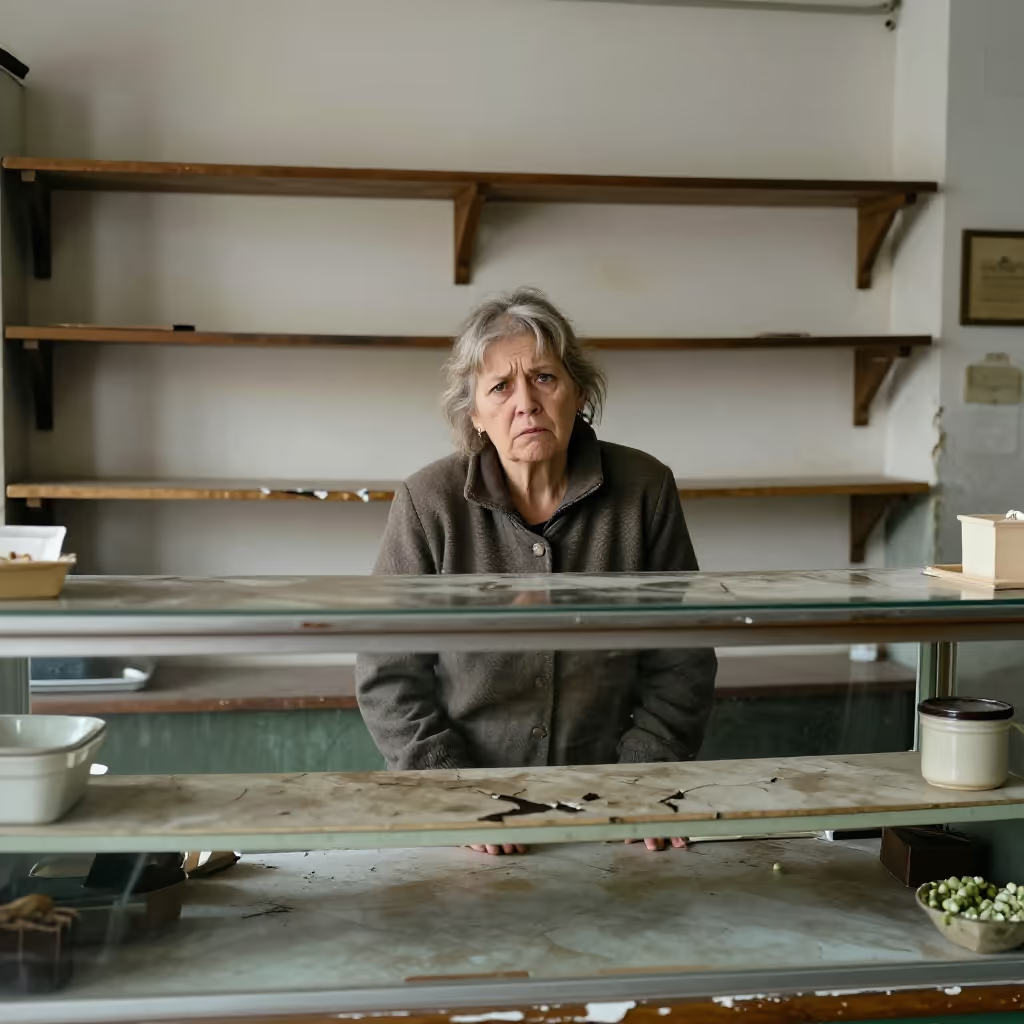
Describes the state or condition of something or someone as good or bad.
Nach der langen Dürre ist es schlecht um die Ernte bestellt.
After the long drought, the harvest is in bad shape.

to appoint someone
To officially install someone in an office or position.
Er wurde zum neuen Geschäftsführer des Unternehmens bestellt.
He was appointed as the company's new managing director.

to cultivate a field
To work agricultural land such as a field or plot in order to prepare it for growing plants.
Im Frühling bestellen die Bauern wieder ihre Felder.
In spring, the farmers cultivate their fields again.
'Bestellen' (to order) is an inseparable verb because it begins with the prefix 'be-'. The prefix is never separated from the verb, and the past participle is formed without 'ge-': 'bestellt'.
Er bestellt sich oft Essen online.
He often orders food online.
The most common meaning of 'bestellen' (to order) is requesting goods or services. Typical combinations are 'Essen bestellen' (to order food), 'ein Getränk bestellen' (to order a drink), 'Waren online bestellen' (to order goods online), or 'ein Taxi bestellen' (to order a taxi).
Lass uns heute Abend eine Pizza bestellen.
Let's order a pizza tonight.
In the phrase 'Grüße bestellen' (to send/pass on greetings), the person to whom the greetings should be passed on is in the dative. The person the greetings come from is introduced with 'von'.
Kannst du bitte deinem Bruder herzliche Grüße von mir bestellen?
Could you please send my warm regards to your brother?
To 'bestellen' (summon) someone to oneself is a formal request and implies a hierarchy. A boss summons an employee to the office, but you don't 'summon' friends to a party.
Der Direktor hat alle Abteilungsleiter zu einer dringenden Sitzung bestellt.
The director summoned all department heads to an urgent meeting.
The idiom 'es ist gut/schlecht bestellt um etwas/jemanden' (something/someone is in good/bad shape) is a fixed construction. It describes the condition or situation of a thing or person.
Nach der langen Krankheit war es schlecht um seine Fitness bestellt.
After the long illness, his fitness was in bad shape.
When someone is officially installed in an office, the structure 'jemanden zu etwas bestellen' (to appoint someone to/as something) is used. The new position or function follows the preposition 'zu' in the dative.
Sie wurde zur neuen Leiterin der Abteilung bestellt.
She was appointed as the new head of the department.
The meaning 'to work/cultivate' is used almost exclusively in agriculture. If you read 'bestellen' together with 'Feld' (field), 'Acker' (field), or 'Garten' (garden), this is the meaning intended.
Der Bauer bestellt sein Feld mit einer neuen Maschine.
The farmer cultivates his field with a new machine.
to insert / to begin / to use
Both verbs can express that someone is given an official position. Bestellen zu emphasizes the formal appointment to a specific office, while einsetzen is used more generally for placing someone in a position. Use bestellen zu for an explicitly formal decision to appoint someone to an office, and einsetzen for a general appointment or assignment.

Der Verein bestellte Frau Keller offiziell zur neuen Vorsitzenden.
The association officially appointed Ms. Keller as its new chairwoman.
Der Verein setzte Frau Keller als neue Vorsitzende ein.
The association appointed Ms. Keller as its new chairwoman.