

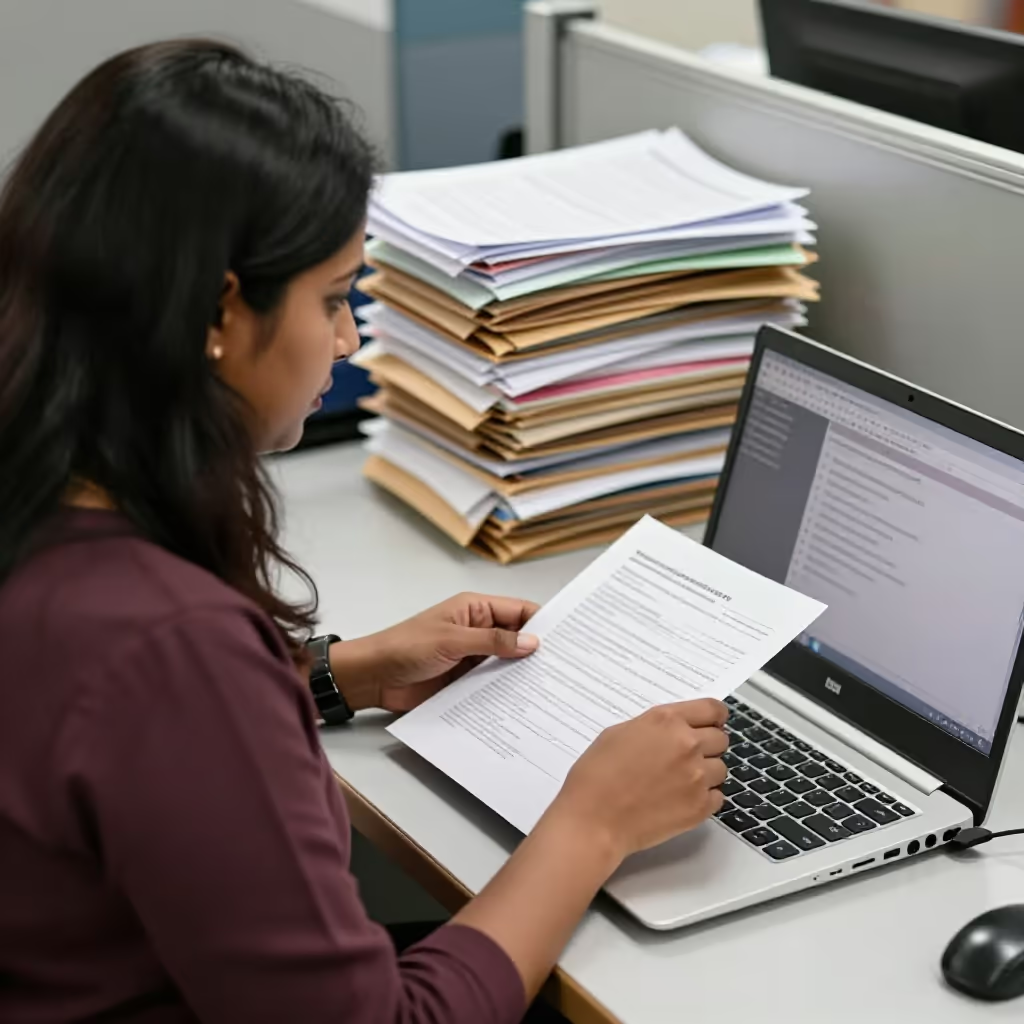
erfassen
to record
To systematically collect and record data or information, often digitally.
EXAMPLE
Alle Kundendaten werden in einer zentralen Datenbank erfasst.
All customer data is recorded in a central database.
to record / grasp
Loading your saved state.
to record
To systematically collect and record data or information, often digitally.
Alle Kundendaten werden in einer zentralen Datenbank erfasst.
All customer data is recorded in a central database.

to grasp
To understand and comprehend a situation, problem, or idea in its entirety.
Es dauerte einen Moment, bis sie die ganze Tragweite der Situation erfasste.
It took her a moment to grasp the full significance of the situation.

to sweep over
To suddenly and strongly overcome or seize someone or something, usually referring to emotions or forces of nature.
Eine Welle der Begeisterung erfasste das Publikum.
A wave of enthusiasm swept over the audience.

to seize
To physically grab, seize, or take hold of someone or something. This meaning is rather formal or old-fashioned.
Der Polizist konnte den flüchtenden Dieb am Arm erfassen.
The police officer was able to seize the fleeing thief by the arm.
'Erfassen' (to record/grasp) is an inseparable verb. It consists of the prefix 'er-' and the verb 'fassen' (to grasp/take hold of). The prefix 'er-' often suggests successful completion — so you successfully 'grasp' data, an idea, or a person.
Der Sensor erfasst die Temperatur im Raum.
The sensor records the temperature in the room.
The object of the sentence reveals the meaning: with 'Daten' (data), 'Zahlen' (numbers), or 'Namen' (names), it is about collecting/recording (m01). With 'Situation' (situation), 'Problem' (problem), or 'Bedeutung' (meaning), it is about understanding (m02). With 'Gefühlen' (feelings) or 'Naturkräften' (forces of nature), it is about seizing or sweeping over (m03).
Er konnte die komplexe Situation schnell erfassen.
He was able to grasp the complex situation quickly.
In administrative and IT contexts, 'erfassen' (to record) is very common. Typical combinations are 'Daten erfassen' (to record data), 'Bestellungen erfassen' (to record orders), 'Adressen erfassen' (to record addresses), or 'digital erfassen' (to record digitally).
Die neue Software soll die Arbeitszeiten der Mitarbeiter automatisch erfassen.
The new software is supposed to automatically record employees' working hours.
When an emotion 'erfasst' (sweeps over/seizes) someone, the emotion is often the subject of the sentence. Alternatively, the person can be the subject in a passive sentence.
Plötzlich erfasste ihn ein Gefühl der Panik.
Suddenly a feeling of panic swept over him.
The meaning 'physisch greifen' (to physically grab) is rare in modern German and sounds very formal or old-fashioned. It is mainly found in police reports or older literature.
Der Greifarm des Roboters erfasste das Bauteil präzise.
The robot's gripper seized the component precisely.
to understand
Verstehen and erfassen can both refer to grasping something mentally. Erfassen often sounds more formal and emphasizes having an overview of the whole situation and its connections. Verstehen is used more generally when the meaning has become clear.

Nach der ausführlichen Erklärung erfasse ich den gesamten Ablauf und seine Zusammenhänge.
After the detailed explanation, I grasp the entire process and its connections.
Nach der Erklärung verstehe ich den schwierigen Ablauf.
After the explanation, I understand the difficult process.