


fortsetzen
to continue
To resume and continue an action, process, or conversation that has already begun after an interruption.
EXAMPLE
Wir setzen die Diskussion morgen früh fort.
We will continue the discussion tomorrow morning.
to continue
Loading your saved state.
to continue
To resume and continue an action, process, or conversation that has already begun after an interruption.
Wir setzen die Diskussion morgen früh fort.
We will continue the discussion tomorrow morning.
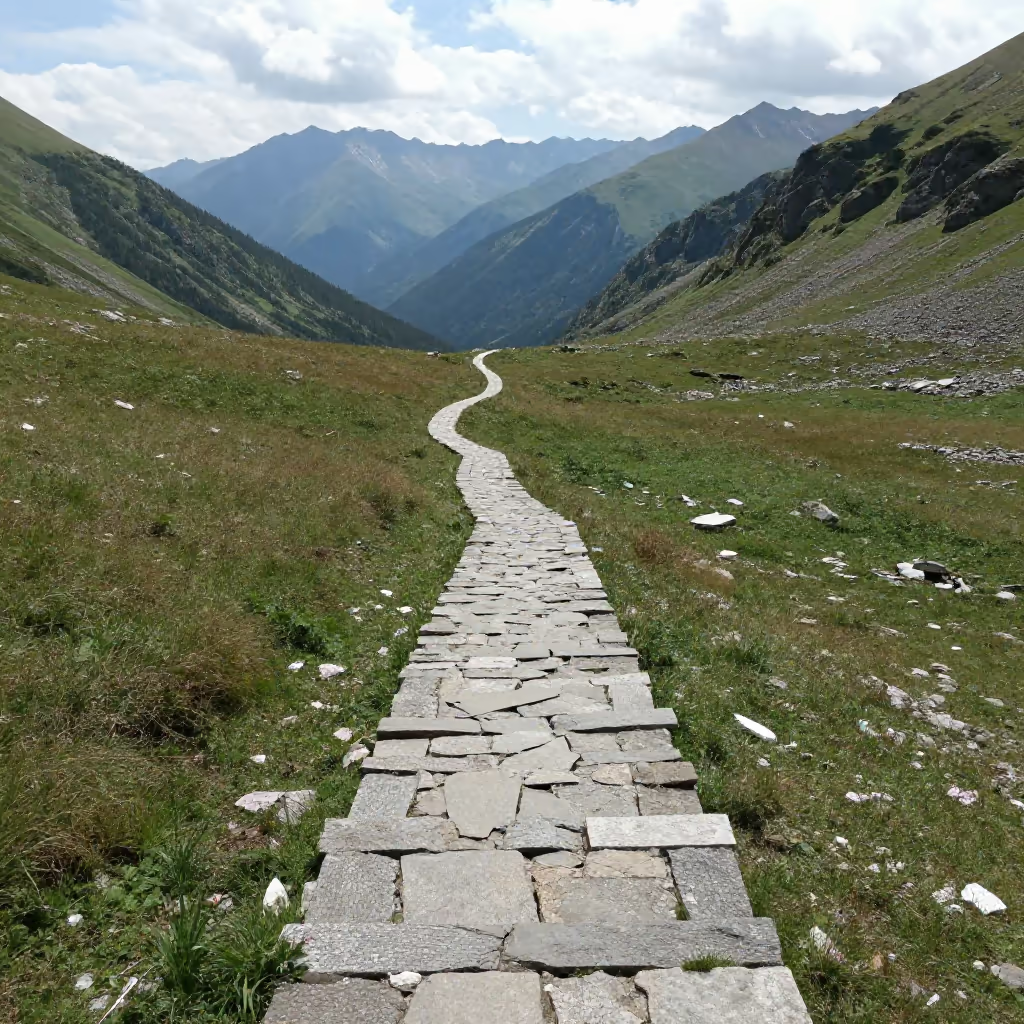
to continue
To go on or continue in terms of space or time.
Der Wanderweg setzt sich hinter dem Wald fort.
The hiking trail continues behind the forest.
'Fortsetzen' (to continue) is a separable verb with the prefix 'fort-'. In a main clause, the prefix goes at the end; in subordinate clauses and in the infinitive with 'zu', the verb stays together.
Nach der Pause setzen wir den Unterricht fort.
After the break, we will continue the lesson.
The verb consists of the prefix 'fort-' and the verb 'setzen' (to set/put). 'Fort' here means 'onward' or 'forward'. So the literal idea is to 'set' an action further or move it forward.
Lasst uns das Gespräch an einem ruhigeren Ort fortsetzen.
Let's continue the conversation in a quieter place.
Pay attention to whether the verb is reflexive or not. If a person actively continues something, use 'fortsetzen' (to continue) with an accusative object. If something goes on or continues by itself, use the reflexive form 'sich fortsetzen' (to continue).
Die Firma setzt die Produktion trotz der Krise fort.
The company is continuing production despite the crisis.
to record / take in
After an interruption, either verb is often possible. Wieder aufnehmen highlights starting the activity again, whereas fortsetzen emphasizes continuing the same activity that had already begun.

Nach der Pause setzt Mia die Arbeit fort.
After the break, Mia continues her work.
Nach der Pause nimmt Mia die Arbeit wieder auf.
After the break, Mia resumes work.