

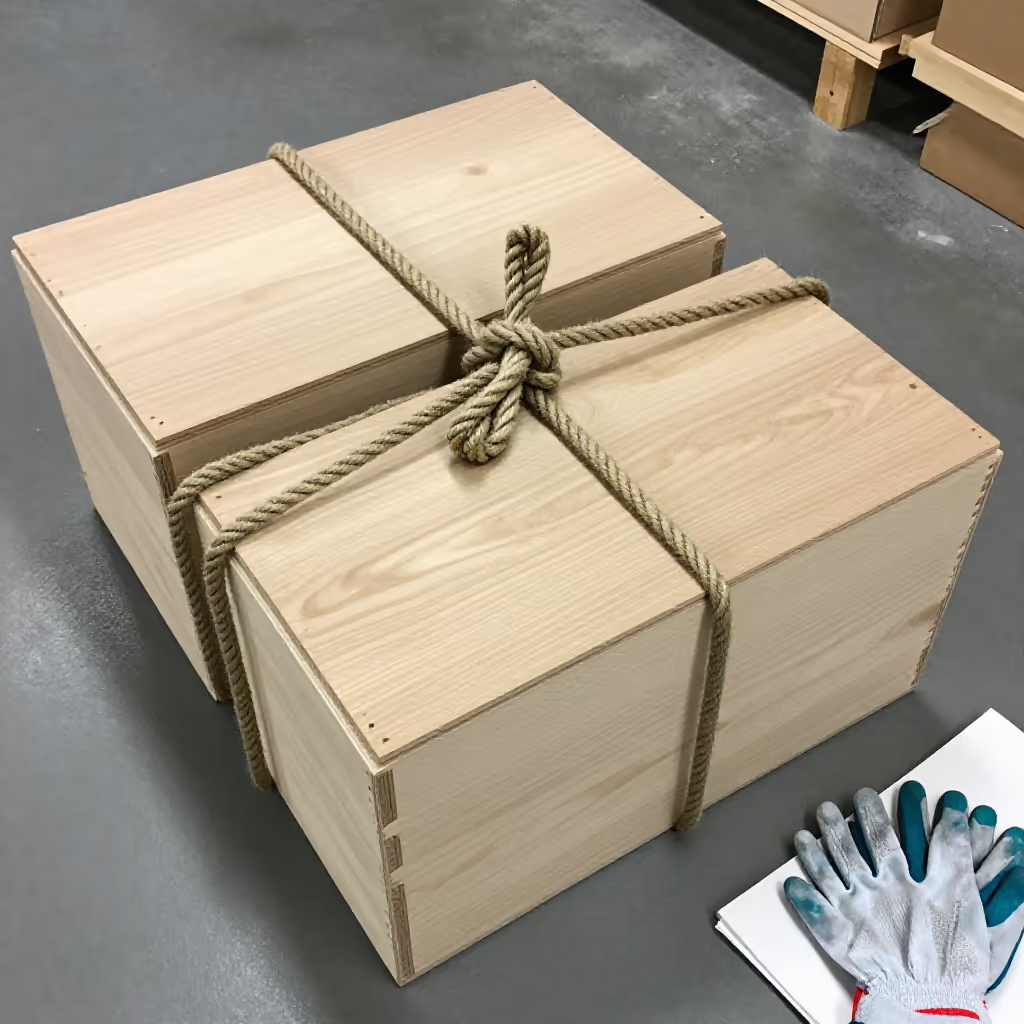
gebunden
bound
Physically fastened or tied together with a rope, string, or something similar.
EXAMPLE
Der Blumenstrauß war mit einem schönen Band gebunden.
The bouquet was bound with a beautiful ribbon.
bound
Loading your saved state.
bound
Physically fastened or tied together with a rope, string, or something similar.
Der Blumenstrauß war mit einem schönen Band gebunden.
The bouquet was bound with a beautiful ribbon.

bound to
Obligated to stick to an agreement, a contract, a promise, or a person. You are not free in your decision.
Ich bin an den Vertrag gebunden und kann nicht einfach kündigen.
I am bound to the contract and can’t simply cancel it.

hardcover
Describes a book with a hard cover, as opposed to a paperback.
Ich kaufe lieber die gebundene Ausgabe, weil sie haltbarer ist.
I prefer to buy the hardcover edition because it is more durable.

thickened
Used in cooking to describe a liquid such as a sauce or soup that has been thickened by adding starch, flour, or egg yolk.
Die Soße wird zum Schluss mit etwas Speisestärke gebunden.
At the end, the sauce is thickened with a little cornstarch.

bonded
In chemistry, the state in which atoms or molecules are connected to each other by a chemical bond.
In Wasser ist der Sauerstoff an zwei Wasserstoffatome gebunden.
In water, oxygen is bonded to two hydrogen atoms.

tied up
Refers to capital that is invested in assets and cannot be made liquid in the short term.
Ein großer Teil seines Vermögens ist in Immobilien gebunden.
A large part of his wealth is tied up in real estate.
'Gebunden' (bound) is the past participle of the verb 'binden' (to bind/tie). All meanings of the adjective derive from the basic idea that something is fastened, connected, or limited in its freedom.
Er hat die alten Zeitungen zu einem Paket gebunden.
He tied the old newspapers into a bundle.
When 'gebunden' (bound) expresses an obligation, it is always used with the preposition 'an' and the accusative. The structure is: 'an etwas gebunden sein' (to be bound to something).
Als Mitarbeiter sind wir an die Regeln des Unternehmens gebunden.
As employees, we are bound to the company’s rules.
In a chemical context, the preposition 'an' is also used. The difference from obligation is made clear by the nouns: here, atoms or molecules are 'an' (to) other atoms bonded.
Im Wassermolekül (H₂O) ist ein Sauerstoffatom an zwei Wasserstoffatome gebunden.
In the water molecule (H₂O), one oxygen atom is bonded to two hydrogen atoms.
In connection with books, 'gebundene Ausgabe' (hardcover edition) is a fixed term for a book with a hard cover. It is the opposite of 'broschierte Ausgabe' (paperback edition).
Viele Sammler bevorzugen die gebundene Erstausgabe eines Romans.
Many collectors prefer the hardcover first edition of a novel.
When 'gebunden' (thickened) is used in cooking, it means that a liquid such as a soup or sauce has been made thicker. The verb for this is 'binden' (to thicken).
Für eine cremig gebundene Suppe kann man etwas Sahne oder Mehl verwenden.
For a creamy, thickened soup, you can use a little cream or flour.
In finance, 'gebunden' (tied up) means that money is not immediately available. Here, the preposition 'in' is often used: capital is 'in' (in) an investment tied up.
Sein Geld ist langfristig in Aktien gebunden.
His money is tied up in stocks for the long term.
guilty / owing
Schuldig and gebunden can both express an existing obligation. Schuldig is used especially in fixed phrases such as „jemandem Dank oder eine Erklärung schuldig sein“, while gebunden emphasizes being generally bound by a promise or agreement. Use schuldig for the specific thing owed, and gebunden for the binding rule.

Nach unserem Versprechen bin ich an diese Vereinbarung gebunden.
Because of our promise, I am bound by this agreement.
Nach seiner Hilfe bin ich ihm eine Erklärung schuldig.
After his help, I owe him an explanation.