

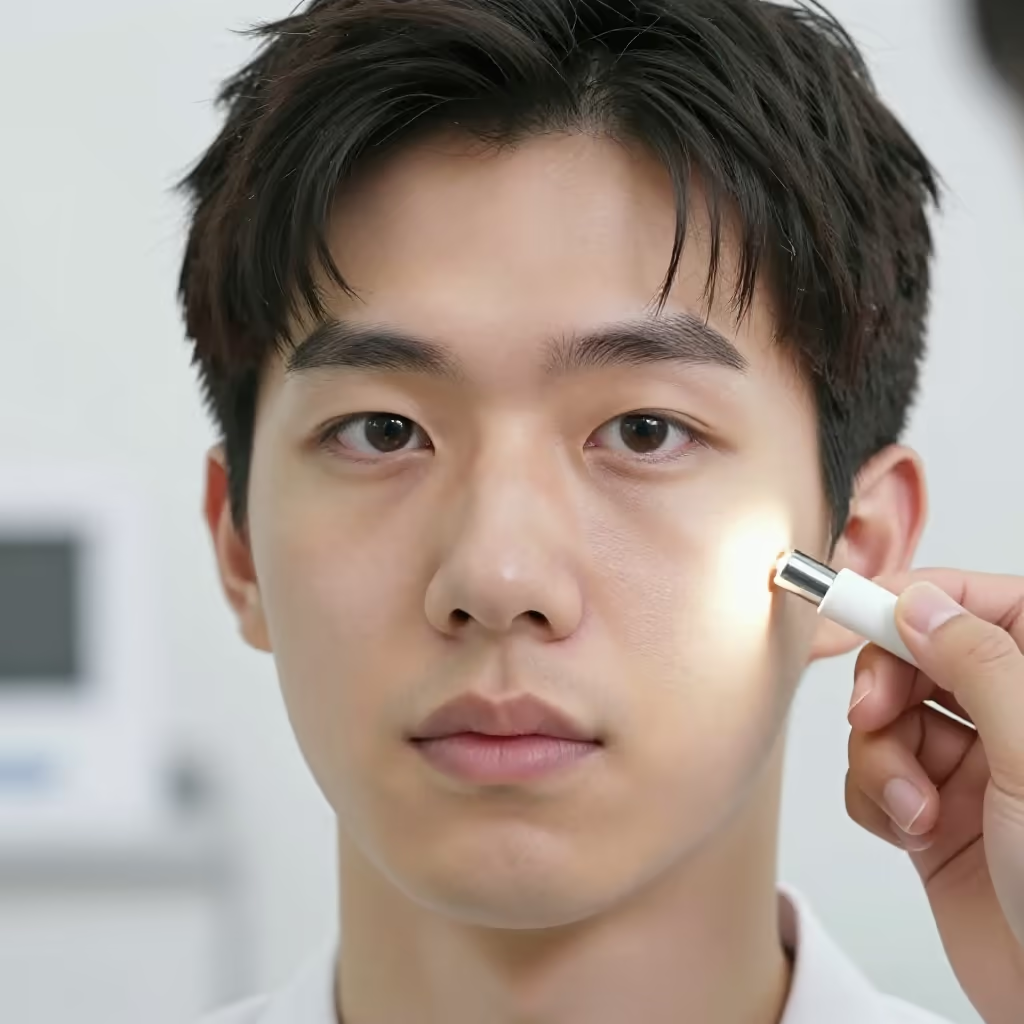
das Gesicht
face
The front part of the human head, which includes the eyes, nose, and mouth.
EXAMPLE
Er wusch sich am Morgen das Gesicht mit kaltem Wasser.
In the morning, he washed his face with cold water.
face
Loading your saved state.
face
The front part of the human head, which includes the eyes, nose, and mouth.
Er wusch sich am Morgen das Gesicht mit kaltem Wasser.
In the morning, he washed his face with cold water.

expression
The facial expression or look that shows a particular mood or emotion.
Als sie die schlechte Nachricht hörte, machte sie ein trauriges Gesicht.
When she heard the bad news, she made a sad expression.

to lose face
To lose one's good reputation, standing, or respect among others.
Durch sein unehrliches Verhalten hat er vor all seinen Freunden das Gesicht verloren.
Through his dishonest behavior, he lost face in front of all his friends.

to say it to someone's face
To tell someone something directly, openly, and honestly, even if it is unpleasant.
Ich finde es besser, wenn du ihm deine Kritik direkt ins Gesicht sagst.
I think it's better if you say your criticism directly to his face.
The word consists of the prefix 'Ge-' and the stem 'Sicht' (sight/view). The prefix 'Ge-' often forms collective terms. So you can think of 'Gesicht' (face) as the whole of what one 'sees' in the front part of the head.
Sie hat ein sehr freundliches Gesicht.
She has a very friendly face.
When a person performs an action on their own face, German often uses a reflexive dative pronoun. The structure is: subject + verb + sich (dative) + das Gesicht (accusative).
Nach dem Sport wäscht er sich das Gesicht.
After exercising, he washes his face.
The meaning 'Gesichtsausdruck' (facial expression) is often recognizable from verbs like 'machen' (to make) or 'ziehen' (to pull/make). Actions like 'waschen' (to wash) or 'schminken' (to put makeup on) refer instead to the physical part of the head.
Als er den Preis sah, machte er ein langes Gesicht.
When he saw the price, he made a long face.
The idiom 'das Gesicht verlieren' (to lose face) is a fixed unit and means to lose standing or respect. The opposite is 'sein Gesicht wahren' (to save face).
Er wollte die Diskussion nicht fortsetzen, um sein Gesicht zu wahren.
He did not want to continue the discussion in order to save face.
The expression 'jemandem etwas ins Gesicht sagen' (to say something to someone's face) follows a fixed pattern: the person you are speaking to is in the dative, and the information is in the accusative.
Sie hat ihm endlich ihre Meinung direkt ins Gesicht gesagt.
She finally told him her opinion directly to his face.
face
Gesicht and Face can both refer to the visible front part of the head. Gesicht is neutral and appropriate in all usual situations. Face, by contrast, is marked as colloquial, youthful, or online language and is mainly suitable in correspondingly informal contexts.

Auf dem Passfoto muss dein Gesicht vollständig zu sehen sein.
Your entire face must be visible in the passport photo.
Auf deinem neuen Profilbild ist dein Face vollständig zu sehen.
Your entire face is visible in your new profile picture.