


knüpfen
to tie
To make a knot in order to connect two or more threads, ropes, or ribbons.
EXAMPLE
Er knüpfte die Schnürsenkel seiner Wanderschuhe fest.
He tied the laces of his hiking boots tightly.
to tie / make
Loading your saved state.
to tie
To make a knot in order to connect two or more threads, ropes, or ribbons.
Er knüpfte die Schnürsenkel seiner Wanderschuhe fest.
He tied the laces of his hiking boots tightly.

to make contacts
To establish or build social or business relationships.
Auf der Konferenz konnte sie viele nützliche Kontakte für ihre Karriere knüpfen.
At the conference, she was able to make many useful contacts for her career.

to attach to
To connect an expectation, condition, or hope with something.
An diesen Erfolg knüpfen sich große Hoffnungen für die Zukunft des Unternehmens.
Great hopes for the company's future are attached to this success.
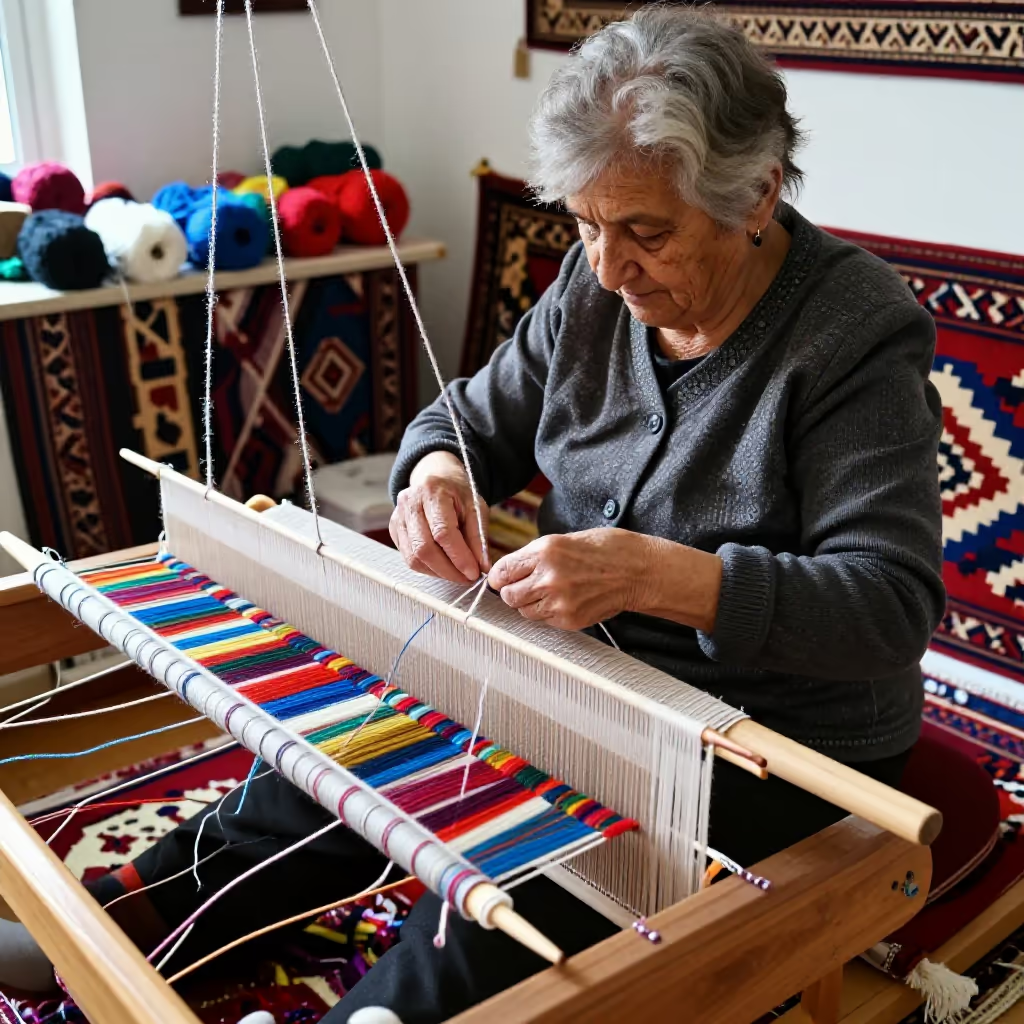
to knot
To make a carpet or a net by systematically knotting threads.
In der Manufaktur lernt man, wie man traditionelle Teppiche von Hand knüpft.
In the workshop, you learn how to knot traditional carpets by hand.
You can recognize the exact meaning of 'knüpfen' (to tie/make) from the object. With 'Kontakten' (contacts), it is about social relationships; with 'Hoffnungen' (hopes), it is about a conceptual connection; and with 'Knoten' (knots) or 'Teppichen' (carpets), it is about the literal, manual activity.
Auf der Konferenz will ich neue Kontakte knüpfen.
At the conference, I want to make new contacts.
The expression 'Kontakte knüpfen' (to make contacts) is very common and means to build new social or professional relationships. Other typical objects in this sense are 'Beziehungen' (relationships), 'Freundschaften' (friendships), or 'ein Bündnis' (an alliance).
Im Ausland ist es anfangs oft schwer, neue Freundschaften zu knüpfen.
Abroad, it is often difficult at first to make new friendships.
When expectations, hopes, or conditions are connected with something, 'knüpfen' (to attach/connect) is used with the preposition 'an' and the accusative. The structure is: 'etwas an etwas (Akk) knüpfen' (to attach something to something [accusative]).
Das Unternehmen knüpft die Beförderung an die Bedingung, dass sie ein Projekt erfolgreich abschließt.
The company attaches the promotion to the condition that she successfully completes a project.
In its literal meaning, 'knüpfen' (to tie) is used for connecting threads, ropes, or ribbons by means of a knot. Typical objects are 'einen Knoten' (a knot), 'Schnürsenkel' (shoelaces), 'ein Band' (a ribbon), or 'ein Netz' (a net).
Kannst du mir helfen, eine Schleife in dieses Geschenkband zu knüpfen?
Can you help me tie a bow in this gift ribbon?
to produce / establish
Herstellen can neutrally express establishing a connection between people. For actively starting new social or professional relationships, however, Kontakte knüpfen (to make contacts) is the usual expression. Someone who connects people establishes contact; someone who starts relationships themselves knüpft Kontakte.

Die Bewerberin knüpft auf der Veranstaltung neue Kontakte zu Unternehmen.
At the event, the applicant makes new contacts with companies.
Die Organisatorin stellt den Kontakt zwischen der Bewerberin und dem Unternehmen her.
The organizer establishes contact between the applicant and the company.