

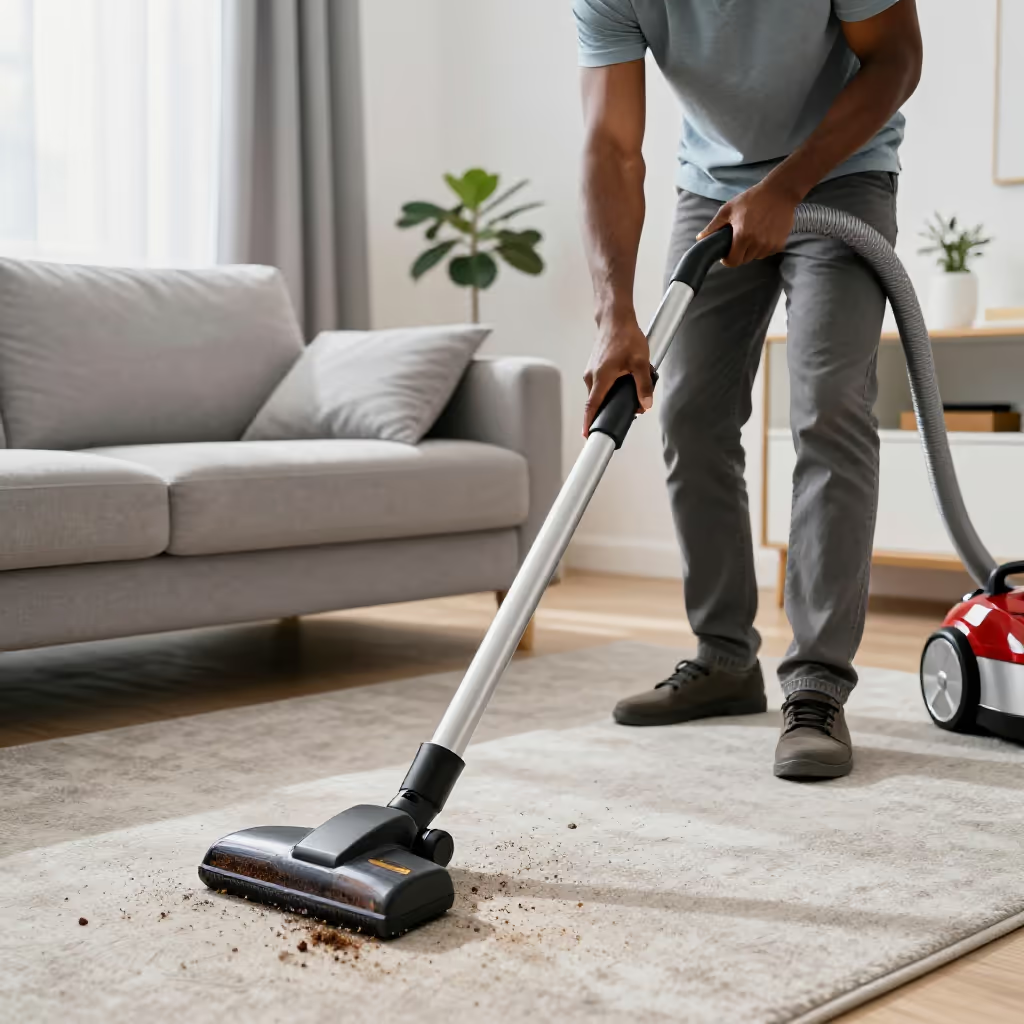
saugen
to vacuum
To remove dust and dirt from a surface with a vacuum cleaner.
EXAMPLE
Ich muss am Wochenende unbedingt die Wohnung saugen.
I really have to vacuum the apartment this weekend.
to vacuum / to suck
Loading your saved state.
to vacuum
To remove dust and dirt from a surface with a vacuum cleaner.
Ich muss am Wochenende unbedingt die Wohnung saugen.
I really have to vacuum the apartment this weekend.

to suck
To draw liquid or air into oneself through a narrow opening, usually the mouth.
Das Baby saugt an der Flasche.
The baby is sucking on the bottle.

to make up
To invent a story, an excuse, or information that is not true.
Diese Erklärung hast du dir doch nur aus den Fingern gesogen, oder?
You just made up that explanation out of thin air, didn't you?
to suction itself
To hold onto a surface through negative pressure.
Der Tintenfisch saugte sich an der Glasscheibe des Aquariums fest.
The octopus suctioned itself firmly to the glass pane of the aquarium.
The verb 'saugen' (to vacuum / to suck) has two past participle forms, and their use depends on the meaning. For vacuuming, the weak form 'gesaugt' is used. In all other meanings, the strong form 'gesogen' is used.
Ich habe gestern die ganze Wohnung gesaugt.
I vacuumed the whole apartment yesterday.
When 'saugen' (to vacuum) is used without an object or only with a location, it almost always means 'Staub saugen' (to vacuum). The word 'Staub' (dust) is often left out in everyday language.
Kannst du bitte im Wohnzimmer saugen?
Could you please vacuum in the living room?
When a person or animal sucks on something, the preposition 'an' is used with the dative. Typical phrases are 'an einem Strohhalm saugen' (to suck on a straw) or 'am Daumen saugen' (to suck one's thumb).
Der Kolibri saugt Nektar an der Blüte.
The hummingbird sucks nectar from the flower.
The idiom 'sich etwas aus den Fingern saugen' (to make something up out of thin air) is fixed. The person who invents something is in the dative ('sich'), and the invented information is in the accusative.
Diese Ausrede hast du dir doch komplett aus den Fingern gesogen.
You completely made up that excuse out of thin air.
In the meaning 'sich festsaugen' (to suction oneself firmly), the verb is used reflexively with the preposition 'an' and a dative or accusative object to name the surface.
Der Oktopus kann sich mit seinen Armen an Felsen saugen.
The octopus can suction itself to rocks with its arms.
to pull / move
When smoking, both words can describe drawing in smoke. „Saugen“ generally refers to drawing air or liquid in through a narrow opening, while „ziehen“ is more idiomatic in the fixed expression „an einer Zigarette ziehen“ (to take a drag on a cigarette). „Ziehen“ is therefore usually used for this action.

Das Kind saugte vorsichtig an der Trinkhalmöffnung, um den Saft zu trinken.
The child carefully sucked on the end of the straw to drink the juice.
Er zog nach dem Essen an seiner Zigarette und blies den Rauch langsam aus.
After dinner, he took a drag on his cigarette and slowly blew out the smoke.