

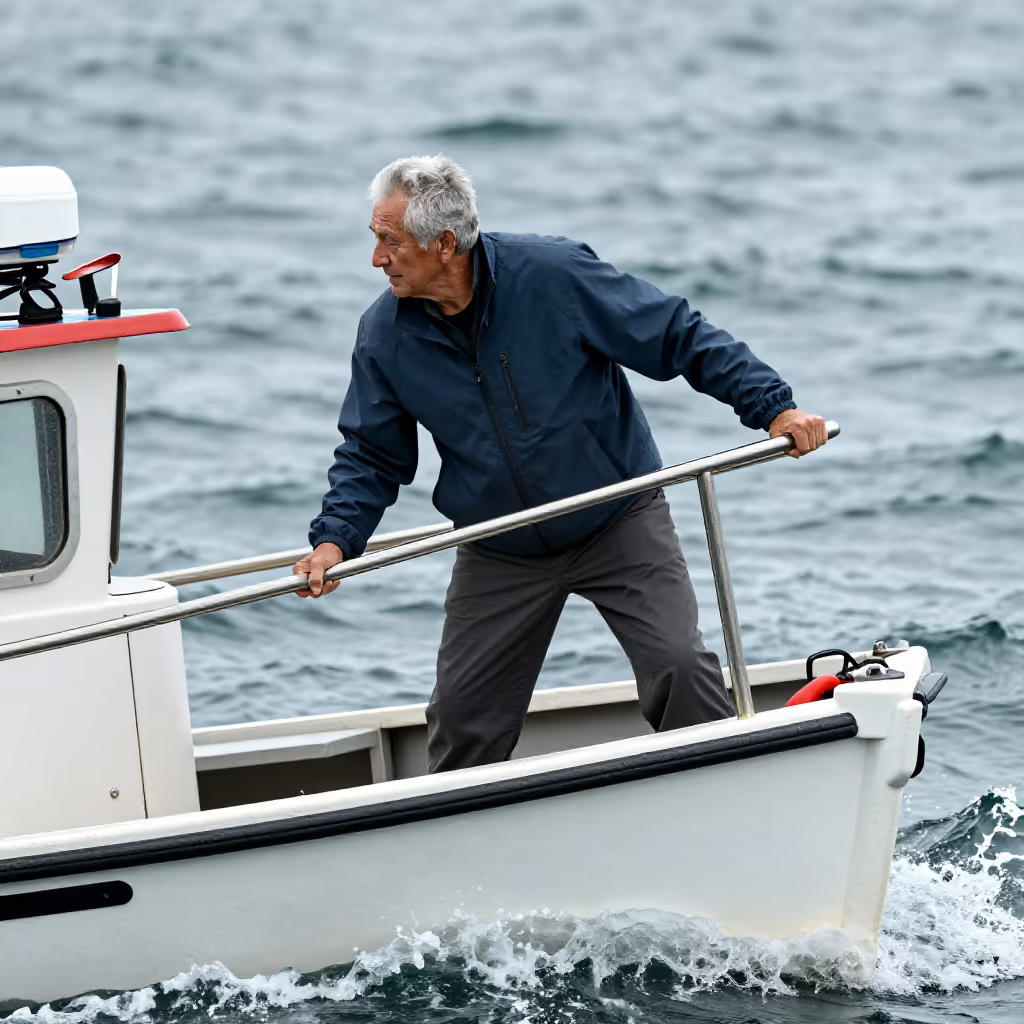
schwanken
to sway
To move back and forth uncertainly or irregularly; to wobble.
EXAMPLE
Die alte Hängebrücke schwankte bedrohlich im Wind.
The old suspension bridge swayed ominously in the wind.
to sway / fluctuate / waver
Loading your saved state.
to sway
To move back and forth uncertainly or irregularly; to wobble.
Die alte Hängebrücke schwankte bedrohlich im Wind.
The old suspension bridge swayed ominously in the wind.

to fluctuate
In reference to values, amounts, or conditions, to be inconsistent and constantly change; to fluctuate.
Die Temperaturen schwanken im April oft zwischen warm und kalt.
Temperatures in April often fluctuate between warm and cold.

to waver
To be undecided; to be torn between different opinions, decisions, or feelings.
Er schwankte lange, ob er das Jobangebot annehmen sollte.
He wavered for a long time over whether he should accept the job offer.

to vary
To be inconsistent in quality or performance, sometimes better and sometimes worse.
Die Leistungen des Sportlers schwankten in dieser Saison stark.
The athlete's performances varied greatly this season.
The core idea of 'schwanken' (to sway/fluctuate/waver) is always some form of instability or irregularity. This idea connects all meanings: a physically swaying bridge, unstable prices, or a person who cannot make a decision.
Das Boot schwankte stark auf den Wellen.
The boat swayed strongly on the waves.
For physical movement, objects such as 'Brücke' (bridge), 'Baum' (tree), or 'Schiff' (ship) are often used as the subject. But it can also be a person, for example someone who is drunk or dizzy.
Der Betrunkene schwankte die Straße entlang.
The drunk man staggered down the street.
When talking about values or amounts that change, the structure 'schwanken zwischen ... und ...' (to fluctuate between ... and ...) is often used to indicate the range of the change.
Die Benzinpreise schwanken täglich zwischen 1,80 € und 1,90 €.
Gas prices fluctuate daily between €1.80 and €1.90.
To express a person's indecision, the patterns 'schwanken zwischen [Option A] und [Option B]' (to waver between [Option A] and [Option B]) or the subordinate-clause construction 'schwanken, ob ...' (to waver over whether ...) are often used.
Sie schwankt noch, ob sie den neuen Job annehmen soll.
She is still wavering over whether she should accept the new job.
In the meaning 'not to be constant', 'schwanken' (to vary) is frequently combined with the nouns 'Leistungen' (performances) or 'Qualität' (quality). The degree of change is often described with an adverb such as 'stark' (greatly/strongly).
Die Qualität der Produkte schwankt leider stark.
Unfortunately, the quality of the products varies greatly.
to doubt
Zweifeln is used when someone is unsure whether a decision is the right one. Schwanken, by contrast, means being torn between several options. If you critically assess a single option, you zweifelst an it; if you cannot decide between options, you schwankst.

Lea schwankt noch zwischen einem Umzug nach Köln und einem Umzug nach Bonn.
Lea is still wavering between moving to Cologne and moving to Bonn.
Lea zweifelt daran, dass der Umzug nach Köln die richtige Entscheidung ist.
Lea doubts that moving to Cologne is the right decision.