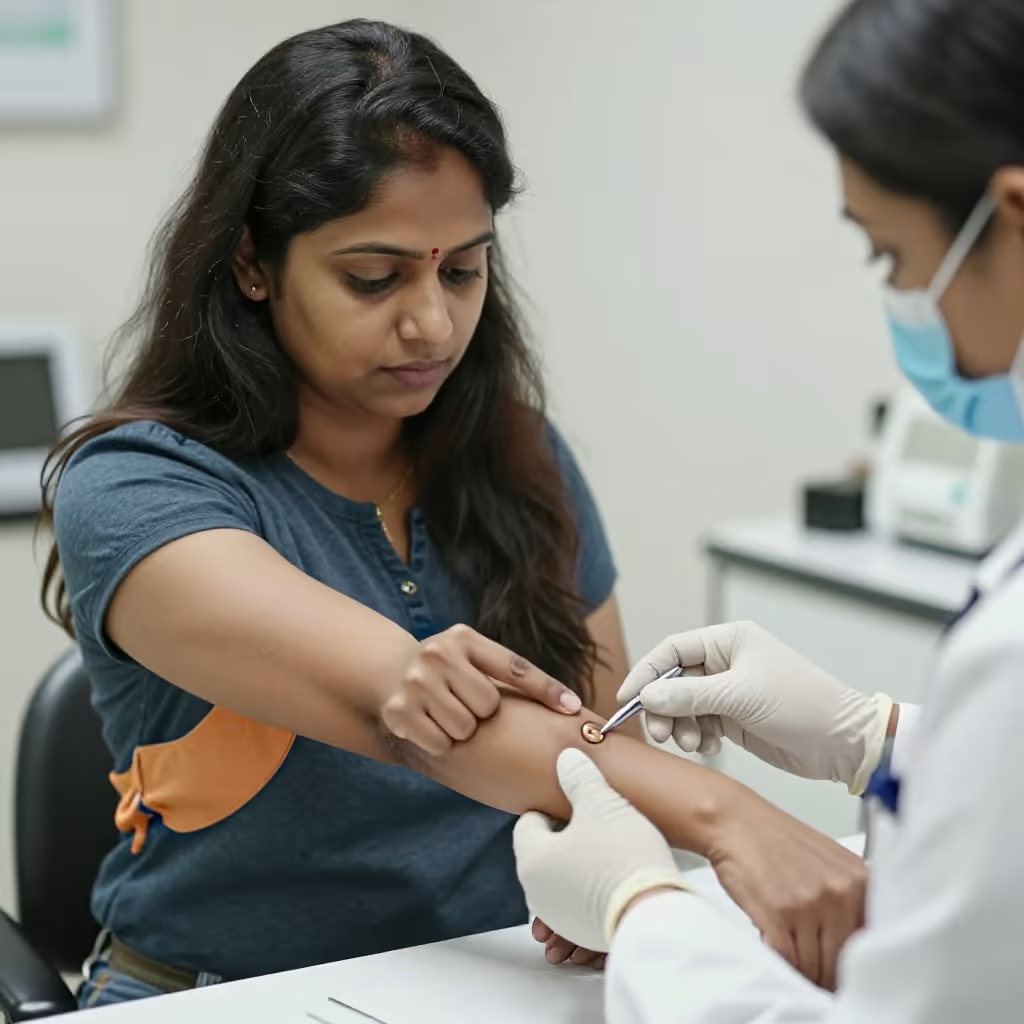
A visible or noticeable enlargement of a body part caused by a buildup of fluid in the tissue, often as a reaction to an injury or inflammation.
example
Nach dem Bienenstich hatte er eine starke Schwellung am Arm.
After the bee sting, he had severe swelling on his arm.

Usage tips
Word structure
'Die Schwellung' (the swelling) is a noun derived from the verb 'schwellen' (to swell). The ending '-ung' turns the verb into a feminine noun that describes the process or result of swelling.
EXAMPLE
Das Bein begann nach der Verletzung sofort zu schwellen.
The leg began to swell immediately after the injury.
Typical collocations
In a medical context, 'Schwellung' (swelling) is often combined with adjectives such as 'stark' (severe), 'leicht' (slight), or 'schmerzhaft' (painful). A typical verb is 'zurückgehen' (to go down) when the swelling subsides.
EXAMPLE
Die Schwellung an seinem Fuß ist über Nacht stark zurückgegangen.
The swelling on his foot went down significantly overnight.
Use with verbs
To express that someone has swelling, the verbs 'haben' (to have) or 'bekommen' (to get) are often used.
EXAMPLE
Nach dem Insektenstich hat sie eine große Schwellung am Hals bekommen.
After the insect bite, she developed a large swelling on her neck.
Context clue
You can recognize the technical meaning from the context. If materials such as 'Holz' (wood), 'Erde' (soil), or 'Ton' (clay) and 'Feuchtigkeit' (moisture) are mentioned, it refers to the increase in volume of the material, not to a physical injury.
EXAMPLE
Durch die hohe Luftfeuchtigkeit kam es zur Schwellung des Parkettbodens.
The high humidity caused the parquet floor to swell.
Compare with
near_synonym · confusable
Schwellung vs Knoten
knot / node
'der Knoten' and 'die Schwellung' can both describe something on the body that you can see or feel. 'die Schwellung' usually means that a body part has become larger, often after an injury or inflammation. It is often soft or tight. 'der Knoten' more often means a small, firm spot in the tissue that you can feel by touch. Learners may confuse the words because both seem like a change in the body. As a practical rule: for a swollen ankle, you would more likely say 'Schwellung'; for a small hard spot under the skin, 'Knoten' is more likely.
Schwellung
Nach dem Sturz ist die Schwellung am Knie schnell größer geworden.
After the fall, the swelling on her knee quickly got bigger.
Knoten
Die Ärztin tastet den kleinen Knoten am Hals vorsichtig ab.
The doctor carefully feels the small lump on his neck.