

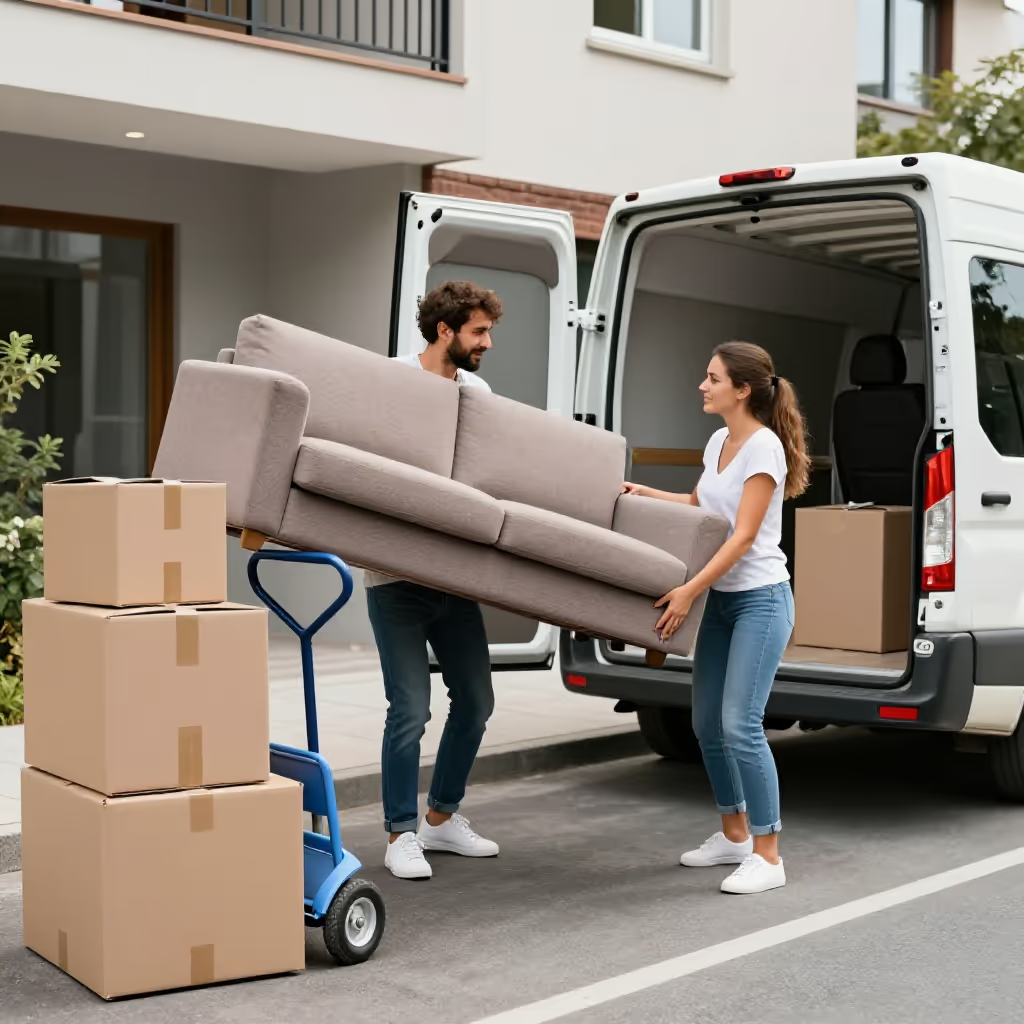
der Umzug
move
The change of residence from one apartment or house to another.
EXAMPLE
Der Umzug in die neue Wohnung war anstrengender als gedacht.
The move into the new apartment was more exhausting than expected.
move / parade
Loading your saved state.
move
The change of residence from one apartment or house to another.
Der Umzug in die neue Wohnung war anstrengender als gedacht.
The move into the new apartment was more exhausting than expected.

parade
A festive or ceremonial procession of people, and often vehicles too, through the streets, usually for a specific occasion such as Carnival or a shooting festival.
Beim Karneval haben wir uns den großen Umzug angesehen.
At Carnival, we watched the big parade.
'Der Umzug' (move/parade) is the nominalization of the separable verb 'umziehen' (to move / to change clothes). It describes the action of the verb as a noun. This helps you connect the two main meanings (moving house and parade) with the respective verbs.
Wir ziehen nächste Woche um, der Umzug wird sicher stressig.
We are moving next week; the move will certainly be stressful.
You can easily recognize the meaning from context. If it is about 'Wohnung' (apartment), 'Möbel' (furniture), or 'Kisten' (boxes), it means moving house. With words like 'Karneval' (Carnival), 'Fest' (festival), or 'Musik' (music), it refers to a parade.
Für den Umzug müssen wir noch viele Kisten packen.
We still have to pack many boxes for the move.
When it is about moving house, typical verbs are 'planen' (to plan), 'organisieren' (to organize), or 'bevorstehen' (to be imminent). A common phrase is also 'beim Umzug helfen' (to help with the move).
Unser Umzug steht kurz bevor.
Our move is coming up very soon.
In the context of a parade, 'Umzug' is often combined with festive occasions, e.g. 'der Karnevalsumzug' (the Carnival parade) or 'der Festumzug' (the festive parade). Typical verbs are 'sich ansehen' (to watch) or 'teilnehmen' (to participate).
Tausende Menschen haben sich den traditionellen Festumzug angesehen.
Thousands of people watched the traditional festive parade.
moving in / entry
Both words refer to moving to a new home. “Der Umzug” means the entire move, often including packing and transportation; “der Einzug” emphasizes moving into and arriving at the new home. Use “Umzug” for the overall process and “Einzug” for the beginning at the new location.

Unser Umzug in die neue Wohnung dauert das ganze Wochenende.
Our move to the new apartment will take the whole weekend.
Unser Einzug in die neue Wohnung ist am Samstag.
We are moving into the new apartment on Saturday.