The place, time, or circumstance where something begins or comes from. It refers to the starting point of a development, object, or event.
example
Der Ursprung des Nils war lange Zeit ein Rätsel.
The origin of the Nile was a mystery for a long time.

Usage tips
Word structure
The word is made up of the prefix 'Ur-' and the noun 'Sprung' (jump). 'Ur-' means 'original' or 'right at the beginning', and 'Sprung' here describes the point from which something proceeds. Literally, it is the 'initial jump'.
EXAMPLE
Die Forscher untersuchen den Ursprung des Universums.
The researchers are investigating the origin of the universe.
Fixed expression
A very common construction is 'seinen Ursprung haben in' (to have one's origin in). It describes where something comes from or where it began. The preposition 'in' requires the dative here.
EXAMPLE
Viele moderne Wörter haben ihren Ursprung im Lateinischen.
Many modern words have their origin in Latin.
Typical collocations
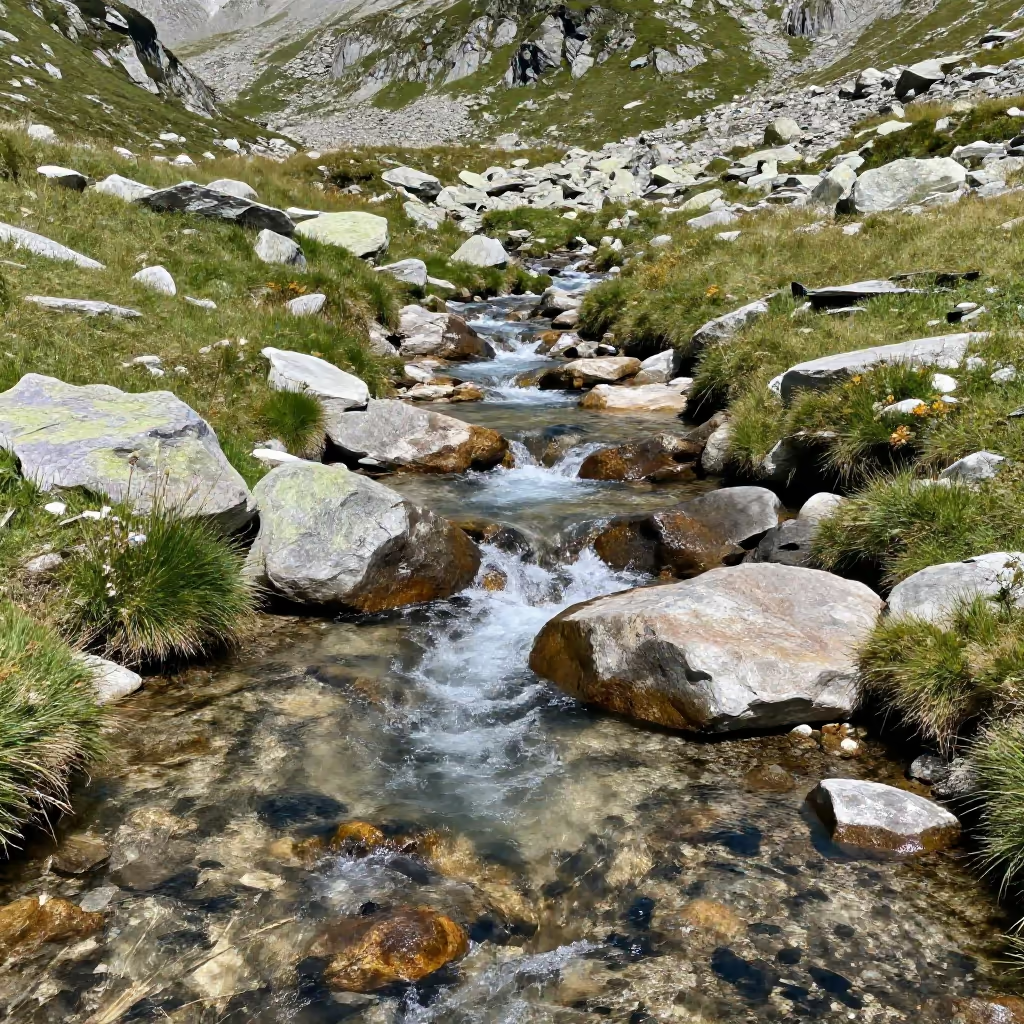
In a geographical or historical context, 'Ursprung' is often connected with concrete things: der Ursprung eines Flusses (the origin of a river), der Ursprung einer Art (the origin of a species), or der Ursprung einer Kultur (the origin of a culture).
EXAMPLE
Der Ursprung dieser Tradition liegt im Mittelalter.
The origin of this tradition lies in the Middle Ages.
Mathematical terminology
In mathematics, 'Ursprung' has a very specific meaning: the point (0,0) in a coordinate system. This usage is limited to mathematical or physical contexts.
EXAMPLE
Die Gerade geht direkt durch den Ursprung des Koordinatensystems.
The line passes directly through the origin of the coordinate system.
Compare with
antonym
Ursprung vs Ende
end
'das Ende' and 'der Ursprung' are often opposites. 'der Ursprung' means the point where something begins or comes from. 'das Ende' means the last part or final point of something. You use 'Ursprung' when asking about the beginning of a development, an idea, or an event. 'Ende' fits when something is finished or does not continue.
Ursprung
Der Ursprung des Problems liegt in einem alten Fehler im Plan.
The origin of the problem lies in an old mistake in the plan.
Ende
Am Ende des Films waren alle im Kino ganz still.
At the end of the film, everyone in the cinema was completely silent.