

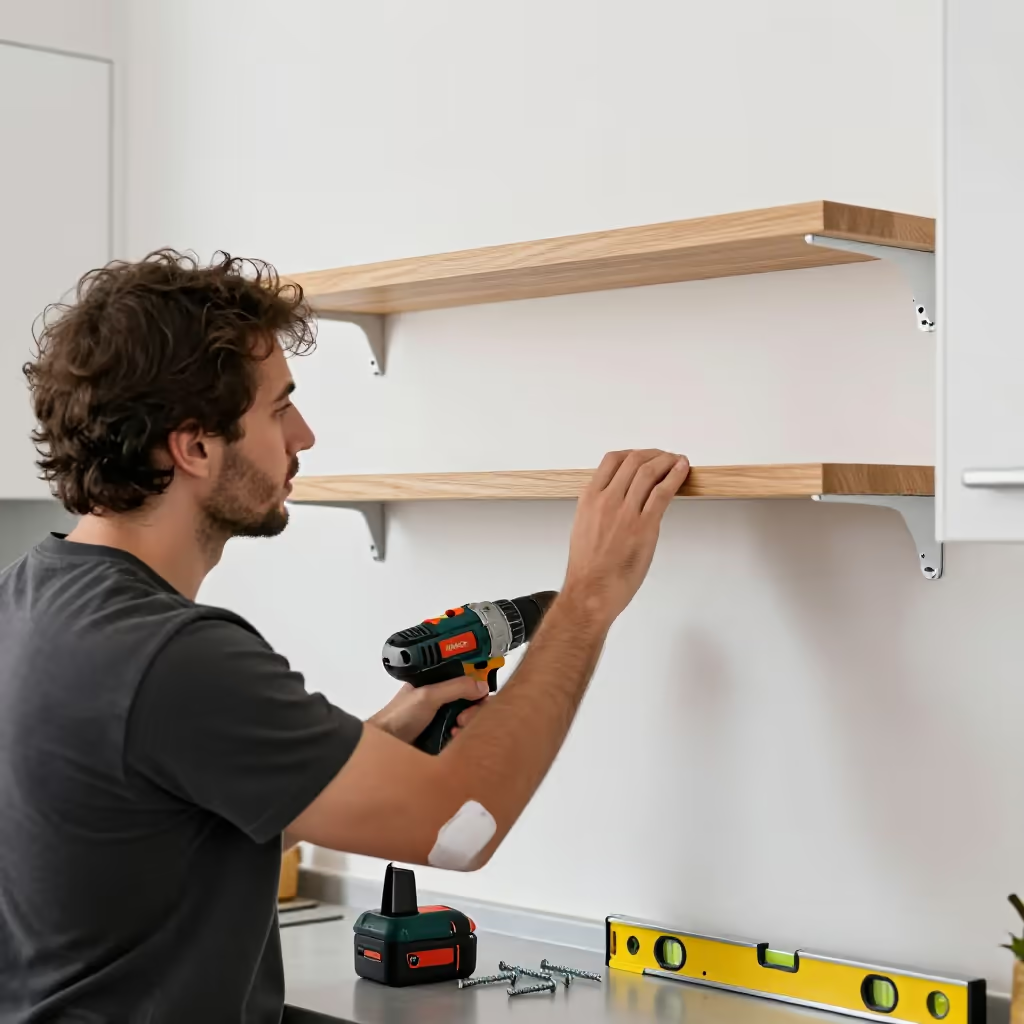
anbringen
to attach
To fasten or mount something on a wall, ceiling, or another object.
EXAMPLE
Wir müssen noch das neue Regal an der Wand anbringen.
We still have to attach the new shelf to the wall.
to attach / bring up
Loading your saved state.
to attach
To fasten or mount something on a wall, ceiling, or another object.
Wir müssen noch das neue Regal an der Wand anbringen.
We still have to attach the new shelf to the wall.

to bring up
To express or put forward a comment, question, or wish at an appropriate moment.
In der Diskussion konnte er seine Kritikpunkte gut anbringen.
In the discussion, he was able to bring up his points of criticism well.

to report
To report someone to an authority or to the police.
Er wurde wegen Diebstahls bei der Polizei angebracht.
He was reported to the police for theft.
'Anbringen' (to attach / bring up) is a separable verb. In a main clause, the prefix 'an-' moves to the end of the sentence. In subordinate clauses or in the infinitive with 'zu', the verb stays together.
Er bringt ein neues Schloss an der Tür an.
He attaches a new lock to the door.
You can recognize the meaning from the object: If it is a physical object (shelf, sign), 'befestigen' (to fasten) is meant. If it is something said (criticism, question), 'äußern' (to express) is meant.
Er hat ein Schild an der Tür angebracht.
He attached a sign to the door.
When fastening something, the preposition 'an' is almost always used. The place where something is attached is in the dative.
Ich möchte diese Lampe an der Decke anbringen.
I would like to attach this lamp to the ceiling.
In the figurative meaning, 'anbringen' (to bring up) is often used with abstract nouns of communication. Typical examples are: 'eine Bemerkung anbringen' (to make a comment), 'einen Vorschlag anbringen' (to make a suggestion), or 'Kritik anbringen' (to voice criticism).
Während der Sitzung konnte er seine Bedenken anbringen.
During the meeting, he was able to bring up his concerns.
to put / to set
Stellen and anbringen can both be used to express asking a question in a conversation. Eine Frage stellen is the neutral, established expression in standard German; anbringen emphasizes that the question is introduced appropriately into the situation. Use stellen for a normal question, and anbringen also when the conversational moment has been deliberately chosen.

Nach dem Vortrag brachte ich der Expertin noch eine wichtige Frage an.
After the lecture, I brought up one more important question with the expert.
Nach dem Vortrag stellte ich der Expertin eine Frage.
After the lecture, I asked the expert a question.