

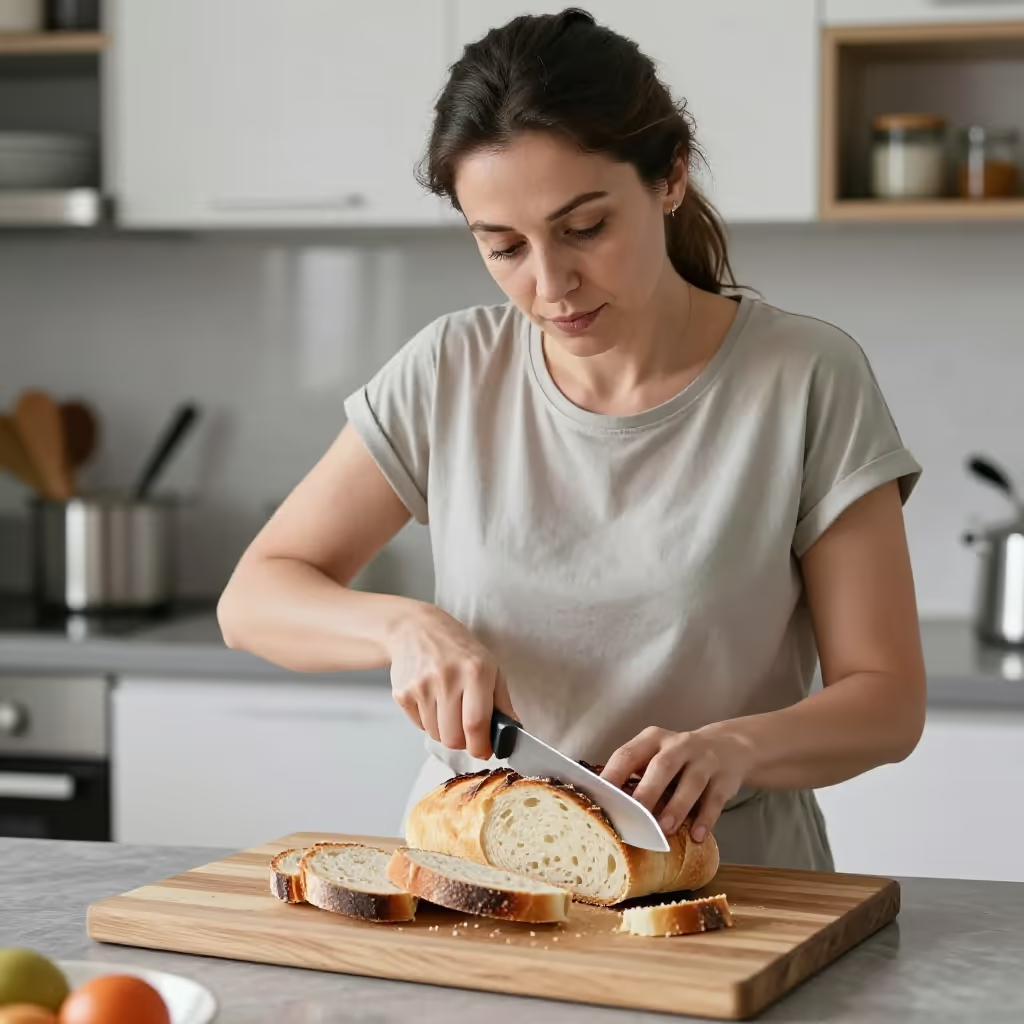
aufschneiden
to cut open
To open something with a knife or scissors, or to cut it into slices.
EXAMPLE
Könntest du bitte den Kuchen aufschneiden?
Could you please cut the cake?
to cut open / to brag
Loading your saved state.
to cut open
To open something with a knife or scissors, or to cut it into slices.
Könntest du bitte den Kuchen aufschneiden?
Could you please cut the cake?

to brag
Colloquial for boasting or showing off; telling exaggerated or untrue stories about oneself.
Hör auf so aufzuschneiden, das glaubt dir doch niemand!
Stop bragging like that—nobody believes you anyway!

to cut open
In a medical context, to surgically open a body or body part.
Der Chirurg musste die Bauchdecke aufschneiden, um den Blinddarm zu entfernen.
The surgeon had to cut open the abdominal wall to remove the appendix.
'Aufschneiden' (to cut open / to brag) is a separable verb. The prefix 'auf-' comes at the end in a main clause. In subordinate clauses or in the infinitive with 'zu', the verb stays together.
Ich schneide schnell den Apfel auf.
I'll quickly cut open the apple.
In the literal meaning, 'aufschneiden' (to cut open/cut) is often used for food. Typical objects are 'Brot' (bread), 'einen Kuchen' (a cake), 'eine Melone' (a melon), or 'einen Braten' (a roast).
Wer möchte das erste Stück vom Geburtstagskuchen aufschneiden?
Who would like to cut the first piece of the birthday cake?
In the meaning 'prahlen' (to brag), 'aufschneiden' (to brag) is colloquial. In this case, it can also be used without an object.
Er schneidet gerne mit seinem neuen Auto auf.
He likes to show off with his new car.
to open
Both words can refer to opening a letter or package. „öffnen“ leaves the method open, while „aufschneiden“ explicitly indicates that a knife or scissors are used. Use „öffnen“ for a generally described process and „aufschneiden“ when the cutting is essential.
Ich schneide den Briefumschlag mit der Schere auf.
I cut open the envelope with scissors.
Ich öffne den Brief vorsichtig, damit das Papier nicht reißt.
I open the letter carefully so that the paper does not tear.