

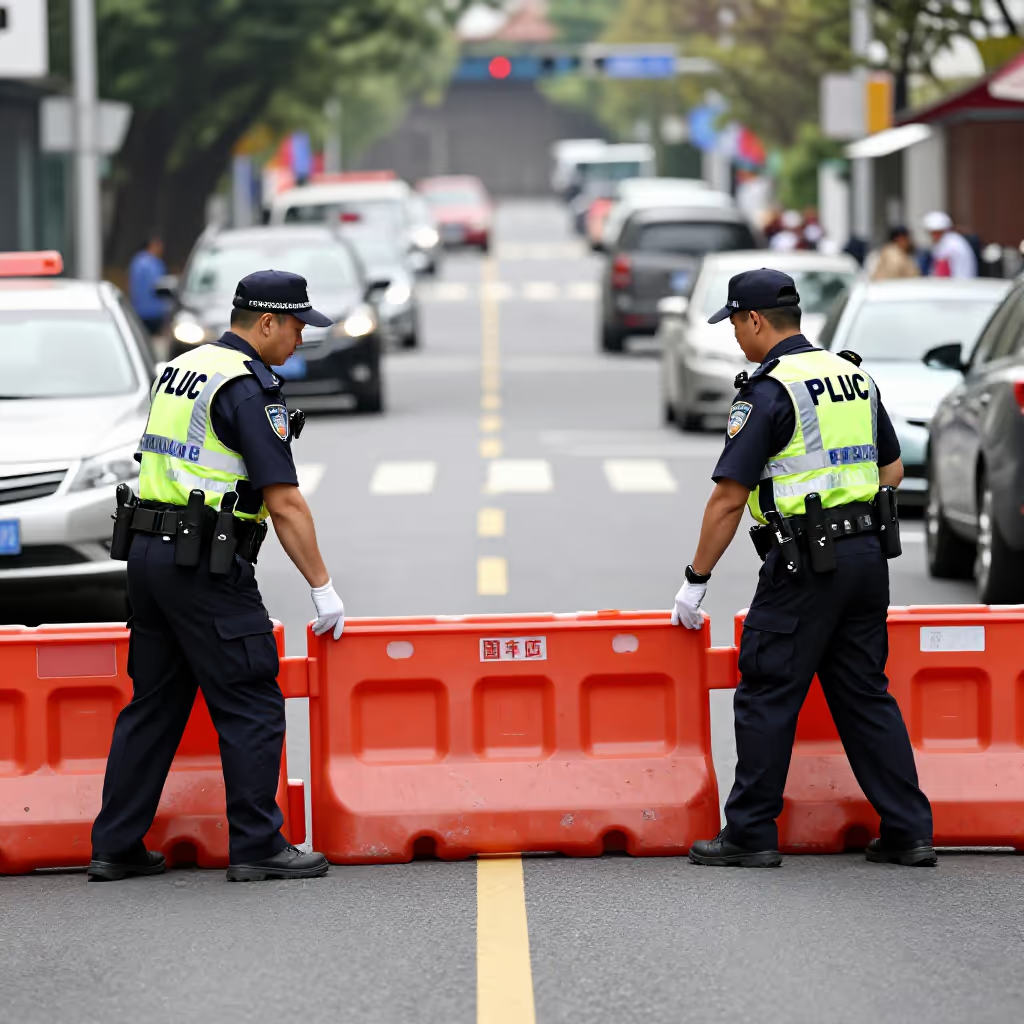
sperren
to block
To block a path, road, or access point so that people can no longer pass through.
EXAMPLE
Wegen des Marathons wird die Innenstadt für den Verkehr gesperrt.
Because of the marathon, the city center will be closed to traffic.
to block / to ban
Loading your saved state.
to block
To block a path, road, or access point so that people can no longer pass through.
Wegen des Marathons wird die Innenstadt für den Verkehr gesperrt.
Because of the marathon, the city center will be closed to traffic.

to block
To block access to something (e.g., an account, a card, a phone) so that it can no longer be used.
Nachdem ich meine Bankkarte verloren hatte, ließ ich sie sofort sperren.
After I lost my bank card, I had it blocked immediately.

to suspend / ban
To forbid a person from taking part in something (e.g., a competition) or from entering a place, often as a punishment.
Der Fußballspieler wurde nach der roten Karte für drei Spiele gesperrt.
The soccer player was suspended for three games after the red card.

to resist
To refuse or resist doing or accepting something.
Das Kind sperrte sich dagegen, sein Zimmer aufzuräumen.
The child resisted tidying up their room.

to open wide
To open one's mouth or eyes wide, often out of amazement or shock.
Die Kinder sperrten die Augen auf, als sie die vielen Geschenke sahen.
The children opened their eyes wide when they saw all the presents.
The meaning of 'sperren' (to block / to ban) depends strongly on the object. You can block physical routes (a road), digital access (a card), or also suspend people (a player).
Die Polizei sperrt die Unfallstelle für den Verkehr.
The police are closing the accident site to traffic.
In the meanings 'to block' and 'to forbid', 'sperren' (to block / to ban) is very often used in the passive. This emphasizes what is being blocked or closed, not who is blocking it.
Die Brücke ist wegen Bauarbeiten gesperrt.
The bridge is closed because of construction work.
This meaning is very common in the context of finance and technology. You typically block a 'Bankkarte' (bank card), a 'Handy' (mobile phone), or an 'Online-Konto' (online account) in order to prevent misuse.
Wenn du dein Handy verlierst, solltest du sofort die SIM-Karte sperren lassen.
If you lose your phone, you should have the SIM card blocked immediately.
When a person is 'gesperrt' (suspended/banned), it is often a punishment, especially in sports or on online platforms. The length of the suspension is often given with the preposition 'für' (for).
Der Torwart wurde nach der roten Karte für das nächste Spiel gesperrt.
The goalkeeper was suspended for the next game after the red card.
In the reflexive form 'sich sperren' (to resist), the verb takes the preposition 'gegen' followed by the accusative. It expresses strong resistance or refusal.
Sie sperrte sich lange gegen die neuen Arbeitszeiten.
She resisted the new working hours for a long time.
In the fixed expression 'die Augen/den Mund aufsperren' (to open one's eyes/mouth wide), the separable prefix 'auf-' is added. This means to open them wide, often out of surprise or amazement.
Als er das riesige Geschenk sah, sperrte er die Augen weit auf.
When he saw the huge present, he opened his eyes wide.
to forbid
Verbieten means generally that an action or participation is not allowed. Sperren, when used for people, typically refers to a specific exclusion measure, often as a punishment and for a set period. That is why sperren is especially appropriate for a time-limited ban from a competition.

Der Verband sperrt den Spieler wegen des Fouls für drei Spiele.
The association suspends the player for three games because of the foul.
Der Verband verbietet dem Spieler die Teilnahme an diesem Wettbewerb.
The association forbids the player from taking part in this competition.