

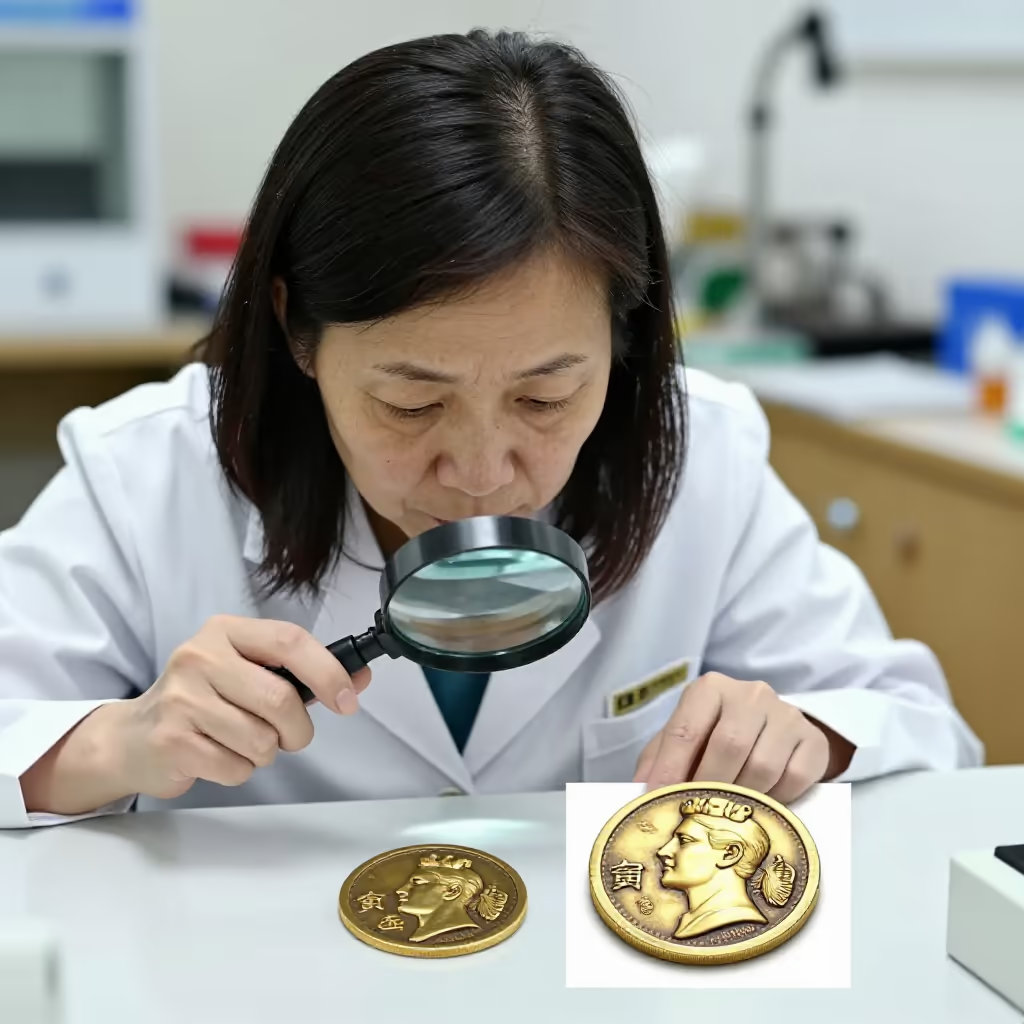
echt
real
Authentic, original, and not fake or imitation.
EXAMPLE
Diese Handtasche ist aus echtem Leder.
This handbag is made of real leather.
real / really
Loading your saved state.
real
Authentic, original, and not fake or imitation.
Diese Handtasche ist aus echtem Leder.
This handbag is made of real leather.

really
Used colloquially as an adverb for emphasis and means 'wirklich' (really) or 'sehr' (very).
Der Film war echt spannend!
The film was really exciting!

genuine
Describes feelings, intentions, or people as sincere and unaffected.
Seine Freude über das Geschenk war echt.
His joy about the gift was genuine.
'Echt' can stand before a noun as an adjective and is then declined. But it can also stand as an unchanging adverb for emphasis before an adjective or verb.
Das ist ein echtes Problem.
That is a real problem.
In the meaning 'authentisch' (authentic), 'echt' is often used to describe materials. Common combinations are 'echtes Gold' (real gold), 'echtes Leder' (real leather), or 'echte Perlen' (real pearls).
Er trägt einen Ring aus echtem Gold.
He is wearing a ring made of real gold.
The use of 'echt' as an adverb for emphasis (in the sense of 'wirklich' (really) or 'sehr' (very)) is typical of colloquial speech. It should be avoided in formal or written contexts.
Ich bin echt müde heute.
I'm really tired today.
To express sincerity, 'echt' is often combined with feelings or social relationships. Typical examples are 'echte Freude' (genuine joy), 'echtes Interesse' (genuine interest), or 'ein echter Freund' (a true friend).
Sie ist eine echte Freundin, auf die ich mich immer verlassen kann.
She is a true friend whom I can always rely on.
very
Before an adjective, sehr and echt can express a high degree. Sehr is neutral and is also suitable for factual statements. As an intensifier, echt sounds colloquial and often more emotional, which is why it is especially appropriate in casual conversations.

Im Gespräch mit Freunden nennt Paul den Film echt spannend.
When talking with friends, Paul calls the film really exciting.
In seiner schriftlichen Bewertung nennt Paul den Film sehr spannend.
In his written review, Paul calls the film very exciting.