


halten
to hold
To grasp something with your hands or arms and not let go.
EXAMPLE
Kannst du bitte kurz meine Tasche halten?
Can you please hold my bag for a moment?
to hold
Loading your saved state.
to hold
To grasp something with your hands or arms and not let go.
Kannst du bitte kurz meine Tasche halten?
Can you please hold my bag for a moment?

to stop
To stop while moving; to come to a halt. Usually used for vehicles.
Der Bus hält direkt vor dem Museum.
The bus stops directly in front of the museum.

to consider
To have an opinion or assessment about someone or something.
Ich halte das für eine ausgezeichnete Idee.
I consider that an excellent idea.

to think of
To have a particular opinion about someone or something. Often used as a question.
Was hältst du von dem neuen Kollegen?
What do you think of the new colleague?

to give a speech
To give a lecture or address in front of an audience.
Der Geschäftsführer wird auf der Weihnachtsfeier eine Rede halten.
The managing director will give a speech at the Christmas party.

to keep
To preserve or maintain a particular state.
Bitte versuche, die Wohnung ordentlich zu halten.
Please try to keep the apartment tidy.

to stick to
To follow and comply with rules, agreements, or requirements.
Alle Teilnehmer müssen sich an die Spielregeln halten.
All participants must stick to the rules of the game.
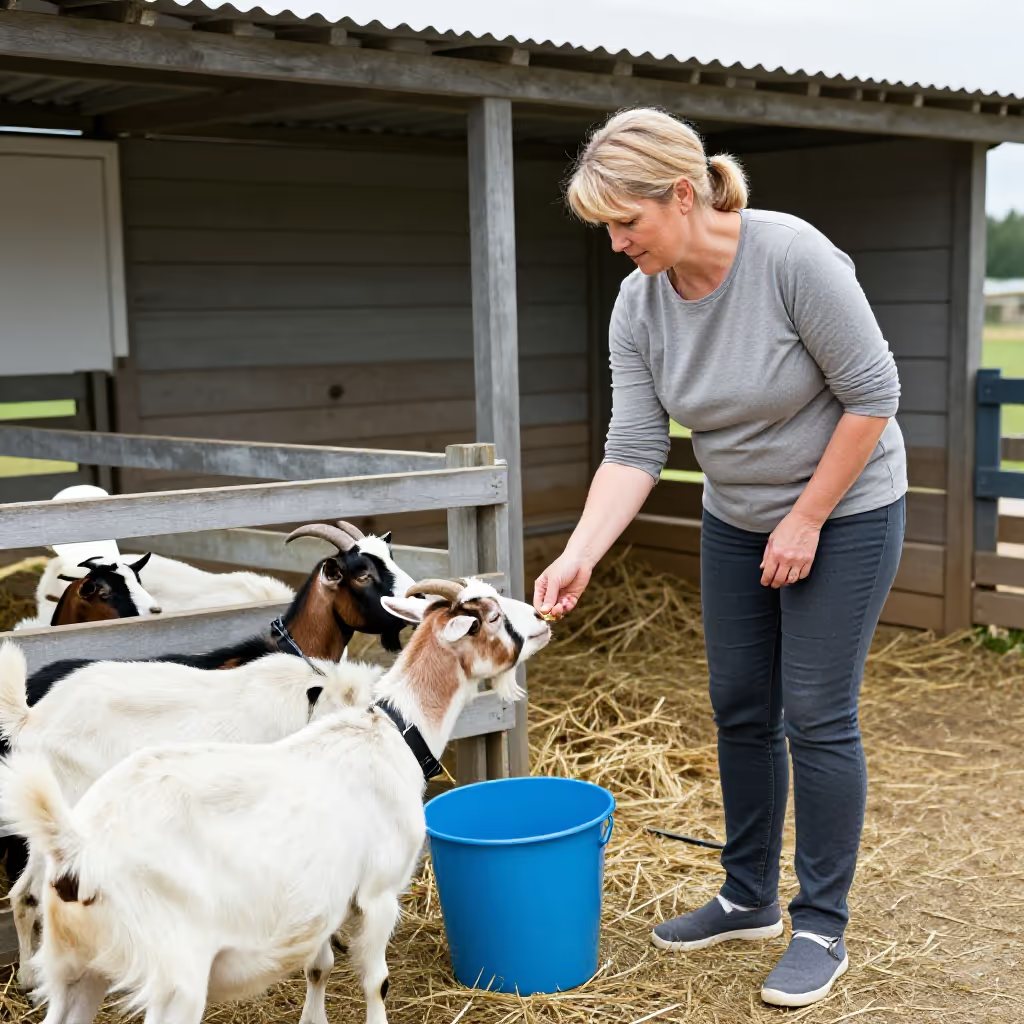
to keep
To own and care for animals.
Unsere Nachbarn halten sich drei Katzen.
Our neighbors keep three cats.

to keep
To remain edible or usable; not to spoil. Usually used for food.
Die frische Milch hält sich im Kühlschrank nur wenige Tage.
Fresh milk only keeps for a few days in the refrigerator.

to hold
To withstand strain; not to break or give way.
Das Seil ist alt, ich weiß nicht, ob es mein Gewicht hält.
The rope is old; I don't know whether it will hold my weight.
'Halten' is a strong verb with a vowel change in the present tense. In the 2nd and 3rd person singular, the 'a' changes to 'ä' (du hältst, er/sie/es hält). This is a common source of mistakes.
Er hält sein Versprechen immer.
He always keeps his promise.
'Halten' is the base verb for many important verbs with prefixes, such as 'anhalten' (to stop), 'behalten' (to keep / not give away), 'erhalten' (to receive), or 'sich unterhalten' (to talk / converse). The basic meaning of 'halten' often helps you understand these words.
Können wir kurz anhalten? Ich möchte ein Foto machen.
Can we stop for a moment? I'd like to take a photo.
In the meaning 'stoppen' (to stop), 'halten' is used almost exclusively for public transportation such as buses, trains, or trams. It describes a scheduled stop.
Entschuldigung, hält dieser Zug auch in Neustadt?
Excuse me, does this train also stop in Neustadt?
The phrase 'jemanden/etwas für etwas halten' (to consider someone/something to be something) expresses an opinion or assessment. The structure is fixed: verb + accusative object + 'für' + adjective or noun in the accusative.
Ich halte ihn für einen sehr kompetenten Arzt.
I consider him a very competent doctor.
The phrase 'etwas von jemandem/etwas halten' (to think something of someone/something) is used to ask for an opinion or express a general opinion. It is formed with the preposition 'von' and the dative.
Ich halte nicht viel von seinen Plänen.
I don't think much of his plans.
'Halten' forms fixed noun-verb combinations. The best-known is 'eine Rede halten' (to give a speech). Others are 'einen Vortrag halten' (to give a talk/lecture), 'eine Präsentation halten' (to give a presentation), or 'eine Vorlesung halten' (to give a lecture).
Nächste Woche muss ich vor der ganzen Abteilung einen Vortrag halten.
Next week I have to give a talk in front of the whole department.
The phrase 'sich an etwas halten' (to stick to something) is reflexive and always uses the preposition 'an' with the accusative. It means that you follow rules, laws, or agreements.
Du musst dich an die Verkehrsregeln halten.
You have to stick to the traffic rules.
When you own and care for animals, you can say 'Tiere halten' (to keep animals) or 'sich Tiere halten' (to keep animals for oneself). The reflexive variant emphasizes that you have the animals for yourself.
Meine Großeltern halten auf dem Bauernhof Hühner und Schafe.
My grandparents keep chickens and sheep on the farm.
In the meaning 'haltbar sein' (to keep / remain usable), 'halten' is always used reflexively: 'sich halten'. The subject of the sentence is the food or product.
Wie lange hält sich der Joghurt nach dem Öffnen?
How long does the yogurt keep after opening?
This meaning describes whether something withstands physical or even emotional strain. The subject is the thing that has to withstand the strain.
Ich hoffe, der alte Stuhl hält mein Gewicht.
I hope the old chair holds my weight.
to have
With animals, haben can generally express ownership or belonging. Halten more specifically means that someone keeps the animals permanently and looks after them. If only ownership matters, haben is appropriate; if responsible animal care is emphasized, halten is a better choice.

Lea hält zwei Kaninchen und versorgt sie täglich.
Lea keeps two rabbits and looks after them every day.
Lea hat zwei Kaninchen.
Lea has two rabbits.