


gerade
right now
As an adverb: expresses that something is happening at exactly this moment; right now.
EXAMPLE
Kann ich dich später zurückrufen? Ich esse gerade.
Can I call you back later? I'm eating right now.
right now / straight
Loading your saved state.
right now
As an adverb: expresses that something is happening at exactly this moment; right now.
Kann ich dich später zurückrufen? Ich esse gerade.
Can I call you back later? I'm eating right now.
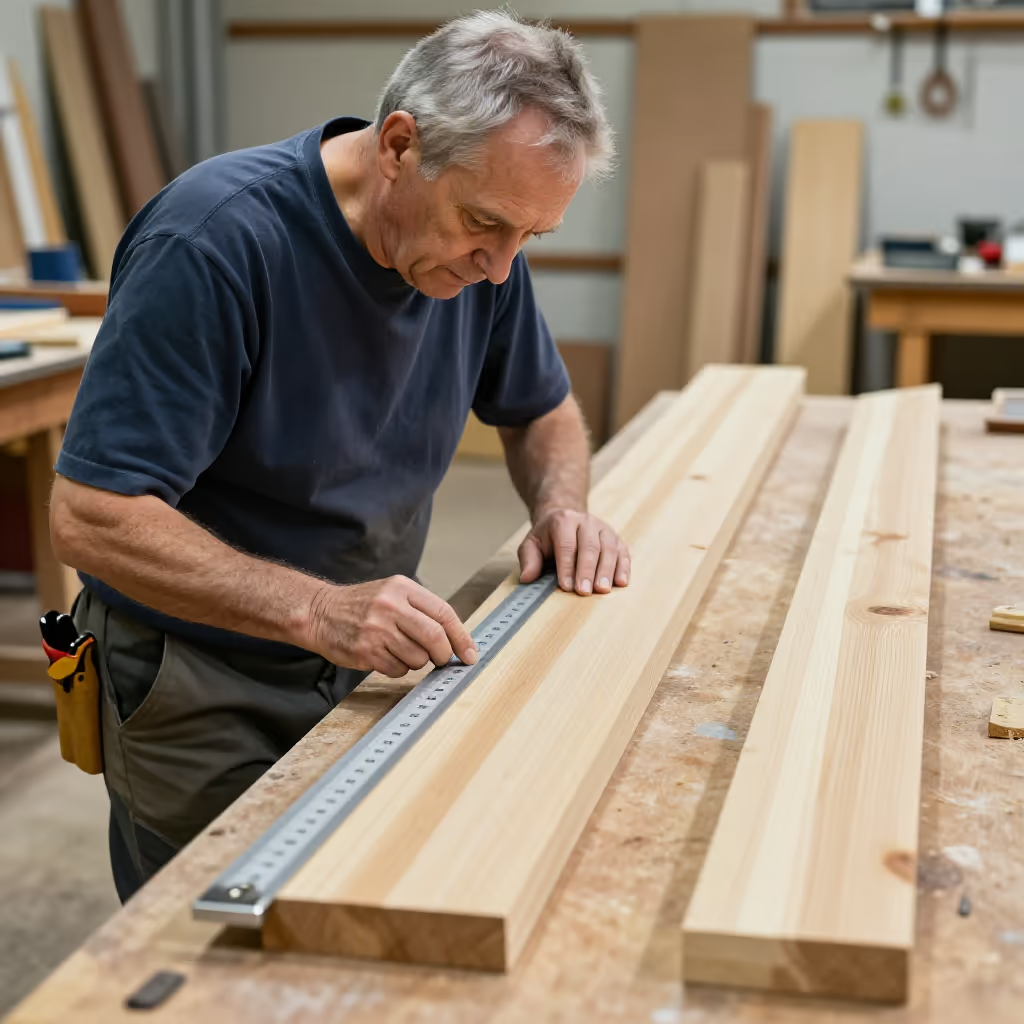
straight
As an adjective: describes something that is not bent or curved; linear and direct.
Mit dem Lineal kannst du eine perfekt gerade Linie ziehen.
With the ruler, you can draw a perfectly straight line.

of all times
As an adverb: used for emphasis and means 'ausgerechnet' (of all times / of all things) or 'besonders' (especially).
Warum muss das gerade heute passieren?
Why does this have to happen today of all days?

even
As an adjective: refers to a number that is divisible by two with no remainder.
Acht ist eine gerade Zahl, sieben ist eine ungerade Zahl.
Eight is an even number; seven is an odd number.

just barely
A fixed expression meaning that something succeeded only by a narrow margin or at the last moment.
Wir sind gerannt und haben den Zug gerade noch erwischt.
We ran and just barely caught the train.
The function of 'gerade' depends on the context. When it describes a noun, it is an adjective, e.g. 'eine gerade Linie' (a straight line). When it describes an action or situation, it is an adverb with various meanings, e.g. 'ich lerne gerade' (I am studying right now).
Der Zaun steht nicht ganz gerade.
The fence is not standing completely straight.
In the meaning 'jetzt in diesem Moment' (right now at this moment), 'gerade' is a temporal adverb. In a main clause, it normally comes directly after the conjugated verb and the subject.
Sie telefoniert gerade mit ihrer Mutter.
She is talking on the phone with her mother right now.
When 'gerade' means 'linear' or 'nicht gebogen' (not bent), it is used like a normal adjective. It is declined when it comes before a noun and remains unchanged when used with verbs like 'sein' (to be).
Er hat einen sehr geraden Rücken.
He has a very straight back.
The meaning 'ausgerechnet' (of all times / of all things) often becomes clear through a tone of surprise, annoyance, or irony. In a sentence, it frequently appears in questions or emotional statements.
Warum musst du gerade jetzt stören?
Why do you have to interrupt right now of all times?
The meaning 'durch zwei teilbar' (divisible by two) is limited exclusively to the context of numbers and mathematics. The opposite is 'ungerade' (odd).
Alle Zahlen, die auf 0, 2, 4, 6 oder 8 enden, sind gerade Zahlen.
All numbers that end in 0, 2, 4, 6, or 8 are even numbers.
The meaning 'knapp' (barely) or 'im letzten Moment' (at the last moment) is almost always expressed through the fixed combinations 'gerade noch' (just barely / just in time) or 'gerade so' (just about / just barely).
Puh, wir haben es gerade noch geschafft!
Phew, we just barely made it!
now
Jetzt and gerade can both place an action in the present. Jetzt highlights the current point in time in contrast to another time, while gerade emphasizes that the action is in progress at this very moment. Use gerade for an ongoing activity and jetzt when making a comparison with another time.

Lea liest gerade den Bericht und kann deshalb nicht telefonieren.
Lea is reading the report right now, so she can't make a phone call.
Jetzt liest Lea den Bericht und nicht erst morgen.
Lea is reading the report now, not tomorrow.