


hochfahren
to boot up
To start a computer, machine, or technical system and make it ready for operation.
EXAMPLE
Warte kurz, ich muss nur schnell meinen Laptop hochfahren.
Wait a second, I just need to quickly boot up my laptop.
to boot up / ramp up / drive up
Loading your saved state.
to boot up
To start a computer, machine, or technical system and make it ready for operation.
Warte kurz, ich muss nur schnell meinen Laptop hochfahren.
Wait a second, I just need to quickly boot up my laptop.

to ramp up
To gradually increase the output or production of something, for example in a factory or power plant.
Nach der Wartung wird das Kraftwerk die Leistung langsam wieder hochfahren.
After the maintenance, the power plant will slowly ramp up output again.
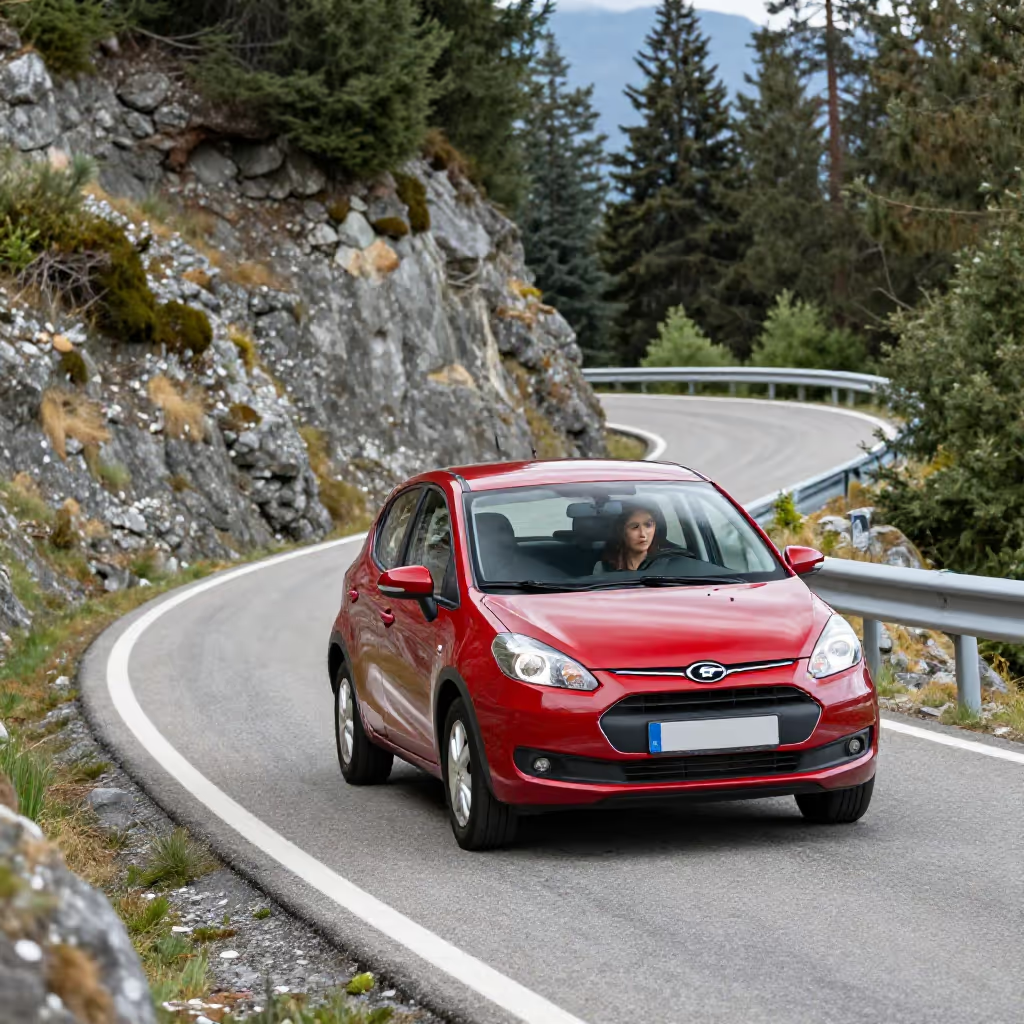
to drive up
To drive up an incline, mountain, or hill in a vehicle.
Wir sind die Serpentinenstraße bis zum Gipfel hochgefahren.
We drove up the winding road all the way to the summit.

to start up
To suddenly startle or react in an angry and hot-tempered way.
Als sie ihn der Lüge bezichtigte, ist er wütend hochgefahren.
When she accused him of lying, he started up angrily.
'Hochfahren' is a separable verb. The prefix 'hoch' comes at the end in main clauses. In subordinate clauses or in the infinitive with 'zu', the verb stays together.
Ich fahre schnell den Computer hoch.
I’m quickly booting up the computer.
Pay attention to the correct auxiliary verb in the perfect tense! For starting technology, e.g. a computer, and increasing production, 'haben' is used. For movement, e.g. driving up a mountain, and sudden reactions, e.g. startling, 'sein' is used.
Ich habe meinen Laptop noch nicht hochgefahren.
I haven’t booted up my laptop yet.
The object or context makes the meaning clear. 'Computer' or 'System' points to technology. 'Produktion' (production) or 'Leistung' (output/performance) points to business or industry. A place like 'Berg' (mountain) or 'Straße' (road) points to literal driving. An emotional reaction without an object points to startling or flaring up.
Können Sie die Produktion wieder hochfahren?
Can you ramp up production again?
In a technical context, 'hochfahren' (to boot up) is almost always used with devices such as 'den Computer' (the computer), 'den Laptop' (the laptop), 'den Rechner' (the computer), or 'das System' (the system).
Bevor wir anfangen können, muss ich erst das System hochfahren.
Before we can begin, I first have to boot up the system.
In the meaning 'aufschrecken' (to startle/start up) or 'aufbrausen' (to flare up), 'hochfahren' is always used without an accusative object. It describes a reaction of the person who is the subject of the sentence.
Als er die Kritik hörte, ist er sofort wütend hochgefahren.
When he heard the criticism, he immediately started up angrily.
to increase
For the output or production of a technical system, erhöhen and hochfahren can both work. Erhöhen refers only to the higher value, while hochfahren also emphasizes the gradual transition to that value. Use erhöhen for the result and hochfahren when the process of getting there is important.

Das Kraftwerk soll seine Leistung am Morgen schrittweise auf 500 Megawatt hochfahren.
The power plant is supposed to gradually ramp up its output to 500 megawatts in the morning.
Das Kraftwerk soll seine Leistung auf 500 Megawatt erhöhen.
The power plant is supposed to increase its output to 500 megawatts.