


knacken
to crack
To make a short, hard sound that occurs when something breaks, tears, or suddenly moves.
EXAMPLE
Die alten Holzdielen knacken bei jedem Schritt.
The old wooden floorboards crack with every step.
to crack
Loading your saved state.
to crack
To make a short, hard sound that occurs when something breaks, tears, or suddenly moves.
Die alten Holzdielen knacken bei jedem Schritt.
The old wooden floorboards crack with every step.
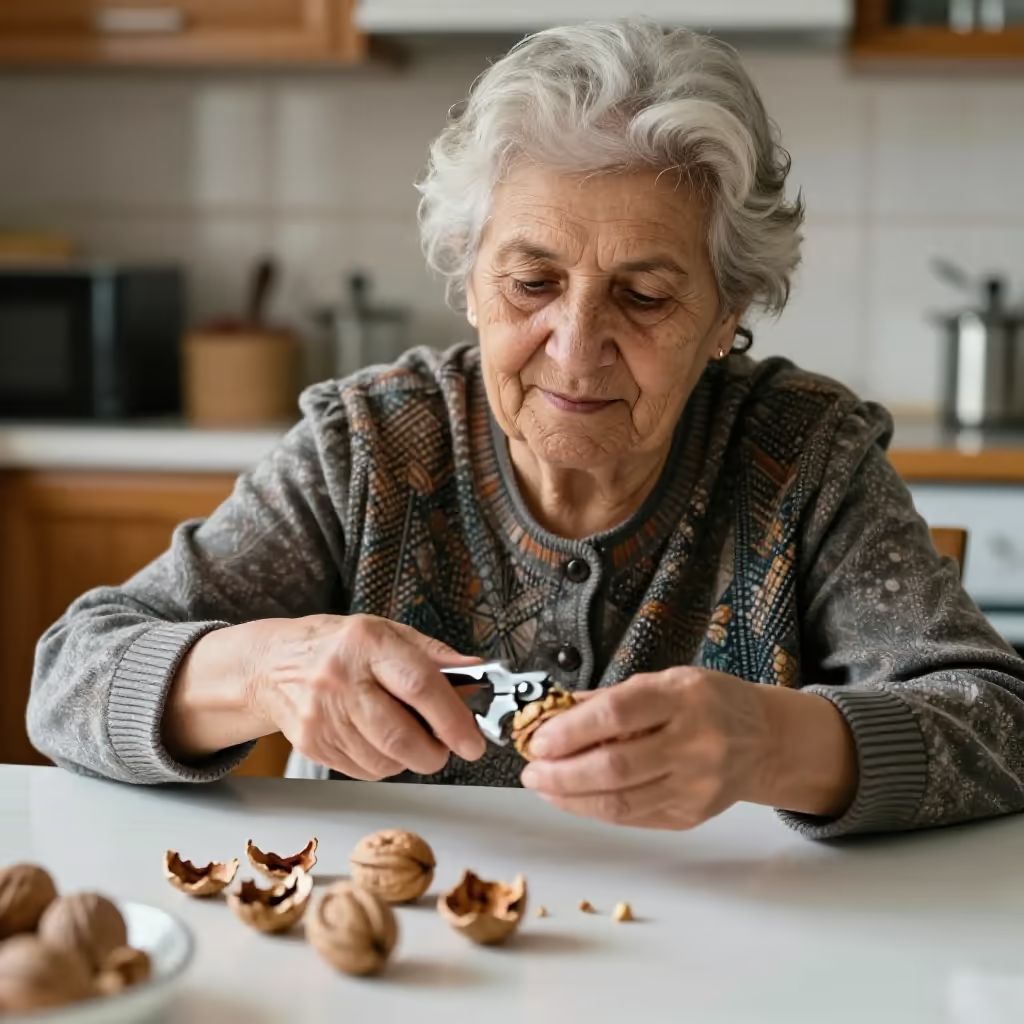
to crack open
To open something with a hard shell, such as a nut or a safe, by force or with skill.
Kannst du mir helfen, diese Walnuss zu knacken?
Can you help me crack open this walnut?

to crack
Colloquial for solving a difficult problem, deciphering a code, or overcoming an obstacle.
Die Ermittler haben den Geheimcode der Spione endlich geknackt.
The investigators finally cracked the spies' secret code.

to break
Colloquial for reaching or exceeding a certain mark, record, or numerical threshold.
Der YouTube-Kanal wird bald die Marke von einer Million Abonnenten knacken.
The YouTube channel will soon break the one-million-subscriber mark.

to crack
Refers to joints that make a cracking sound when moved.
Er lässt zur Entspannung oft seine Fingerknöchel knacken.
He often cracks his knuckles to relax.
'Knacken' (to crack) can be used with or without an object, which changes the meaning. Without an object, it means to make a sound ('Das Eis knackt' — The ice cracks). With an accusative object, it means to open or solve something ('eine Nuss knacken' — to crack a nut).
Im Winter knackt das Holz im warmen Zimmer.
In winter, the wood cracks in the warm room.
When 'knacken' (to crack) has an object, that object reveals the exact meaning. A 'Nuss' (nut) is literally opened, a 'Code' (code) is deciphered, and a 'Rekord' (record) is surpassed.
Hast du den Code für das WLAN geknackt?
Did you crack the Wi-Fi code?
In its literal meaning, 'knacken' (to crack open) is often combined with things that have a hard shell or a locking mechanism. Typical examples are: 'eine Nuss knacken' (to crack a nut), 'einen Safe knacken' (to crack a safe), 'ein Schloss knacken' (to pick/crack a lock).
Mit diesem Nussknacker kann man jede Nuss knacken.
With this nutcracker you can crack any nut.
The idea of opening is often used metaphorically for solving difficult, abstract problems. For example, you can say 'ein Rätsel knacken' (to solve a riddle), 'einen Fall knacken' (to crack a case), or 'ein Passwort knacken' (to crack a password).
Die Detektivin hat den schwierigen Fall nach monatelanger Arbeit geknackt.
The detective cracked the difficult case after months of work.
When talking about sounds made by joints, you can say 'Die Knie knacken' (The knees crack) intransitively, or use the phrase 'mit etwas knacken' (to crack something).
Beim Aufstehen knacken meine Knie immer.
When I stand up, my knees always crack.
to solve / loosen
Both verbs can express successfully dealing with a difficult puzzle or problem. Lösen is the neutral standard choice, while knacken sounds colloquial and figurative and particularly emphasizes the difficulty. Use lösen in neutral situations and knacken mainly in casual everyday speech.

Die Schülerin knackte den schwierigen Code nach wenigen Minuten.
The student cracked the difficult code in just a few minutes.
Die Schülerin löste das schwierige Rätsel nach wenigen Minuten.
The student solved the difficult puzzle in just a few minutes.