


lösen
to solve
To find the answer to a problem, a puzzle, or a task.
EXAMPLE
Die Schüler konnten die schwierige Matheaufgabe nicht lösen.
The students couldn't solve the difficult math problem.
to solve / loosen
Loading your saved state.
to solve
To find the answer to a problem, a puzzle, or a task.
Die Schüler konnten die schwierige Matheaufgabe nicht lösen.
The students couldn't solve the difficult math problem.

to loosen / untie
To loosen or open something that is tied or fastened.
Kannst du mir helfen, diesen Knoten zu lösen?
Can you help me untie this knot?
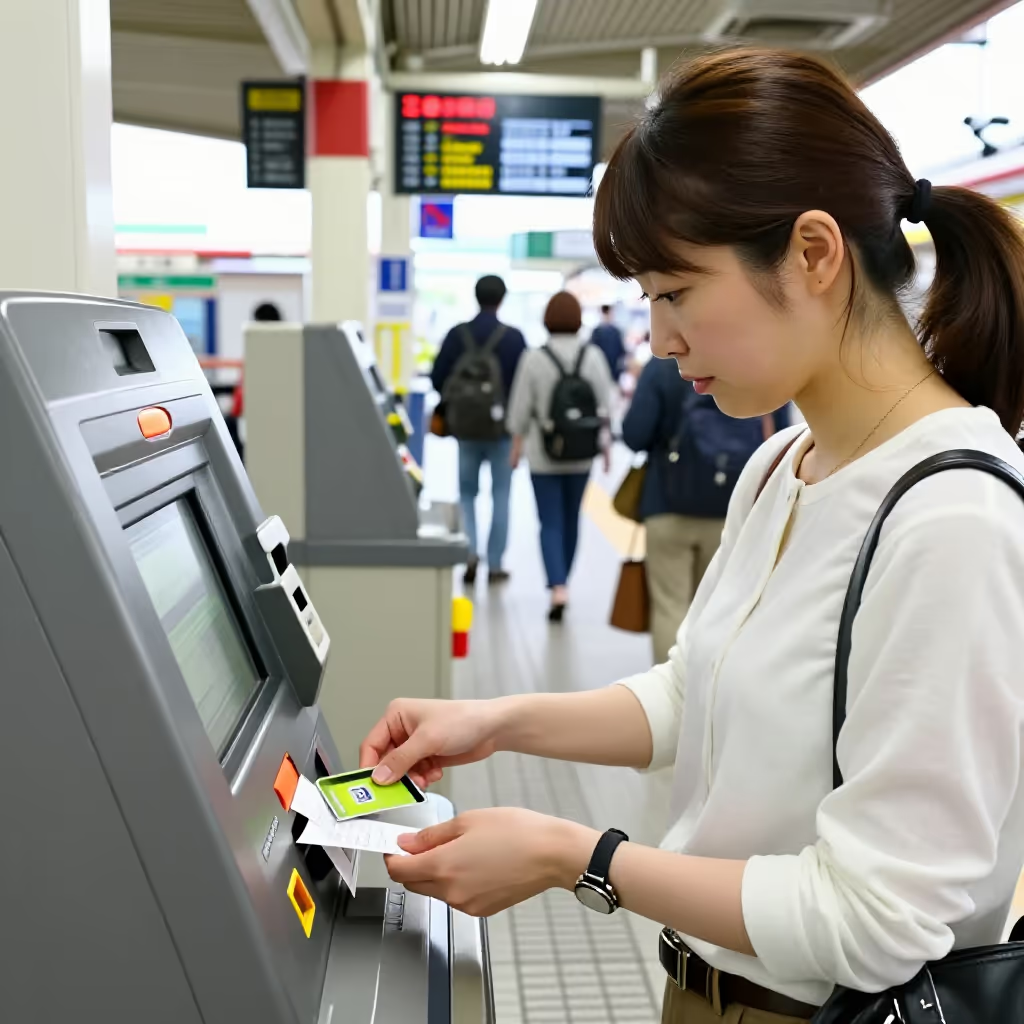
to buy a ticket
To buy a travel ticket or admission ticket.
Ich muss am Automaten noch schnell eine Fahrkarte lösen.
I still need to quickly buy a ticket from the machine.

to dissolve
To cause a solid substance to dissolve in a liquid.
Man muss die Tablette in einem Glas Wasser lösen.
You have to dissolve the tablet in a glass of water.

to terminate
To end a contract, a connection, or an engagement.
Nach langen Überlegungen hat sie die Verlobung gelöst.
After long consideration, she broke off the engagement.

to come loose
To separate from or fall off something to which one was attached.
Durch die Feuchtigkeit löste sich die Tapete von der Wand.
Because of the moisture, the wallpaper came loose from the wall.
Many meanings of 'lösen' (to solve / loosen) can be derived from the idea of 'los machen' (to loosen / set free) or 'frei machen' (to free). You make a problem 'loose' (solve it), a knot 'loose' (untie it), or a substance 'loose' from its solid form (dissolve it in water).
Er versucht, die festgerostete Schraube zu lösen.
He is trying to loosen the screw that has rusted tight.
Since 'lösen' has many meanings, the object of the verb is the most important clue. The word that comes after 'lösen' almost always tells you the exact meaning: a puzzle, a knot, a ticket, or a contract.
Sherlock Holmes konnte jedes Rätsel lösen.
Sherlock Holmes could solve every puzzle.
In the meaning 'eine Antwort finden' (to find an answer), 'lösen' is typically combined with abstract challenges. Common collocations are 'ein Problem lösen' (to solve a problem), 'einen Konflikt lösen' (to resolve a conflict), or 'eine Gleichung lösen' (to solve an equation).
Die Politiker versuchen, den politischen Konflikt zu lösen.
The politicians are trying to resolve the political conflict.
The phrase 'eine Fahrkarte lösen' (to buy a ticket) is correct, but sounds somewhat formal or technical. In everyday language, many people simply say 'eine Fahrkarte kaufen' (to buy a ticket).
Bitte lösen Sie Ihr Ticket vor Fahrtantritt am Automaten.
Please purchase your ticket from the machine before starting your journey.
When it comes to formal agreements, 'lösen' means something like 'beenden' (to end) or 'auflösen' (to dissolve / terminate). This is often used in a legal or business context.
Die Firma hat den Vertrag mit dem Lieferanten gelöst.
The company terminated the contract with the supplier.
In the reflexive form 'sich lösen' (to come loose / detach), the preposition 'von' (from) with the dative is often used. It describes something separating from a surface or a person.
Das Etikett hat sich von der Flasche gelöst.
The label came loose from the bottle.
to buy
Kaufen generally refers to acquiring something in exchange for money and can also be used for tickets. With tickets and admission tickets, lösen has the same basic meaning, but it is a special, fixed expression in this context. Both work, but „lösen“ is restricted to this kind of ticket.

Lea löst am Automaten eine Fahrkarte nach Bonn.
Lea buys a ticket to Bonn at the vending machine.
Lea kauft am Automaten eine Fahrkarte nach Bonn.
Lea buys a ticket to Bonn at the vending machine.