
die Lage
situation
The total set of circumstances or the current situation in which someone or something finds themselves.
Die politische Lage im Land ist derzeit sehr instabil.
The political situation in the country is currently very unstable.

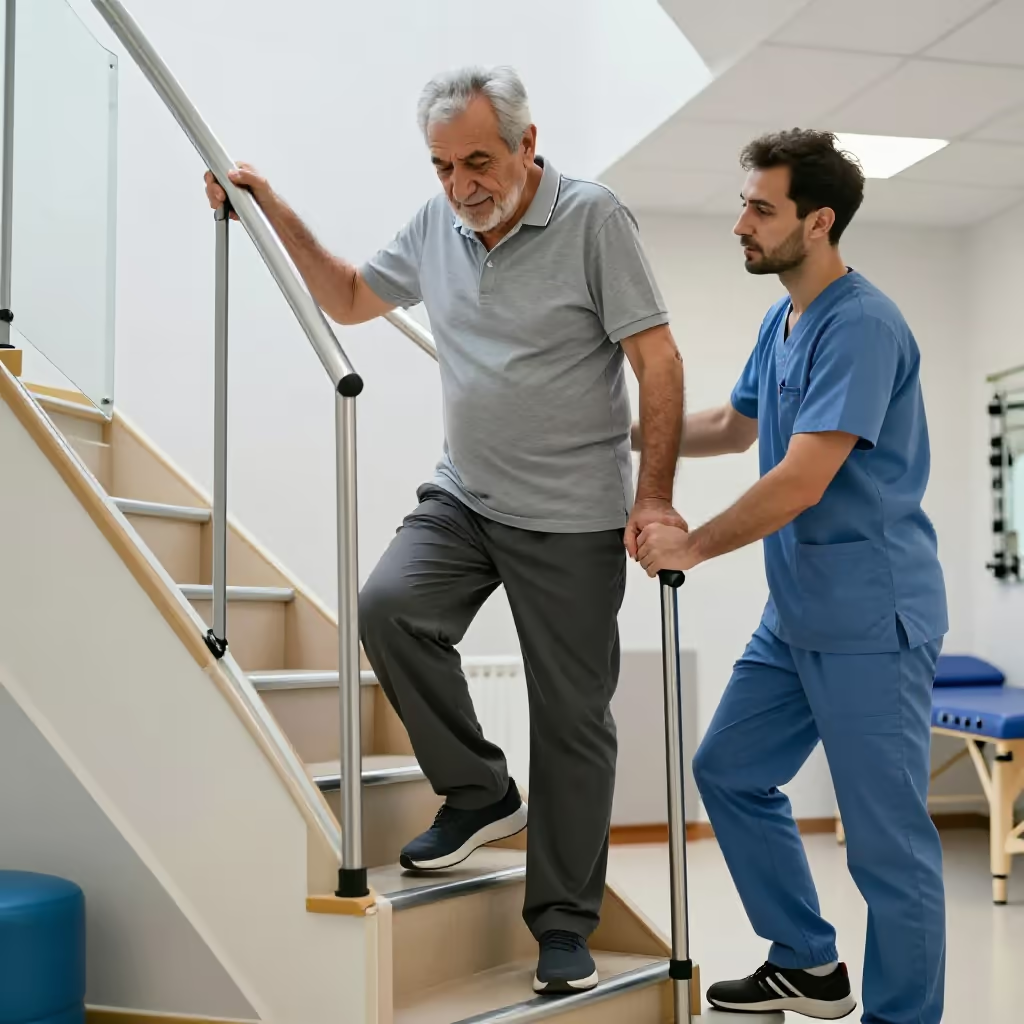
situation / location
Loading your saved state.
situation
The total set of circumstances or the current situation in which someone or something finds themselves.
Die politische Lage im Land ist derzeit sehr instabil.
The political situation in the country is currently very unstable.

'Die Lage' (the situation/location/position) is closely related to the verb 'liegen' (to lie). It describes how or where something 'lies'—whether it is a situation, a place, or a position.
Das Hotel liegt sehr zentral. Die Lage ist also perfekt.
The hotel is very centrally located. So the location is perfect.
When 'Lage' (situation) means a situation, it is often combined with adjectives like 'politisch' (political), 'wirtschaftlich' (economic), 'schwierig' (difficult), or 'ernst' (serious). You can also say 'die Lage einschätzen' (to assess the situation) or 'die Lage ist angespannt' (the situation is tense).
Ein Experte soll die wirtschaftliche Lage des Unternehmens beurteilen.
An expert is supposed to assess the company's economic situation.
When 'Lage' (location) describes a place, typical adjectives are 'ruhig' (quiet), 'zentral' (central), 'sonnig' (sunny), or 'idyllisch' (idyllic). For example, people talk about the 'Lage eines Hauses' (location of a house).
Wir suchen eine Wohnung in ruhiger Lage.
We are looking for an apartment in a quiet location.
The phrase 'in der Lage sein, etwas zu tun' (to be able to do something) is a fixed expression and a more formal alternative to 'können' (can/be able to). It is always used with 'zu' and an infinitive at the end of the sentence.
Ich bin im Moment nicht in der Lage, Ihnen zu helfen.
At the moment, I am not able to help you.
In the meaning 'körperliche Position' (physical position), 'Lage' (position) is frequently used in medical contexts. The 'stabile Seitenlage' (recovery position) is a well-known first-aid measure.
Die Sanitäter brachten den Verletzten in eine sichere Lage.
The paramedics put the injured person in a safe position.
You can recognize this meaning from the context of materials that are placed on top of each other. Typical contexts are cooking (e.g., lasagna), geology (rock), or construction/painting (paint).
Der Maler trägt noch eine zweite Lage Farbe auf.
The painter applies a second layer of paint.
case / fall
'der Fall' and 'die Lage' can both have to do with a situation. 'der Fall' refers more to one specific situation or a particular occurrence. 'die Lage' describes more the overall circumstances someone or something is currently in. Learners may confuse the words because both are often explained with 'situation'. In practical terms: 'Fall' fits when you are talking about one specific point or matter. 'Lage' fits when you mean the overall picture, for example with work, family, weather, or problems.

Wegen des Wetters bleibt die Lage auf den Straßen schwierig.
Because of the weather, the situation on the roads remains difficult.
Morgen besprechen wir den Fall noch einmal im Team.
Tomorrow we'll discuss the case again as a team.