


der Ort
place / location
A specific spot, a particular place, or a point in a space.
EXAMPLE
Markiere den Ort auf der Karte, an dem du den Schatz versteckt hast.
Mark the place on the map where you hid the treasure.
place / town
Loading your saved state.
place / location
A specific spot, a particular place, or a point in a space.
Markiere den Ort auf der Karte, an dem du den Schatz versteckt hast.
Mark the place on the map where you hid the treasure.
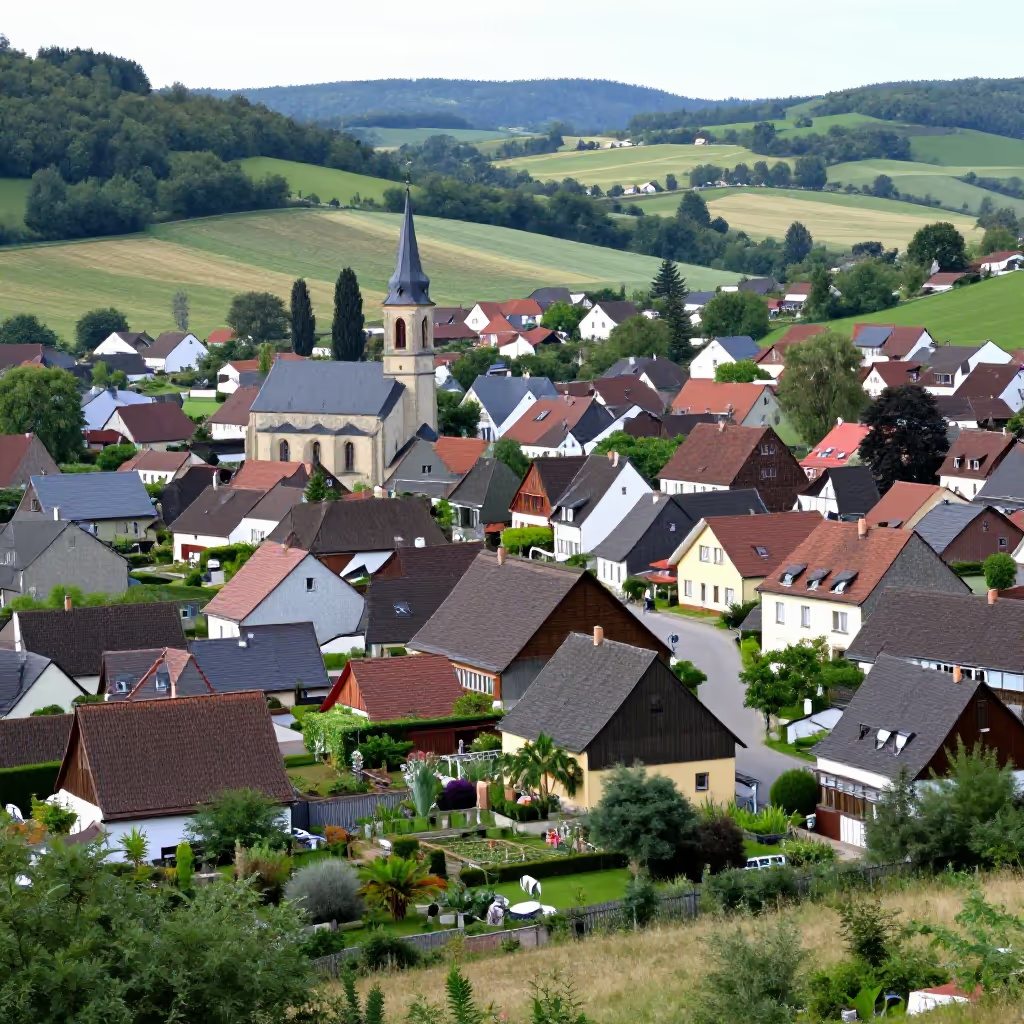
town / village
A locality, such as a village, a small town, or a municipality.
Er lebt in einem kleinen Ort mit nur 500 Einwohnern.
He lives in a small town with only 500 inhabitants.

on site
At the relevant place itself; directly at the scene.
Der Reporter berichtete live vom Unfallort.
The reporter reported live from the scene of the accident.

then and there
Immediately and in the same place, without moving away.
Der Schaden wurde vom Techniker direkt an Ort und Stelle repariert.
The damage was repaired by the technician right then and there.
The word 'Ort' (place) is a very productive component of compound nouns. The suffix '-ort' always refers to a place connected with the first part of the word.
Bitte geben Sie Ihren Wohnort und Ihren Geburtsort an.
Please provide your place of residence and your place of birth.
The preposition depends on the meaning. 'An einem Ort' (at a place) describes a specific spot (m01). 'In einem Ort' (in a town/village) means that you are within a locality (m02).
Wir trafen uns an einem geheimen Ort im Wald.
We met at a secret place in the forest.
Whether 'Ort' means a spot (m01) or a locality (m02) is revealed by the context. Adjectives like 'klein' (small) or 'bekannt' (well-known) point to a locality. Genitive attributes like 'des Treffens' (of the meeting) point to a specific place.
Wir treffen uns am vereinbarten Ort.
We'll meet at the agreed place.
The expression 'vor Ort' (on site) means that someone or something is directly at the relevant place. It is often used to express that no travel or transport is necessary.
Ein Techniker kommt vorbei, um das Problem vor Ort zu lösen.
A technician will come by to solve the problem on site.
The expression 'an Ort und Stelle' (then and there / on the spot) means 'immediately and exactly in this place.' It emphasizes that something happens without delay and without changing location.
Die Polizei war schnell da und befragte die Zeugen an Ort und Stelle.
The police arrived quickly and questioned the witnesses on the spot.
place / space
Both words can refer to a location. „Der Ort“ identifies a location neutrally, while „der Platz“ usually means an available spot or one intended for someone or something. Use „Ort“ for the location itself and „Platz“ when the use or assignment of the spot is important.

Der Ort neben dem Fenster ist für den neuen Schrank gut geeignet.
The spot next to the window is well suited for the new cabinet.
Für den neuen Schrank ist neben dem Fenster noch genug Platz.
There is still enough space next to the window for the new cabinet.