


landen
to land
To deliberately touch down from the air on the ground or another surface with an airplane, spacecraft, or as a bird.
EXAMPLE
Das Flugzeug aus München ist pünktlich gelandet.
The plane from Munich landed on time.
to land
Loading your saved state.
to land
To deliberately touch down from the air on the ground or another surface with an airplane, spacecraft, or as a bird.
Das Flugzeug aus München ist pünktlich gelandet.
The plane from Munich landed on time.

to end up
Colloquial for arriving or ending up at a certain place, often by chance or unplanned.
Nach der langen Fahrt sind wir schließlich in einem kleinen Dorf gelandet.
After the long drive, we eventually ended up in a small village.

to land
Colloquial for successfully achieving or getting something, e.g. a job or a success.
Sie hat mit ihrer Bewerbung einen echten Volltreffer gelandet.
With her application, she landed a real bull's-eye.

to end up
Used for objects that fall or are thrown somewhere and remain lying there.
Der Brief ist versehentlich im Müll gelandet.
The letter accidentally ended up in the trash.
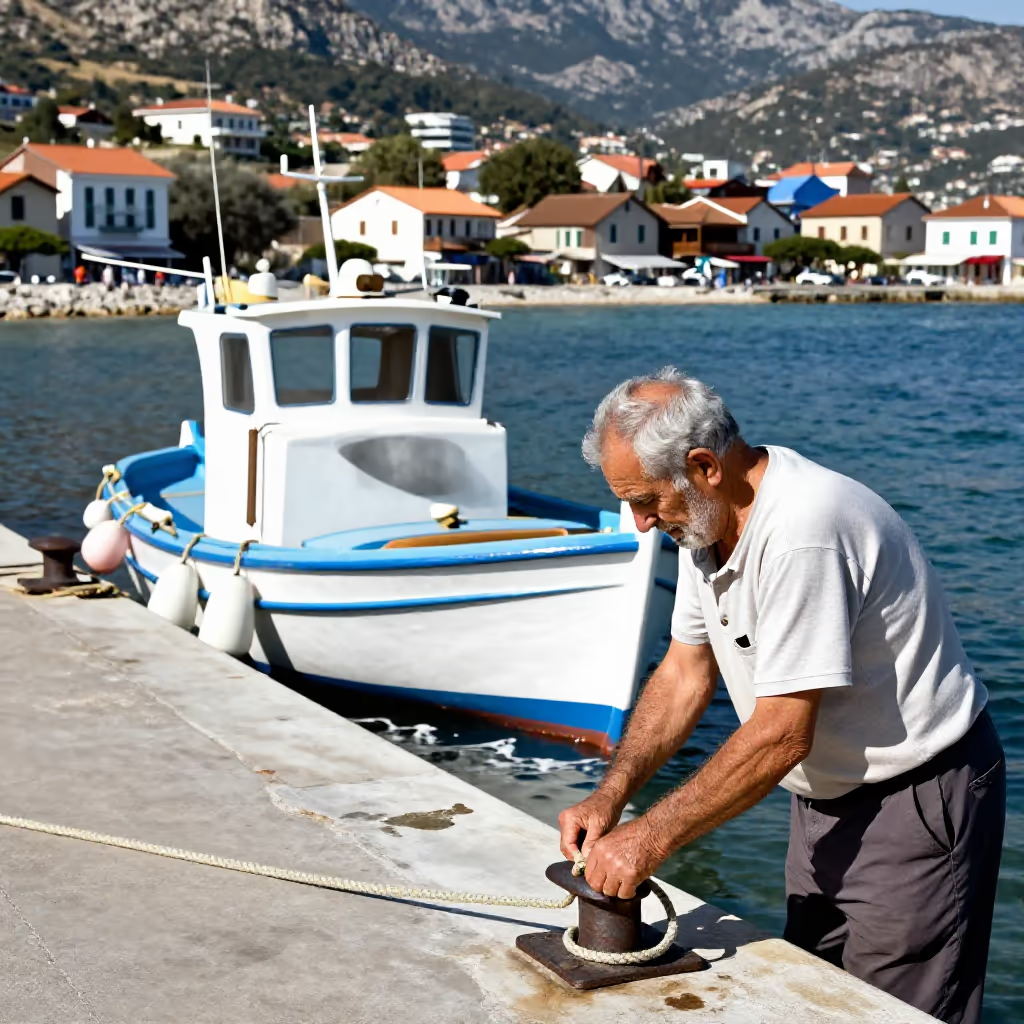
to land
To dock on the coast with a ship or boat.
Die Fähre landet in wenigen Minuten am Pier.
The ferry will land at the pier in a few minutes.
'Landen' (to land) describes movement or a change of location. Therefore, the perfect tense is always formed with the auxiliary verb 'sein' (to be), never with 'haben' (to have). This applies to all meanings of the word.
Wir sind gestern Abend sicher in Berlin gelandet.
We landed safely in Berlin yesterday evening.
The verb 'landen' (to land) is related to the noun 'das Land' (land/country). The act of landing is described by the noun 'die Landung' (landing). This connection helps you understand the basic meaning.
Die Landung des Flugzeugs war sehr sanft.
The landing of the plane was very smooth.
The subject of the sentence gives an important clue to the meaning. If it is an airplane, a bird, or a ship, the literal meaning is meant. If people or objects are the subject, it is often a figurative, colloquial meaning.
Der Falke ist auf dem Baum gelandet.
The falcon landed on the tree.
In the literal meaning of landing, the location is usually given with the prepositions 'in' + dative (for cities, countries) or 'auf' + dative (for airports, runways).
Die Maschine aus New York landet auf dem Flughafen Frankfurt.
The plane from New York is landing at Frankfurt Airport.
In the meaning 'to successfully achieve something', 'landen' (to land) is often used with an accusative object in fixed collocations. Typical examples are 'einen Treffer landen' (to score a hit), 'einen Erfolg landen' (to achieve a success), or 'einen Hit landen' (to land a hit).
Mit diesem Produkt hat die Firma einen großen Erfolg gelandet.
With this product, the company achieved a great success.
to get / receive
When talking about a job, “bekommen” and “landen” can both express successfully obtaining one. “Bekommen” is neutral, while “landen” sounds colloquial and places more emphasis on the success or fortunate outcome. “Bekommen” suits a factual statement, while “landen” suggests a particularly successful result.

Trotz der starken Konkurrenz landete Nina eine begehrte Stelle.
Despite the strong competition, Nina landed a coveted position.
Nach mehreren Bewerbungen bekam Nina eine neue Stelle.
After applying for several jobs, Nina got a new position.