


anlegen
to invest
To invest money in such a way that it brings interest or profit.
EXAMPLE
Er hat sein Erspartes gewinnbringend in Aktien angelegt.
He invested his savings profitably in stocks.
to invest / create / dock
Loading your saved state.
to invest
To invest money in such a way that it brings interest or profit.
Er hat sein Erspartes gewinnbringend in Aktien angelegt.
He invested his savings profitably in stocks.

to create
To create, set up, or design something according to a plan, for example a garden, a list, or a user account.
Könntest du für das neue Projekt bitte einen Ordner anlegen?
Could you please create a folder for the new project?

to mess with
To start an argument or confrontation with someone; to provoke someone.
Mit ihm solltest du dich besser nicht anlegen, er ist der Chef.
You'd better not mess with him; he's the boss.
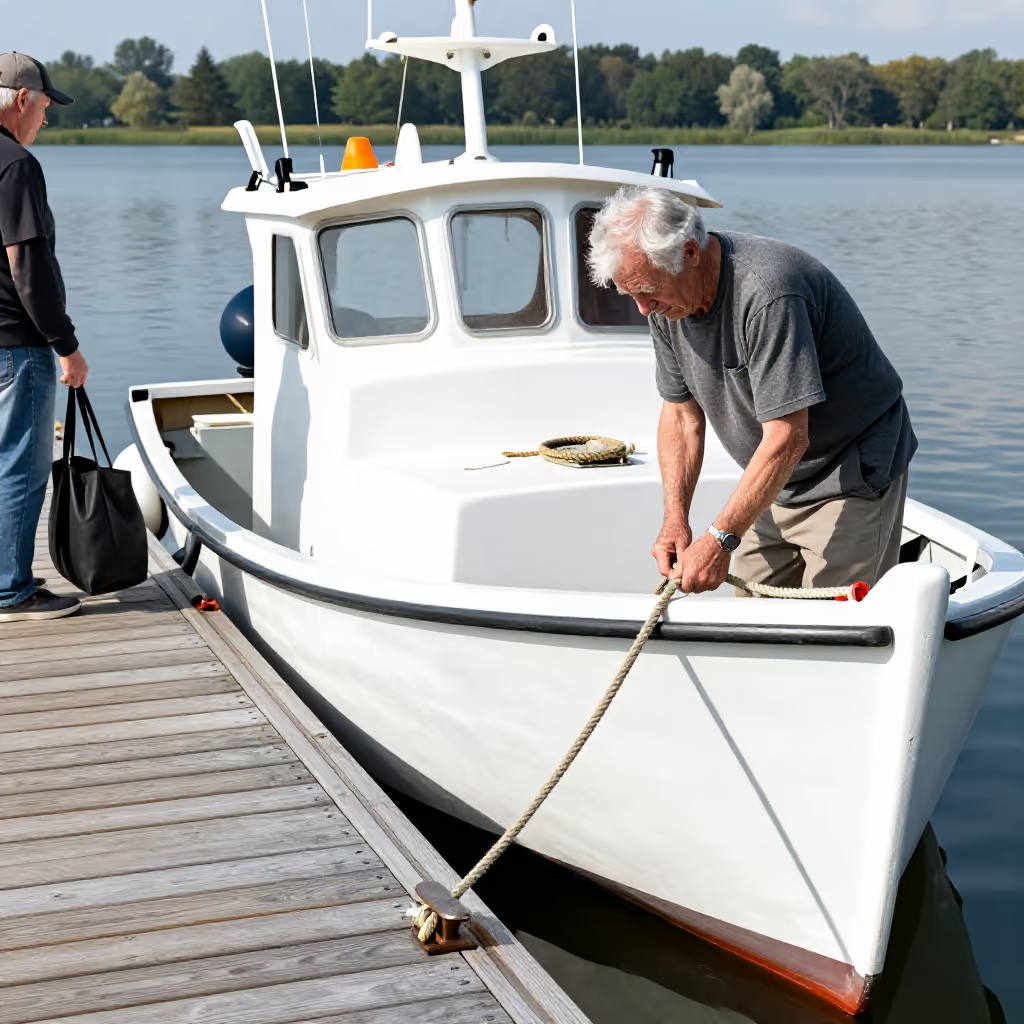
to dock
To moor a ship or boat at the shore or at a landing stage.
Die Fähre nach Amrum legt in wenigen Minuten an.
The ferry to Amrum docks in a few minutes.

to put on
To bring something onto the body or a surface, for example clothing, jewelry, or a bandage.
Der Sanitäter legte dem Verletzten einen Druckverband an.
The paramedic put a pressure bandage on the injured person.

to shoulder
To bring a firearm into position in order to aim at a target.
Der Jäger legte das Gewehr an und zielte auf den Hirsch.
The hunter shouldered the rifle and aimed at the deer.

to apply a standard
To use a particular criterion or standard to judge something.
Wenn man denselben strengen Maßstab an alle Kandidaten anlegt, war seine Leistung die beste.
If you apply the same strict standard to all candidates, his performance was the best.
'Anlegen' is a separable verb. The prefix 'an-' comes at the end in a main clause. In subordinate clauses or in the infinitive with 'zu', the verb stays together.
Sie legt einen neuen Garten an.
She creates a new garden.
The verb consists of 'an-' and 'legen' (to lay, to put). The basic idea is to bring or position something in a place. This idea appears in many meanings, for example investing money, designing a garden, or mooring a ship at the shore.
Der Gärtner legt ein neues Blumenbeet an.
The gardener creates a new flower bed.
In the financial meaning, the object is almost always money or an investment. Typical combinations are 'Geld anlegen' (to invest money), 'Kapital anlegen' (to invest capital), 'Ersparnisse anlegen' (to invest savings), or 'in Aktien anlegen' (to invest in stocks).
Sie möchte ihr Geld sicher anlegen.
She wants to invest her money safely.
In the meaning 'erstellen' (to create) or 'einrichten' (to set up), the objects are things that get a structure. Common combinations are 'einen Garten anlegen' (to create a garden), 'eine Liste anlegen' (to create a list), or 'ein Benutzerkonto anlegen' (to create a user account).
Für die Party müssen wir eine Gästeliste anlegen.
For the party, we need to create a guest list.
The expression 'sich mit jemandem anlegen' (to mess with someone) is reflexive and always uses the preposition 'mit' followed by the dative. It means to provoke an argument.
Leg dich besser nicht mit ihm an!
You'd better not mess with him!
When it is about ships, 'anlegen' (to dock) is often used without a direct object. The subject is then the ship or boat.
Das große Kreuzfahrtschiff legt gerade im Hafen an.
The large cruise ship is docking in the harbor right now.
In the meaning 'etwas an den Körper bringen' (to put something on the body), the objects are often things like 'einen Verband' (a bandage), 'den Sicherheitsgurt' (the seat belt), or 'Schmuck' (jewelry).
Bitte legen Sie jetzt den Sicherheitsgurt an.
Please fasten your seat belt now.
The phrase 'einen Maßstab anlegen' (to apply a standard) is a fixed expression. It means that you judge something according to a particular criterion.
Man kann nicht an alle den gleichen Maßstab anlegen.
You cannot apply the same standard to everyone.
to open
Both verbs can be used when setting up a new account. „Eröffnen“ generally refers to the official start of an account relationship with a bank or institution, while „anlegen“ highlights the planned setup of a user account. Use „eröffnen“ for a bank account and „anlegen“ for the technical setup.

Für das Onlineportal muss ich zuerst ein Benutzerkonto anlegen.
I first have to create a user account for the online portal.
Ich möchte bei dieser Bank ein neues Girokonto eröffnen.
I would like to open a new checking account at this bank.