


schlagen
to hit
To violently strike someone or something with your hand, an object, or through a quick movement.
EXAMPLE
Der Boxer schlug seinen Gegner k.o.
The boxer knocked out his opponent.
to hit / beat
Loading your saved state.
to hit
To violently strike someone or something with your hand, an object, or through a quick movement.
Der Boxer schlug seinen Gegner k.o.
The boxer knocked out his opponent.

to beat
To defeat an opponent in a competition, game, or fight.
Es ist uns gelungen, die gegnerische Mannschaft im Finale zu schlagen.
We managed to beat the opposing team in the final.

to beat / strike
The rhythmic beating of the heart or the sound a clock makes on the hour.
Die alte Standuhr im Flur schlägt jede halbe Stunde.
The old grandfather clock in the hallway strikes every half hour.
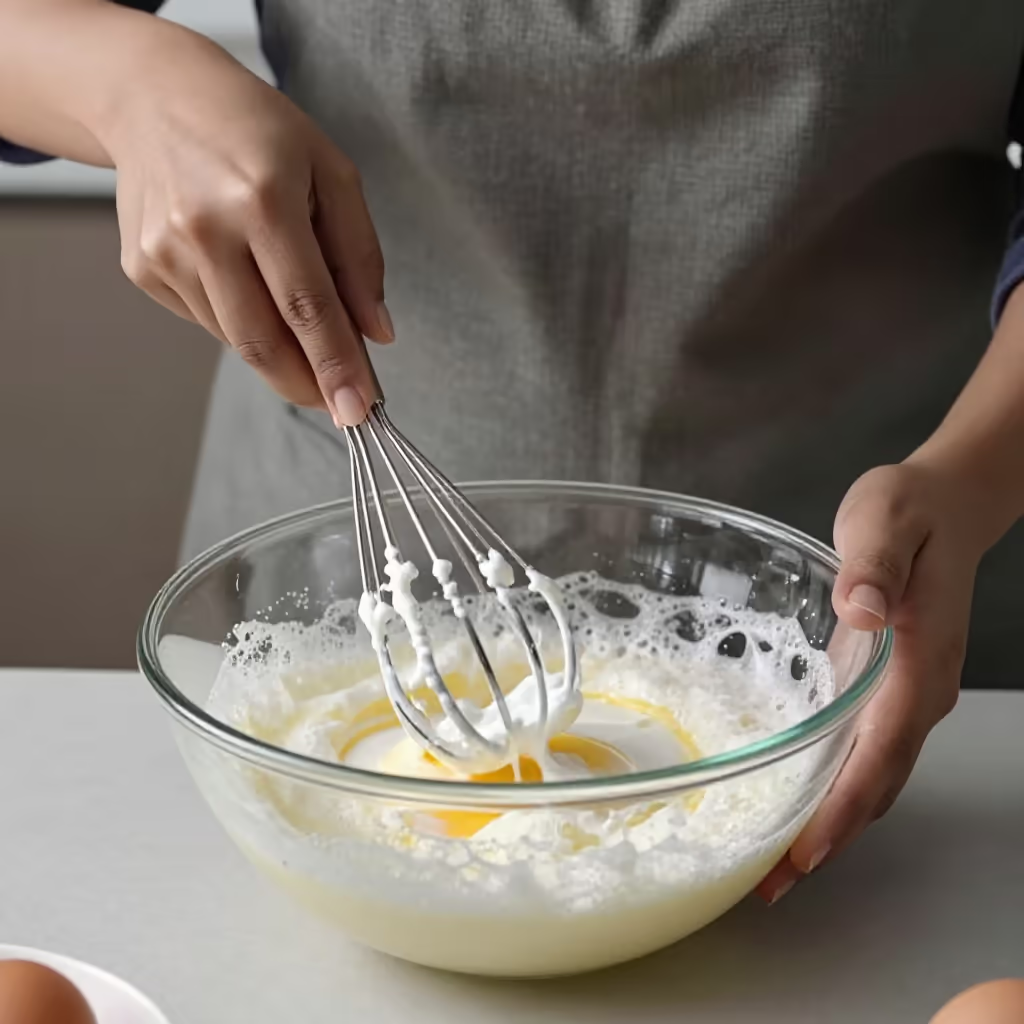
to beat / whip
To move a liquid or soft mixture, such as cream or eggs, quickly with a whisk in order to make it stiff or foamy.
Für das Dessert musst du das Eiweiß zu steifem Schnee schlagen.
For the dessert, you have to beat the egg whites until stiff.

to do / fare
To manage in a particular situation or task, or to show a certain level of performance.
Dafür, dass sie keine Erfahrung hatte, hat sie sich im neuen Job wirklich gut geschlagen.
Considering she had no experience, she did really well in the new job.

to raise the alarm
To draw attention to an acute danger or urgent problem and issue a warning.
Als er den Rauch sah, schlug er sofort Alarm.
When he saw the smoke, he immediately raised the alarm.

to put down roots
To settle in a new place and feel at home; to become established.
Die aus dem Ausland stammende Pflanze hat in unserem Garten schnell Wurzeln geschlagen.
The plant from abroad quickly put down roots in our garden.
The verb 'schlagen' (to hit/beat) is closely connected to the noun 'der Schlag' (hit, blow). A single act of hitting is 'ein Schlag' (a hit/blow).
Der Schlag des Boxers war sehr hart.
The boxer's blow was very hard.
'Schlagen' (to hit/beat) can be used with an accusative object (to hit someone/something). But it can also stand without an object when it describes a rhythmic movement.
Er schlug wütend auf den Tisch.
He angrily hit the table.
When 'schlagen' (to beat) is used in the context of sports, games, or competitions, it means 'besiegen' (to defeat). Watch for words like 'Gegner' (opponent), 'Mannschaft' (team), or 'Rekord' (record).
Unsere Mannschaft hat den Favoriten geschlagen.
Our team beat the favorite.
In the context of cooking and baking, 'schlagen' (to beat/whip) is almost always used with 'Sahne' (cream) or 'Eiweiß' (egg whites). It often states what the result should be: 'steif schlagen' (to beat until stiff) or 'schaumig schlagen' (to beat until foamy).
Für die Torte muss die Sahne steif geschlagen werden.
For the cake, the cream has to be whipped until stiff.
In the meaning 'sich bewähren' (to prove oneself) or 'eine Leistung zeigen' (to perform), 'schlagen' is used reflexively. The reflexive pronoun ('sich') must match the subject.
Ich finde, du hast dich bei der Prüfung sehr gut geschlagen.
I think you did very well on the exam.
The expression 'Alarm schlagen' (to raise the alarm) is a fixed combination and means 'warnen' (to warn) or 'auf eine Gefahr aufmerksam machen' (to draw attention to a danger). 'Alarm' is the fixed object here.
Die Wissenschaftler schlagen wegen des Klimawandels Alarm.
The scientists are raising the alarm because of climate change.
'Wurzeln schlagen' (to put down roots) is a fixed expression. It can be used literally for plants or figuratively for people who become at home in a new place.
Nach dem Umzug hat unsere Familie in der neuen Stadt schnell Wurzeln geschlagen.
After the move, our family quickly put down roots in the new city.
to win / gain
Gewinnen and schlagen can both express success in a competition. Gewinnen names the competition or the result, whereas schlagen directly names the defeated opponent as the object. Use gewinnen when the contest is the focus and schlagen when the opponent is important.

Unsere Mannschaft schlug den Tabellenführer im entscheidenden Spiel mit zwei zu eins.
Our team beat the league leaders two to one in the decisive game.
Unsere Mannschaft gewann das entscheidende Spiel mit zwei zu eins.
Our team won the decisive game two to one.