

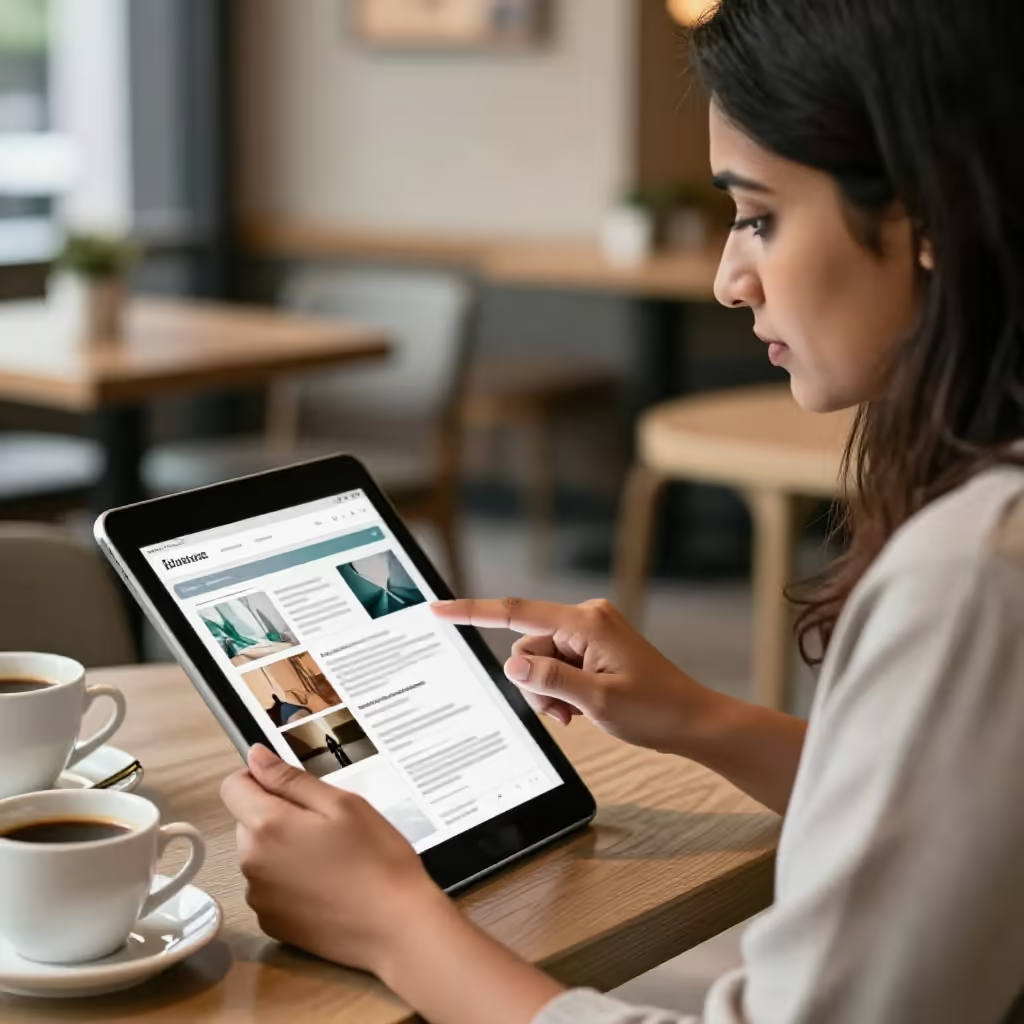
To move the displayed content on a screen, for example a webpage or document, upward, downward, or sideways.
example
Du musst noch etwas nach unten scrollen, um die Kommentare zu sehen.
You need to scroll down a little more to see the comments.

Usage tips
Origin of the word
'Scrollen' (to scroll) is a loanword from English ('to scroll'). It is fully integrated into German and is conjugated like a regular German verb: ich scrolle, du scrollst, er hat gescrollt.
EXAMPLE
Ich habe bis ganz ans Ende der Seite gescrollt.
I scrolled all the way to the bottom of the page.
Use with directions
The direction of the movement is almost always given with the adverbs 'nach oben' (up), 'nach unten' (down), 'nach links' (to the left), or 'nach rechts' (to the right).
EXAMPLE
Scrolle bitte ein Stück nach oben, ich möchte das Bild noch einmal sehen.
Please scroll up a bit; I want to see the picture again.
Use with prepositions
To describe what you are looking through, the preposition 'durch' (+ accusative) is often used. To name a destination, you use 'zu' (+ dative).
EXAMPLE
Er scrollte durch seine alten Fotos.
He scrolled through his old photos.
Compare with
near_synonym · confusable
scrollen vs verschieben
to postpone / move / fence
'verschieben' and 'scrollen' both have to do with movement. 'verschieben' is general: you move something from one place to another, for example a chair or an image on a screen. 'scrollen' is used only for screens, when you move through a webpage, document, or list upward, downward, or sideways. The words can be confused because when you scroll, the displayed content is moved. For digital content that you are only looking at and moving through, 'scrollen' is more precise.
scrollen
Auf der Webseite muss man lange nach unten scrollen, bis die Preise erscheinen.
On the webpage, you have to scroll down for a long time before the prices appear.
verschieben
Lisa verschiebt das Foto auf dem Bildschirm ein Stück nach links.
Lisa moves the photo on the screen a little to the left.