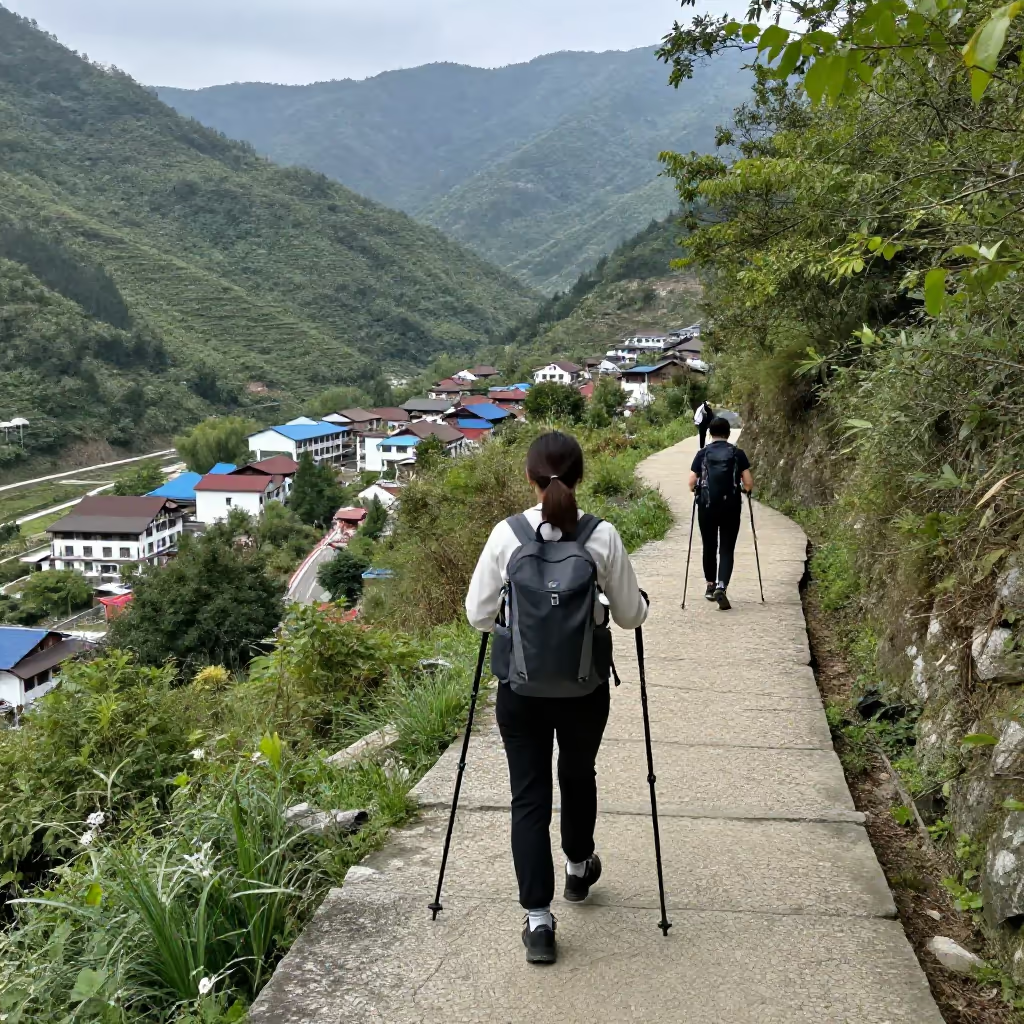
A journey or excursion during which you visit different places, often on foot, by bicycle, or in a vehicle.
example
Am Wochenende machen wir eine lange Tour mit dem Fahrrad durch die Berge.
At the weekend we're going on a long bike tour through the mountains.

Usage tips
Word family
The words 'der Tourist' (tourist; a person who goes on a tour) and 'der Tourismus' (tourism; the travel industry) are derived from 'die Tour' (the tour). This connection helps expand your vocabulary.
EXAMPLE
Im Sommer kommen viele Touristen in die Stadt.
In summer, many tourists come to the city.
Typical verbs
For an excursion or journey, the phrase 'eine Tour machen' (to go on a tour/trip) is very common. When a band is on a concert tour, people often say it 'ist auf Tour' (is on tour).
EXAMPLE
Wir haben am Sonntag eine wunderschöne Radtour gemacht.
We went on a beautiful bike tour on Sunday.
Colloquial question
The meaning 'Art und Weise' (way/manner) is colloquial. It is very often used in the question 'Auf welche Tour...?' (How...?/By what trick...?) to ask how someone achieved something, often in a clever way.
EXAMPLE
Auf welche Tour hast du denn die Konzertkarten noch bekommen?
How on earth did you still get the concert tickets?
Colloquial expression
The meaning 'Anfall von schlechter Laune' (fit of bad temper) is also colloquial and negative. It is mostly used in the fixed expression 'eine Tour kriegen' or 'eine Tour bekommen' (to throw a fit/get worked up).
EXAMPLE
Immer wenn die Technik nicht funktioniert, kriegt er eine Tour.
Whenever the technology doesn't work, he throws a fit.
Common compounds
To specify the type of journey or excursion, 'Tour' (tour/trip) is often used as the second part of a compound noun, e.g. 'Radtour' (bike tour), 'Wandertour' (hiking trip), or 'Bergtour' (mountain tour).
EXAMPLE
Für die geplante Wandertour brauchen wir gutes Schuhwerk.
For the planned hiking trip, we need good footwear.
Compare with
near_synonym · confusable
Tour vs Reise
journey / trip
'die Reise' and 'die Tour' can both mean that you are traveling and visiting places. 'Reise' is more general and fits longer or more important trips, for example to another country or for work. 'Tour' is more suitable when you visit several stops, follow a particular route, or perform as an artist in different places. Learners may confuse the words because both have to do with being on the move. If the path or route is important, 'Tour' often sounds more natural; if the whole stay or purpose is important, 'Reise' fits better.
Tour
Am Sonntag machen wir eine Tour mit dem Fahrrad durch die Weinberge.
On Sunday we're going on a bike tour through the vineyards.
Reise
Nach der langen Reise nach Kanada war Paul sehr müde.
After the long trip to Canada, Paul was very tired.