


die Runde
group
A group of people gathered for a conversation, a game, or a social activity.
EXAMPLE
In gemütlicher Runde saßen wir noch lange zusammen.
We sat together for a long time in a cozy group.
round
Loading your saved state.
group
A group of people gathered for a conversation, a game, or a social activity.
In gemütlicher Runde saßen wir noch lange zusammen.
We sat together for a long time in a cozy group.
round
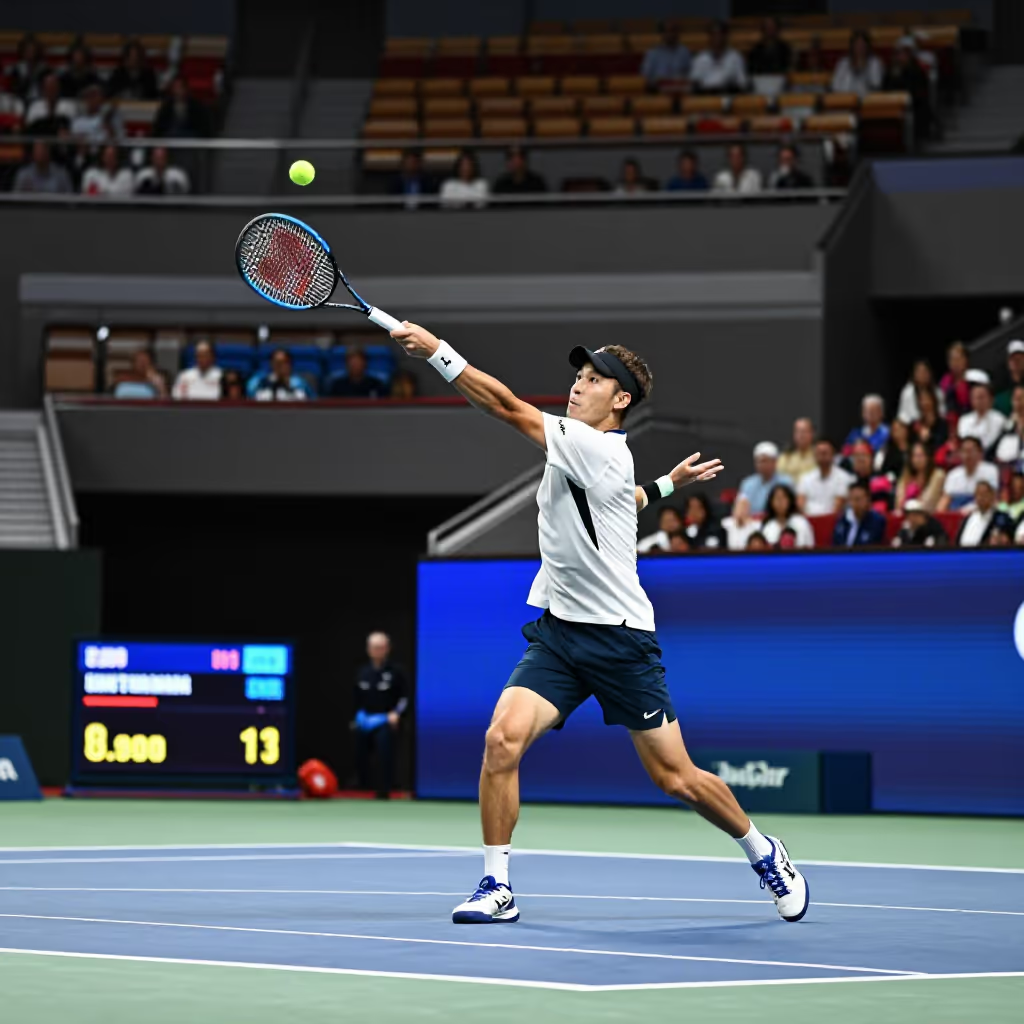
A completed section or stage in a competition, game, or sport.
Der Boxer gewann den Kampf in der dritten Runde.
The boxer won the fight in the third round.

round
An amount of drinks ordered or paid for for all the people present.
Der Gewinner gibt eine Runde für alle aus.
The winner is buying a round for everyone.

to make the rounds
To spread; to be passed on or retold by many people (e.g., a rumor, a piece of news, or a joke).
Die Nachricht von seiner Kündigung machte schnell die Runde.
The news of his resignation quickly made the rounds.

round
An inspection walk or a fixed route that is regularly walked or driven.
Der Nachtwächter macht jede Stunde seine Runde durch das Gebäude.
The night watchman makes his round through the building every hour.
The noun 'die Runde' (the round) is derived from the adjective 'rund' (round). The basic idea of a circle or circular movement connects all the meanings: a circle of people, a round in sports, a round of drinks for everyone in the circle.
Wir saßen in einem runden Kreis um das Lagerfeuer.
We sat in a round circle around the campfire.
When 'Runde' (group) means a group of people, it often appears with the preposition 'in'. Typical expressions are 'in gemütlicher Runde' (in a cozy group), 'in großer Runde' (in a large group), or 'in die Runde fragen' (to ask the group).
Wir haben den Abend in kleiner Runde ausklingen lassen.
We wound down the evening in a small group.
In the context of sports or competitions, fixed expressions like 'eine Runde weiterkommen' (to advance one round), 'die nächste Runde erreichen' (to reach the next round), or 'in der ersten Runde ausscheiden' (to be eliminated in the first round) are very common.
Die Mannschaft ist eine Runde weitergekommen.
The team advanced one round.
The expression 'eine Runde ausgeben' or 'eine Runde schmeißen' means that you order and pay for a drink for everyone present in a group.
Weil er Geburtstag hat, gibt er heute eine Runde aus.
Because it's his birthday, he's buying a round today.
The fixed expression 'die Runde machen' (to make the rounds) means that information spreads quickly. The subject of the sentence is the information, e.g., a rumor, a piece of news, or a joke.
Das Gerücht über den neuen Chef machte schnell die Runde.
The rumor about the new boss quickly made the rounds.
When a person walks an inspection route, the expression 'seine Runde machen' or 'seine Runde drehen' is often used. This is typical for professions such as night watchmen or security staff.
Der Polizist dreht seine Runde durch das Viertel.
The police officer makes his round through the neighborhood.
circle / district
„Kreis“ and „Runde“ can both refer to a group of people. „Der Kreis“ tends to emphasize the people connected to one another or their social circle, while „die Runde“ focuses more on the specific gathering for a conversation or social activity. Choose „Runde“ when the gathering itself is the focus.

In dieser Runde sprechen wir heute offen über persönliche Probleme.
In this group, we are talking openly about personal problems today.
In unserem kleinen Kreis sprechen wir offen über persönliche Probleme.
In our small circle, we talk openly about personal problems.