


die Unruhe
restlessness
A state of inner nervousness, tension, or restlessness.
EXAMPLE
Vor der wichtigen Präsentation spürte sie eine wachsende Unruhe.
Before the important presentation, she felt a growing restlessness.
unrest
Loading your saved state.
restlessness
A state of inner nervousness, tension, or restlessness.
Vor der wichtigen Präsentation spürte sie eine wachsende Unruhe.
Before the important presentation, she felt a growing restlessness.
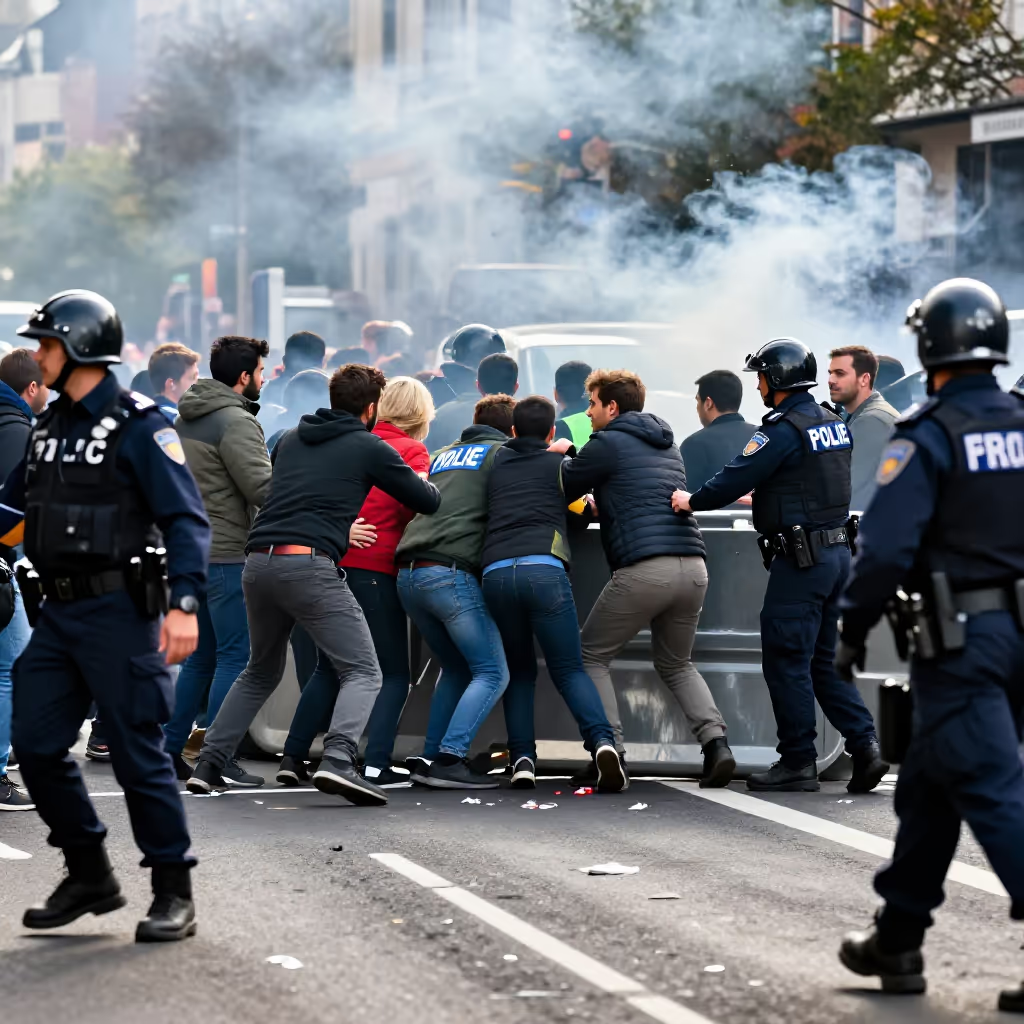
unrest
A situation of disturbances, upheaval, or turmoil in public, often associated with protests or violence.
Nach der Verkündung des Wahlergebnisses kam es in der Hauptstadt zu politischen Unruhen.
After the election results were announced, political unrest broke out in the capital.

balance wheel
The central oscillating component in a mechanical watch or clock that sets the rhythm.
Der Uhrmacher erklärte, dass die Unruhe der alten Taschenuhr beschädigt sei.
The watchmaker explained that the balance wheel of the old pocket watch was damaged.
The word is made up of the prefix 'Un-' and the noun 'Ruhe' (calm/rest). The prefix 'Un-' expresses the opposite, so 'Unruhe' (unrest/restlessness) is literally the absence of calm.
Die laute Musik störte die Ruhe im Haus.
The loud music disturbed the peace in the house.
You can recognize the meaning from the context: inner 'Unruhe' (restlessness/nervousness) is often felt or sensed. Political 'Unruhen' (unrest) are usually plural and break out. The 'Unruhe' (balance wheel) in a watch or clock is a technical term.
Vor dem Examen spürte ich eine große innere Unruhe.
Before the exam, I felt great inner restlessness.
For the state of nervousness, phrases such as 'innere Unruhe' (inner restlessness), 'Unruhe stiften' (to deliberately cause unrest), or 'jemanden in Unruhe versetzen' (to unsettle someone) are typical.
Die Nachricht von seiner Kündigung versetzte das ganze Team in Unruhe.
The news of his dismissal unsettled the whole team.
In the context of turmoil, people often speak of 'politischen' or 'sozialen Unruhen' (political or social unrest). Typical verbs are 'ausbrechen' (to break out) or the phrase 'es kommt zu Unruhen' (unrest occurs / breaks out).
Wegen der hohen Preise kam es zu sozialen Unruhen im Land.
Because of the high prices, social unrest broke out in the country.
This meaning of 'Unruhe' (balance wheel) as a watch or clock component belongs to watchmakers' technical language and is very rare in general usage.
Nur ein Spezialist kann die Unruhe einer so alten Uhr reparieren.
Only a specialist can repair the balance wheel of such an old clock.
excitement / commotion
Aufregung and Unruhe can both refer to inner agitation. Aufregung is usually linked to a specific occasion and can also be joyful; Unruhe emphasizes that someone cannot remain calm or relaxed. For restless discomfort, Unruhe is therefore the better fit.

Vor ihrem ersten Konzert lief Mia aus innerer Unruhe ständig im Zimmer umher.
Mia paced around her room constantly because of her inner restlessness before her first concert.
Vor ihrem ersten Konzert konnte Mia ihre freudige Aufregung kaum verbergen.
Mia could barely hide her excitement before her first concert.