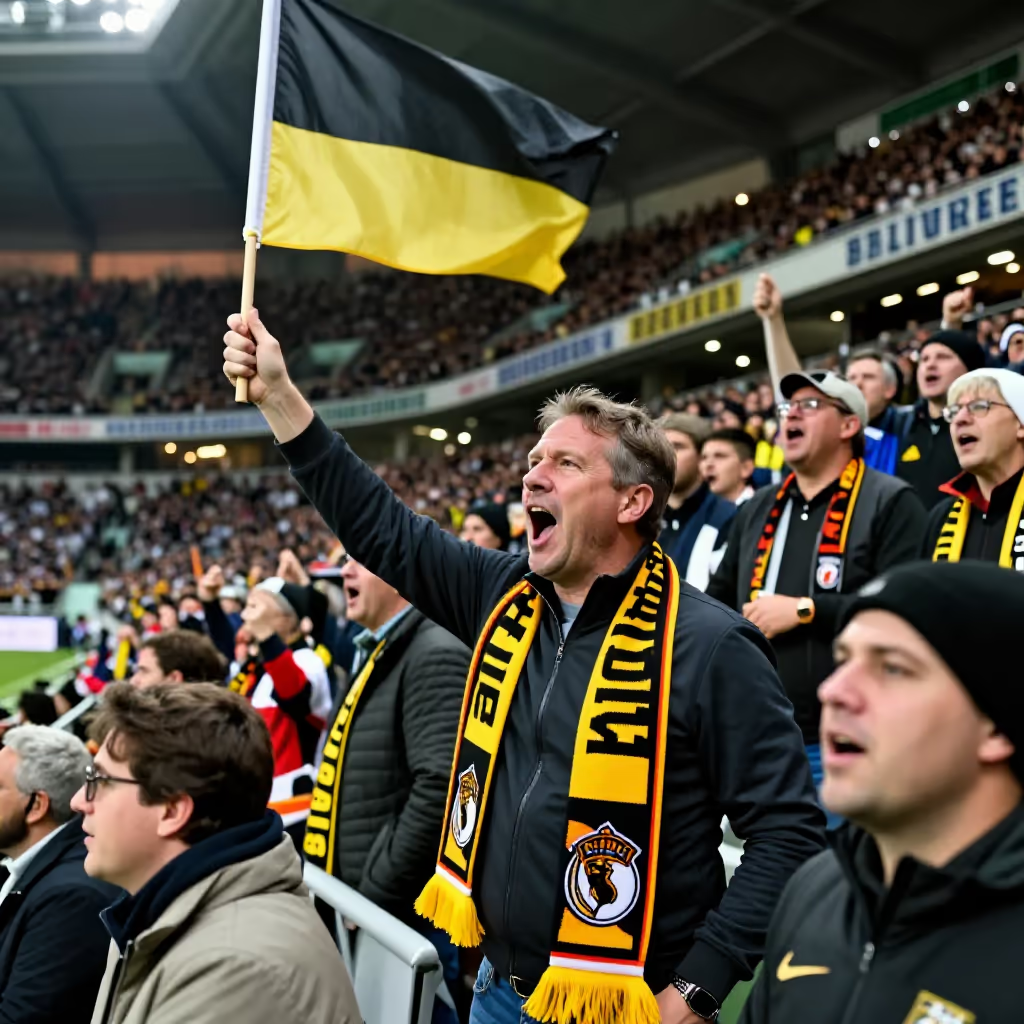
A person who supports and approves of an idea, a political movement, a sports club, or a person; a fan or follower.
example
Nach dem Sieg feierten die Anhänger ihre Mannschaft ausgelassen.
After the victory, the supporters celebrated their team exuberantly.

Usage tips
Word structure
The noun “der Anhänger” (supporter/trailer/pendant) is derived from the separable verb “anhängen” (to attach/hang onto). The basic idea of “hanging on something” connects all meanings: a fan is attached to their club, a vehicle trailer is attached to a car, and a jewelry pendant hangs on a chain.
EXAMPLE
Er hängt sehr an seinem alten Auto.
He is very attached to his old car.
Context clues
The context makes clear which “Anhänger” (supporter/trailer/pendant/tag) is meant. Words like “Partei” (party) or “Fußballverein” (soccer club) point to a person. “Auto” (car) or “LKW” (truck) indicate the vehicle, and “Kette” (chain) or “Schmuck” (jewelry) point to the piece of jewelry.
EXAMPLE
Er ist ein großer Anhänger des lokalen Fußballclubs.
He is a big supporter of the local soccer club.
Typical collocations
When a person is meant, “Anhänger” (supporter) is often used with the genitive or the preposition “von.” Typical combinations are “Anhänger einer Partei” (supporter of a party), “Anhänger eines Vereins” (supporter of a club), or “Anhänger von einer Idee” (supporter of an idea).
EXAMPLE
Die Anhänger der Opposition protestierten auf der Straße.
The supporters of the opposition protested in the street.
Typical collocations
In connection with vehicles, “Anhänger” (trailer) is often used with verbs like “ziehen” (to pull), “mieten” (to rent), or “ankuppeln” (to hitch up). People also speak of an “Anhängerkupplung” (trailer hitch) on a car.
EXAMPLE
Pass auf, das Auto vor uns zieht einen breiten Anhänger.
Watch out, the car in front of us is pulling a wide trailer.
Compare with
near_synonym
Anhänger vs Sohn
son
'der Sohn' and 'der Anhänger' can both express a close connection to a person, idea, or group in figurative or religious contexts. 'Anhänger' directly says that someone supports an idea, a party, a club, or a person. 'Sohn' in this sense is more figurative and often sounds religious, traditional, or solemn. It does not simply mean a child in a family, but rather a special belonging or spiritual closeness. In normal conversations about support, 'Anhänger' is much more natural. 'Sohn' only fits when the figurative or religious tone is intended.
Anhänger
Ich bin ein Anhänger dieser Idee, weil sie vielen Menschen helfen kann.
I am a supporter of this idea because it can help many people.
Sohn
In der Rede nennt der Priester ihn einen treuen Sohn der Kirche.
In the speech, the priest calls him a faithful son of the Church.