


hingehen
to go there
To move toward a specific place or destination.
EXAMPLE
Ich weiß nicht, ob ich zu der Party hingehen soll.
I don't know whether I should go to the party.
to go there
Loading your saved state.
to go there
To move toward a specific place or destination.
Ich weiß nicht, ob ich zu der Party hingehen soll.
I don't know whether I should go to the party.

to go
Describes the passing of time.
Ich frage mich oft, wo all die Zeit hingegangen ist.
I often wonder where all the time has gone.

to let something pass
To consider something just about acceptable or sufficient, even though it is not perfect.
Die Übersetzung ist nicht ideal, aber für unsere Zwecke können wir sie hingehen lassen.
The translation isn't ideal, but for our purposes we can let it pass.
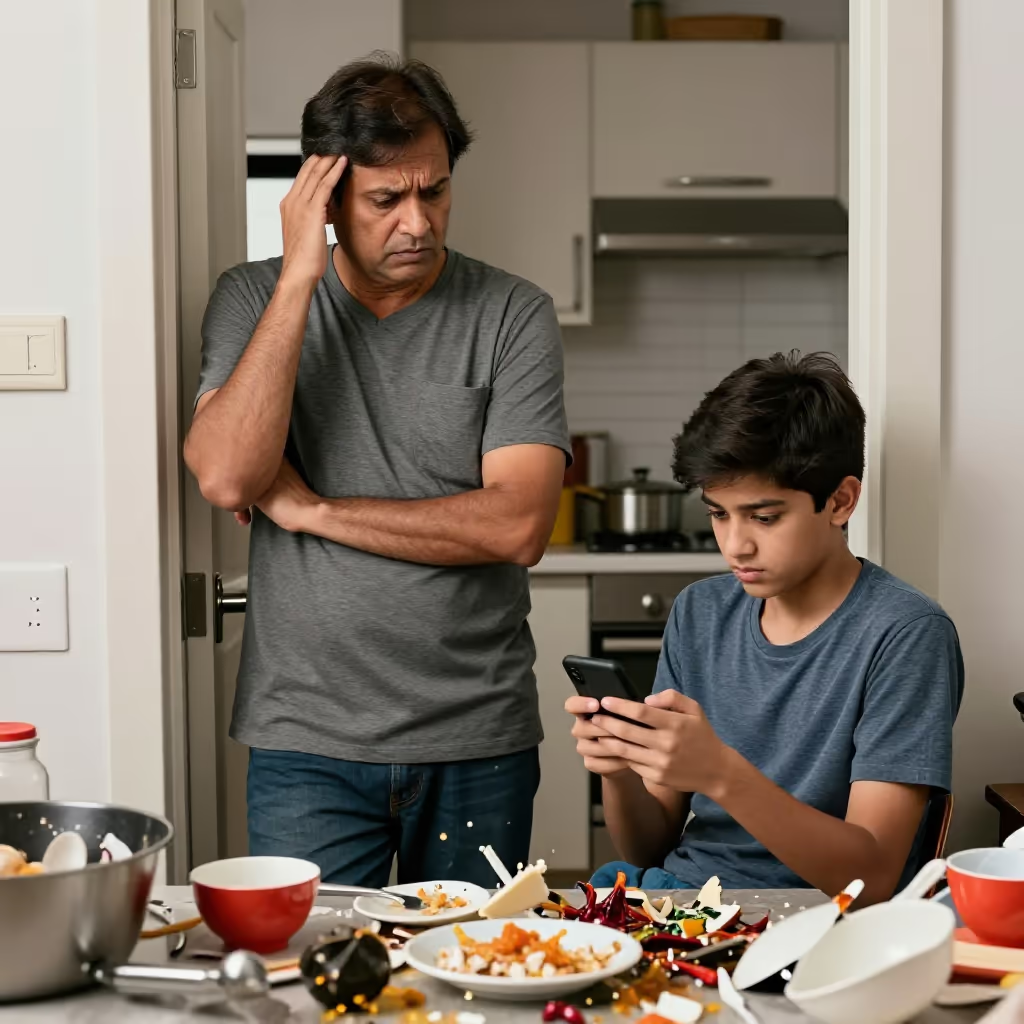
where is this going?
A rhetorical question that expresses concern about a negative development or problematic behavior.
Jeden Tag neue schlechte Nachrichten – wo soll das alles nur hingehen?
New bad news every day—where is all this going?
The verb 'hingehen' (to go there) is separable. The prefix 'hin' stands at the end in a main clause. In a subordinate clause, the verb stays together, and in the infinitive with 'zu', 'hinzugehen' is formed.
Gehst du heute Abend zur Feier hin?
Are you going to the celebration tonight?
The prefix 'hin-' describes movement away from the speaker toward a specific destination. It is the counterpart to the prefix 'her-', which expresses movement toward the speaker.
Schau mal, da vorne ist ein schönes Café, lass uns da hingehen.
Look, there's a nice café up ahead; let's go there.
When 'hingehen' (to go) refers to time, it almost always appears in a question with 'wohin' (where to). It expresses the feeling that time has passed quickly and unnoticed.
Ich kann nicht glauben, dass schon Dezember ist. Wohin ist das Jahr nur hingegangen?
I can't believe it's already December. Where has the year gone?
The expression 'etwas hingehen lassen' (to let something pass) means to accept something even though it is not perfect. In this construction, 'lassen' is conjugated and 'hingehen' stands as an infinitive at the end of the sentence.
Der Kratzer im Lack ist klein, den können wir hingehen lassen.
The scratch in the paint is small; we can let that pass.
The question 'Wohin soll das hingehen?' (Where is this going?) is a fixed expression. It is used to express worry or criticism about a negative development.
Die Preise steigen immer weiter. Wo soll das alles nur hingehen?
Prices keep rising. Where is all this going?
to go
Gehen and hingehen can both express movement to a place. Gehen remains neutral, while hingehen refers more strongly to a destination that has already been specified or mentioned. Use gehen for movement in general and hingehen when the destination has already been established in the conversation.

Der Markt ist schon lange geplant, und ich gehe am Samstag hin.
The market has been planned for a long time, and I am going there on Saturday.
Nach dem Essen gehe ich noch zum Markt.
After dinner, I am going to the market.